Ukrainian Volunteers Recover Over 1,500 Fallen Soldiers From Frontlines
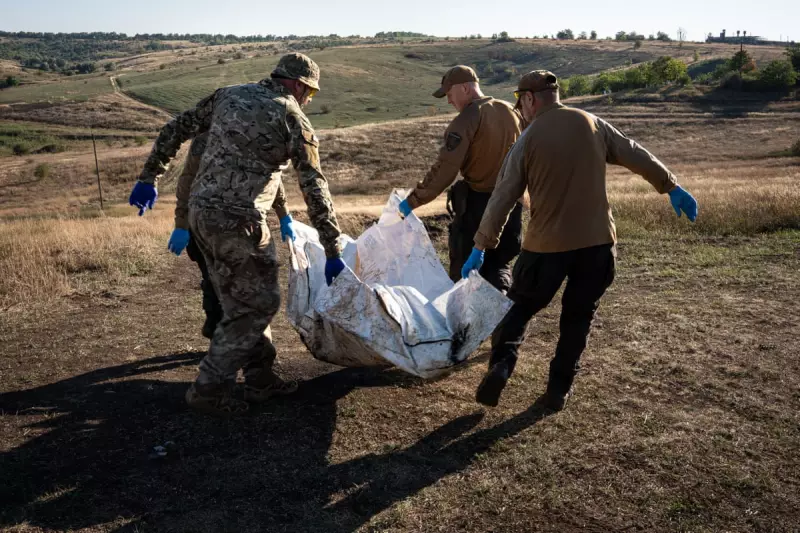
Driven by an unwavering belief in common humanity, the Ukrainian Platzdarm search team has now recovered the bodies of more than 1,500 soldiers killed in combat. These volunteers operate on the dangerous frontlines of the Donbas region, retrieving fallen fighters regardless of whether they fought for Ukraine or Russia.
A Delicate and Complex Task
Alexei, a veteran search volunteer with over two decades of experience, describes the painstaking process. "If I were to die, I would want someone to search for me. To bring me home," he explains, capturing the team's fundamental motivation. The work involves meticulously combing through combat perimeters—wooded areas and barren lands where battle lines have become entangled.
The identification process is complex and delicate. Volunteers like Alexei carefully examine military uniforms, personal effects, and remains. From a worn piece of paper with a name and Moscow phone number to a grimy St George's ribbon symbolising Russian patriotism, each clue is documented. A third volunteer photographs remains valuable for identification, while details are recorded on a small whiteboard. For now, each corpse is reduced to scattered words and an assigned number.

Operating in the Kill Zone
The Platzdarm group ventures where few dare to go, carrying bodies for miles under what Alexei describes as a "lethal dome" enveloping the war front. This area, increasingly referred to as the kill zone, is guarded by legions of executioner drones. The team now relies on fog to somewhat hinder drone visibility, almost making a pact with the haze to find moments for retrieval.
Alexei recalls his worst experience in the village of Klishchiivka in eastern Ukraine. "I had never seen anything like it. The entire hillside was covered with corpses. There wasn't even space to set a foot down," he says, describing bodies from 2022, 2023 and 2024 accumulated in one horrific scene.
Beyond Nationality and Sides
The team's philosophy transcends the conflict's divisions. "Nationality does not matter," Alexei states firmly. "Nor the side on which they fought. Whether Ukrainian or Russian, all souls are the same." This principle guides their work even when faced with ambiguous evidence—like a corpse wearing Ukrainian army socks that turned out to be a Russian soldier likely part of a sabotage team.
When uncertainty persists, they mark remains as "unknown" for DNA testing and further verification. Alexei notes it's common for soldiers from both sides to disguise themselves to gain ground, adding another layer of complexity to identification.
A Lifelong Commitment to the Fallen
Alexei began this work as a twenty-year-old, feeling a profound duty to recover those lost to conflict. Before 2014, his team searched for casualties from the First and Second World Wars and victims of political repression. They discovered mass graves containing those shot by Nazis or the NKVD, the USSR's secret police, and worked to repatriate remains whenever possible.
"It is very painful," he admits. "To see a destroyed destiny. A human destiny. You feel something for the dead that you never thought you could feel." The emotional toll is particularly heavy when volunteers have had direct contact with a soldier's family, understanding their journey from beginning to final breath.
The Human Connection Amidst Horror
Search volunteers describe themselves as links between life and death—bearers of terrible truths that families must live with forever. Yet they find solace in providing closure. "It's an honour for us if we can return someone's son, husband, brother or father to their family," Alexei reflects. "It means the effort was worth it."
Above all, Alexei emphasises preserving humanity in circumstances designed to strip it away. "War has taught me to what extent a person can become a non-human," he observes. "Something worse than an animal. Because in war, human life is worth nothing."

His dream is simple yet profound: "That it all ends. For everyone." He acknowledges the lasting physical and psychological wounds, and the many who will never return. Through their gruelling, dangerous work, the Platzdarm team maintains that every soldier deserves a dignified final rest—a principle that guides them through fog, drone threats, and unimaginable scenes of loss.