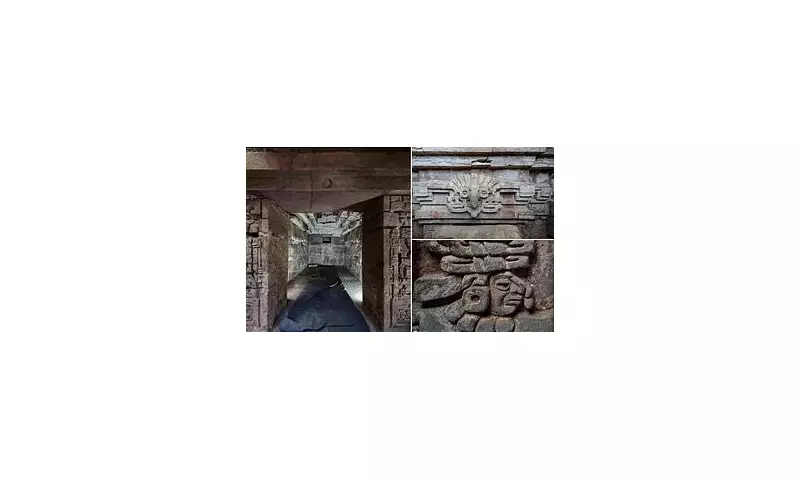
Archaeologists in Mexico have made what is being described as the most significant archaeological discovery in a decade, unearthing a 1,400-year-old tomb in the Central Valleys of Oaxaca that had been lost to history. The stone structure, constructed by the Zapotec culture—known as Be'ena'a or 'The Cloud People'—is adorned with sculptures, murals, and carved symbols that strongly suggest ritual significance.
Unveiling the Tomb's Entrance and Symbolism
The Zapotec people held a belief that their ancestors descended from the clouds and that, upon death, their souls would return to the heavens as spirits. This spiritual worldview is vividly reflected in the tomb's design. At the entrance sits a massive carved owl, its open beak revealing the face of a Zapotec lord. According to the National Institute of Anthropology and History, this symbol represents both death and power, serving as a guardian figure for the burial site.
The doorway is framed by a stone threshold and lintel, above which a frieze of engraved slabs displays ancient calendrical names. Flanking the entrance are carved figures of a man and a woman, both wearing elaborate headdresses and holding ritual objects. These figures are likely intended as guardians of the tomb, protecting its sacred contents from intruders.

Inside the Burial Chamber
Within the burial chamber, preserved sections of a vibrant mural remain remarkably intact. The mural depicts a procession of figures carrying bundles of copal, a resin used in rituals, as they move toward the tomb's entrance. This scene provides a rare glimpse into the funerary practices and ceremonial activities of the Zapotec civilization.
Mexico's president, Claudia Sheinbaum Pardo, has hailed the find, stating: 'It is the most important archaeological discovery of the last decade in Mexico due to its level of preservation and the information it provides.' The Zapotecs have a history spanning over 2,500 years, having established a major pre-Columbian civilization centered at Monte Albán, which was noted for its advanced agriculture and writing systems.
Preservation and Ongoing Research
An interdisciplinary team from the INAH Oaxaca Center is currently working to conserve and protect the tomb, with a particular focus on stabilizing the fragile mural painting. Experts note that the mural's condition is delicate, threatened by factors such as root growth, insect activity, and sudden shifts in temperature and humidity.
Simultaneously, researchers are conducting ceramic, iconographic, and epigraphic studies, along with physical anthropology analyses. These efforts aim to better understand the rituals, symbols, and funerary practices connected to the tomb, offering new insights into Zapotec social organization and cultural beliefs.
Historical Context and Recent Discoveries
The Zapotec civilization mysteriously declined in the area around 900 AD, but the people did not completely disappear; there are at least 400,000 living descendants today. Mexico's Secretary of Culture, Claudia Curiel de Icaza, described the tomb as an 'exceptional discovery' due to its preservation, noting that it reveals how the Zapotec culture was a complex social organization with intricate funerary rituals.
In a related development, archaeologists announced in 2024 the discovery of tunnels beneath a centuries-old church in Mitla, a city in southern Mexico associated with Pitao Bezelao, the Zapotec god of death. The Spanish, upon arriving in the 16th century, razed the city and built a church on the ruins of its most important temple. A priest later wrote that 'the back door of hell' lay under the city, referring to huge caverns believed to be the entrance to the Zapotec underworld.
Using non-invasive techniques such as ground-penetrating radar, electric resistivity tomography, and seismic noise tomography, archaeologists have revealed a series of chambers and tunnels beneath the city. Marco Vigato, founder of the ARX Project leading the search, stated that some tunnels extend to depths exceeding 50 feet. The age of these tunnels remains uncertain, with possibilities ranging from Zapotec creation to much older origins.

Vigato emphasized that the findings from geophysical scans will need confirmation through archaeological methods to determine the nature of the cavities and whether they contain artifacts of significance. This ongoing research continues to unravel the mysteries of the Zapotec civilization, highlighting Mexico's ancient grandeur and its enduring cultural legacy.