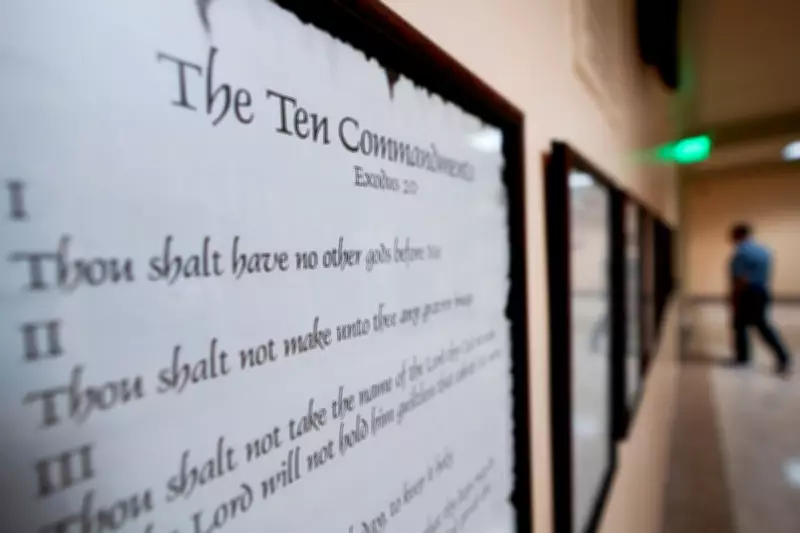
Federal Judge Strikes Down Arkansas Law Mandating Ten Commandments in Schools
A federal judge has blocked an Arkansas law that required the Ten Commandments to be prominently displayed in all public school classrooms, delivering a significant blow to efforts by Republican lawmakers to incorporate religious symbols into educational settings.
Legal Challenge and Court Ruling
The ruling came on Monday from U.S. District Court Judge Timothy L. Brooks, who was nominated by former President Barack Obama. In his written judgment, Judge Brooks stated unequivocally that "nothing could possibly justify hanging the Ten Commandments—with or without historical context—in a calculus, chemistry, French, or woodworking class, to name a few." He further emphasized that there is "no need to strain our minds to imagine a constitutional display mandated" by the 2025 law, concluding that "One doesn't exist."
The lawsuit was filed last year by seven Arkansas families representing diverse religious and nonreligious backgrounds, challenging the state's mandate for all public elementary and secondary schools to display the Ten Commandments in every classroom and library. The legal action named six school districts as defendants, though it remains unclear how many institutions had actually implemented the requirement.

Political Context and National Implications
This Arkansas law is part of a broader movement pushed by Republicans, including former President Donald Trump, to integrate religious elements into public schools. Similar mandates have been enacted in Louisiana and Texas, all facing ongoing legal challenges that many observers expect will eventually reach the U.S. Supreme Court.
Critics argue these laws violate the constitutional separation of church and state, while proponents maintain the Ten Commandments hold historical significance as part of America's foundation. The debate has stirred long-running controversies about the role of religion in government institutions.
Reactions and Next Steps
Megan Bailey, a spokesperson for the American Civil Liberties Union of Arkansas representing the challenging families, declared the ruling "makes clear the law is unconstitutional" and warned it would be "unwise for any school district in Arkansas to move forward with posting the Ten Commandments."
Arkansas Governor Sarah Huckabee Sanders responded with a statement vowing to appeal the decision and "defend our state's values." The scope of Judge Brooks' ruling remains uncertain—whether it applies only to the specific school districts named in the lawsuit or extends statewide.
Parallel Developments in Louisiana and Texas
In Louisiana, which became the first state to mandate Ten Commandments displays in 2024, a recent appellate court ruling has cleared the way for implementation. Following a February 20 decision from the full 5th U.S. Circuit Court of Appeals, Governor Jeff Landry instructed schools to proceed with posting the commandments, though reports suggest many institutions remain hesitant due to litigation concerns.
Texas implemented a similar mandate last year, marking the nation's widest-reaching attempt to display the Ten Commandments in public schools. While many districts have accepted donated posters or paid to print them, about two dozen of Texas's roughly 1,200 school districts face injunctions blocking implementation as litigation continues before the 5th Circuit.
These parallel cases in multiple states highlight the ongoing national battle over religious displays in public institutions, with legal experts predicting the issue will likely require ultimate resolution by the Supreme Court.