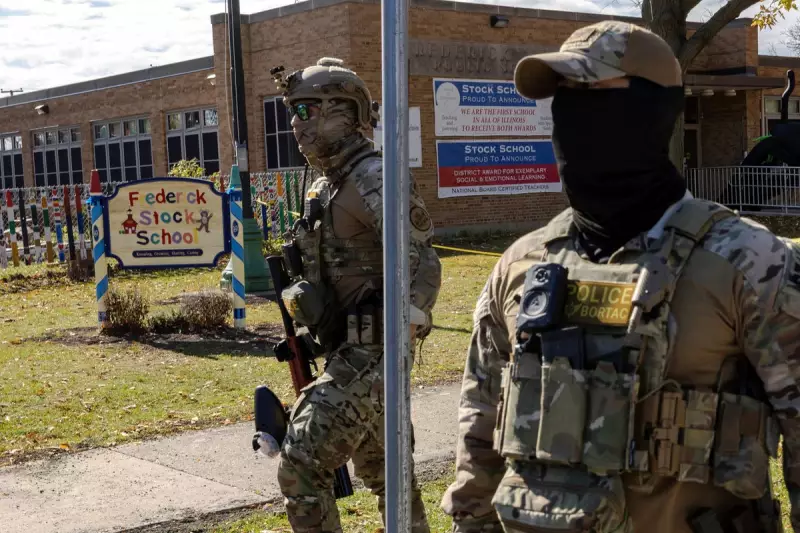
The sweeping immigration enforcement operations launched by the Trump administration have created turmoil in schools across the United States, leading to thousands of empty classrooms as students stay home fearing arrests.
School Communities on Edge
Teachers, families, and school administrators are bracing for the arrival of federal agents on campus, with parents already arrested near schools in at least 10 states this year according to a Washington Post review. The situation has become so tense that volunteer groups of parents now patrol near campuses watching for immigration officers.
In Charlotte, North Carolina, approximately one in five students was absent across the district during the recent surge of Immigration and Customs Enforcement and Customs and Border Protection agents. Following the first weekend of arrests, roughly 30,000 students were marked absent in the Charlotte-Mecklenburg school district alone.

Trauma and Tension in Classrooms
Educators report deeply anxious and traumatised students who worry their parents might be arrested. Lucy Silverstein, a senior at Providence High School, described an unusual atmosphere in her school: "Some hallways that are normally loud and full of life have felt unusually still."
Amanda Thompson, president of the Charlotte-Mecklenburg Association of Educators, shared heartbreaking stories from teachers, including children arriving at school with handwritten tags stating "I am a US citizen" and parents messaging schools to say their child was carrying their passport for protection.
Justin Parmenter, a Charlotte-area middle school teacher who placed "You belong here!" signs in his classroom in both English and Spanish, told The Washington Post that "people know that schools are not safe just because they're schools." Despite attendance improving from nine to twenty students in his homeroom, Parmenter noted that "trauma doesn't just go away on its own."
Broader Consequences for Education
The Trump administration has abandoned previous policies preventing enforcement operations near "sensitive" areas like school campuses. While Homeland Security insists schools aren't being targeted, the operations occur close enough to disrupt schedules and create widespread fear.
More than 70 Democratic members of Congress have written to Education Secretary Linda McMahon, warning that the enforcement activity "is injecting chaos and trauma in the lives of children regardless of their immigration status" and will have "a harmful and lasting impact on whole communities of school aged children."
The consequences extend beyond immediate trauma. Decreased enrollment and chronic absenteeism following immigration enforcement spikes could reduce school funding in states like California and Texas that use attendance-based funding models. In one stark example, a Texas middle school for newly arrived children recently closed because it lacked enough students - news the White House celebrated as "proof the Trump agenda is delivering."
With approximately 16 million children in the United States having at least one immigrant parent according to the Urban Institute, and another 2.5 million children being immigrants themselves, the impact of these enforcement operations reaches deep into American classrooms and communities.