Shakespeare's Surprising Role in Tackling Britain's Reading Crisis
At Thomas Jones Primary School in West London, an extraordinary educational experiment is unfolding. While the nation grapples with declining literacy rates, this state-funded community school has discovered an unexpected weapon in the battle for reading proficiency: William Shakespeare.
A Classroom Where Classics Come Alive
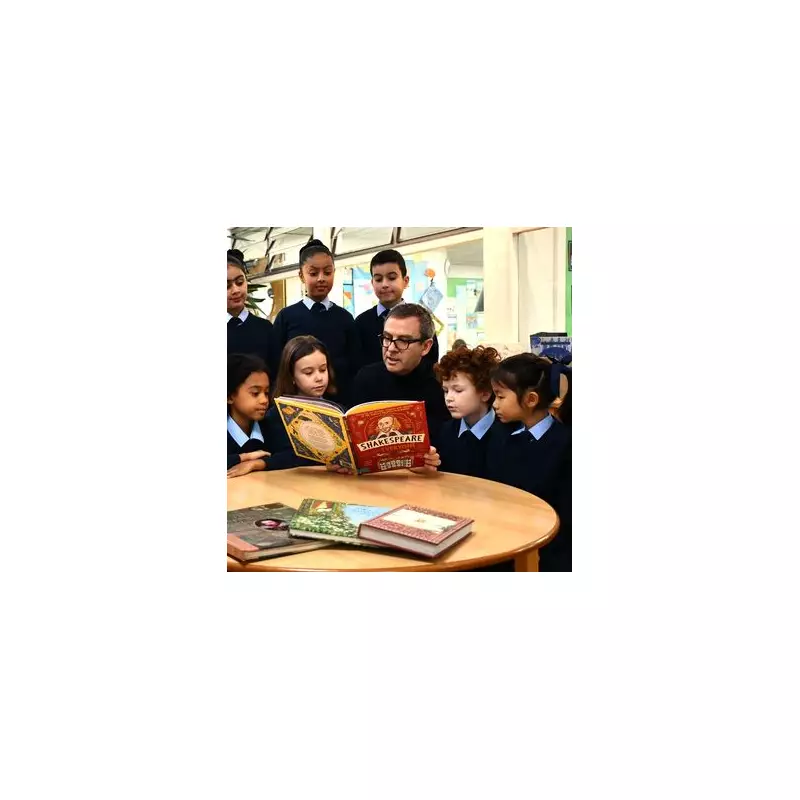
Step into the English classroom at Thomas Jones Primary, and you'll witness something remarkable. On shelves labelled for Year 6 pupils, Shakespeare sits comfortably alongside Milton, Blake and Dickens. Children who look like typical ten-year-olds confidently use vocabulary like "magnanimous" and "antithesis" in classroom discussions.
The school's location adds poignant context to its mission. Just a five-minute walk away, Grenfell Tower stands partially dismantled, its remaining structure wrapped in a banner bearing the words "Forever in our Hearts." This proximity to both tragedy and regeneration informs the school's unique educational philosophy.

Record-Breaking Success Against the Odds
Under the 25-year leadership of headteacher David Sellens and deputy head Lindsey Johnson, Thomas Jones Primary has accumulated almost every educational accolade available. It became the first primary school in the UK to achieve World Class school status, has been repeatedly cited as an Ofsted exemplar, and in 2025 topped the Sunday Times Parent Power League table as both Best Primary School in the UK and Primary School of the Year in London.
"There's a wonderful line," Sellens reflects when presented with this catalogue of achievement. "Check yourself before you wreck yourself." This Public Enemy reference captures the school's ethos: serious about education but never taking itself too seriously, celebrating community achievements while avoiding complacency.
The Dual Philosophy Driving Results
At the heart of Thomas Jones Primary's approach lies a dual philosophy refined over decades. The first principle is straightforward: don't neglect early years education. Getting foundations right from nursery age pays significant dividends later.
The second principle reveals itself through a reading syllabus that would be ambitious even for university students. The school describes itself as a "reading school" with two non-negotiable lines: every child must read fluently before leaving, and access to great literature is treated as an entitlement rather than an elitist privilege.
Remarkably, 65 percent of pupils learn English as an additional language, with many living in nearby social housing. Yet this hasn't deterred the school from teaching canonical writers including Shakespeare, Blake, Dickens, Tennyson and Maya Angelou.
Addressing a National Crisis
This approach gains particular significance against Britain's troubling literacy landscape. According to the National Literacy Trust's 2025 report, reading enjoyment among children and young people has reached its lowest level since records began. Just one in three 8-to-18-year-olds now say they enjoy reading in their spare time, representing a 36 percent decline since 2005.
As reading pleasure collapses, standards have followed. Over a quarter of Year 6 pupils nationally fail to meet expected reading standards, while English GCSE pass rates continue their yearly decline. This has prompted government plans for a new mandatory reading test at the end of Year 8.
At Thomas Jones, the contrast couldn't be starker. Children clutch copies of Little Women and The Hobbit, nodding enthusiastically when asked about their reading habits. Most report reading for one to two hours each night at home.
Critical Reading for Complex Times
Pupils here receive more than basic literacy instruction; they're trained to read critically and responsibly. In Year 6 lessons, Sellens addresses challenging topics directly, such as antisemitism in Oliver Twist. "Was Dickens antisemitic? Probably," he acknowledges. "Does that mean we stop studying his work? No, because then we'd have to stop studying Picasso, Turner - so many artists across disciplines."

The school's location in Kensington and Chelsea - Britain's wealthiest borough - creates stark contrasts with the social housing estates of nearby Ladbroke Grove. Sellens recognises that great literature carries risks as well as rewards in this environment.
"When we teach Romeo and Juliet," he explains, "we sometimes use Baz Luhrmann's film adaptation. But aesthetically, it's challenging given our proximity to areas experiencing knife crime and gang culture. The film presents an incredible dystopian version of the play, but it almost glamorises gang culture. With Year 6 pupils, we must ensure they don't absorb or misconstrue those messages."
Preparing Pupils for Life Beyond School
The result is nuanced engagement with literary classics that prepares pupils not just for academic success, but for life's complexities. Former head girl Annie, now at a local secondary school, reflects on her Thomas Jones education: "It's not just about preparing for what's next. Knowing Shakespeare makes me think about how Shakespeare would think about things. It gives you a curiosity about the world I didn't have before."
The trajectory of former pupils, including one now studying at Brown University, has taught Sellens something vital about education's value. "Learning is a great distraction," he observes. "It's also a way to change your life. When life becomes very hard, that matters even more."
As Britain searches for solutions to its reading crisis, Thomas Jones Primary offers compelling evidence that Shakespeare and classic literature, taught with sensitivity and high expectations, can transform educational outcomes even in challenging circumstances.