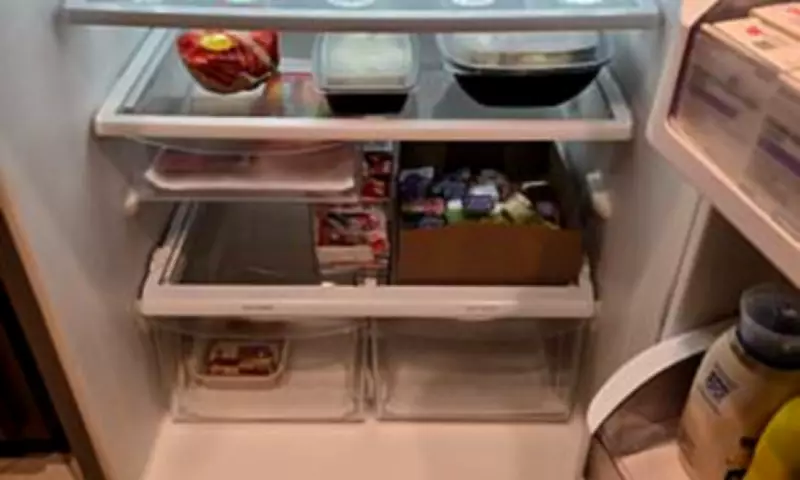
A seemingly ordinary refrigerator has become the centre of a heated online debate after a concerned brother shared a revealing snapshot of his sister's weekly essentials, exposing what he describes as a 'sad' reality of her lifestyle.
A Fridge Frozen in Time
The image, posted to Reddit, shows a meticulously arranged interior that has reportedly remained unchanged for nearly two decades. The top shelf is lined with twenty plastic water bottles, perfectly ordered. Below, three leftover takeaway meals occupy the second shelf, while the bottom shelf holds two tubs overflowing with condiments, predominantly sourced for free from fast-food establishments.
Notably absent are any fresh fruits or vegetables, with the crisper drawers sitting virtually empty. "This is my sister's fridge. She's kept the fridge arranged like this for nearly 20 years," the man explained in his post, expressing bewilderment at the lack of fresh ingredients.

A Family History of Food
The brother contrasted this with their upbringing, highlighting their father's career. "Our dad retired from 20 years in the navy as a cook and after his service, he worked in restaurants as a general manager. Our fridge and freezer were always packed," he recounted. He noted that his own adult refrigerator mirrors this abundance, making his sister's starkly minimalist approach even more perplexing to him.
He detailed that her diet primarily consists of restaurant and drive-thru meals. An anecdote illustrated her strict adherence to this setup: when her son once tried to place a takeout plate on the water bottle shelf, she reportedly responded, "There's no space in the fridge for that."
Online Reaction: From Spooky to Strategic
The post garnered over 1,400 comments, with users sharply divided. Some found the image unsettling, with one declaring it "the spookiest fridge I have ever seen," while another admired its orderliness, calling it the "neatest fridge I've ever seen." A humorous comment noted the water bottles were "practicing social distancing."
Mental Health and Compulsive Behaviour
Many respondents pointed to potential underlying mental health conditions. The hoarding of large quantities of condiments prompted suggestions of Obsessive-Compulsive Disorder (OCD) or hoarding disorder. One user shared a personal connection: "My grandmother had OCD and hoarded. She would take all the condiments off the table and ask for more."
Another commenter reflected, "OCD most likely. It is manageable. Is the fridge hurting anyone? No. Is it hurting her wallet? Probably. Hope she's getting help." Others described the setup as "the weirdest combination of minimalist and hoarder possible."
Alternative Perspectives and Defence
Not all commentary was critical. Some users admitted their own refrigerators were similar, attributing it to a preference for daily shopping. "I don't mind going to the grocery multiple times a week because I never really know what I want to eat until I want it," one explained.
Others defended the possibility of a balanced diet without home cooking. "A bit of devil's advocate here, but... salads and veggies are available at restaurants, no?" one user argued, suggesting it's possible to eat well while dining out exclusively.
Environmental concerns were also raised, with several commenters urging the sister to switch from disposable plastic bottles to a water filter. However, some offered light-hearted support, with one stating, "We love a hydrated queen," and another proposing the method was "kind of genius" for portion control and preventing overeating.
A Personal Divide
Amidst the public analysis, the brother revealed a deeper personal conflict. "I love her because she's my sister and because of our shared past, but I don't like her as a person. She's unpleasant to be around," he confessed, concluding his post by expressing curiosity for others' insights into the situation.
The discussion transcends a simple critique of grocery habits, touching on themes of family dynamics, mental health awareness, environmental responsibility, and the diverse ways people navigate nutrition and daily life in the modern world.