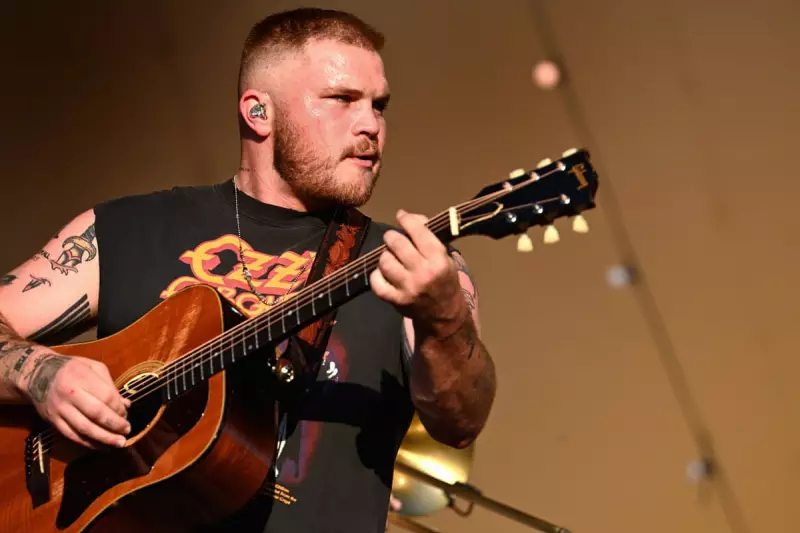
On 9th January, acclaimed country singer-songwriter Zach Bryan officially released his provocative track 'Bad News', featuring the pointed lyrics: 'ICE is gonna come bust down your door / Try to build a house no one builds no more.' The song has ignited a fierce debate, drawing criticism from Trump administration officials and raising questions about whether country music is beginning to awaken to the realities of America's immigration crackdown.
Emerging Stars Challenge Genre's Conservative Legacy
A new generation of country artists is starting to critique former President Donald Trump's stringent immigration policies, defying the genre's long-standing reputation for conservatism. The personal story of fellow country singer Frank Ray underscores the human cost of these policies. Over the Thanksgiving holiday, Ray's family gathering in Tennessee was shattered when his brother-in-law, Juan Nevarez-Porras, was detained by ICE at El Paso International Airport.
Nevarez-Porras, born in Mexico, has lived in the United States for two decades, holds a green-card application, and possesses valid work authorisation. Despite this, he was taken into custody while his sixteen-year-old son, a US citizen, was placed with border patrol. Ray's family found themselves powerless, a scenario becoming increasingly familiar across America.

A History of Advocacy Amidst Mainstream Silence
Country music has a sporadic history of addressing immigrant struggles. Decades ago, legends like Merle Haggard with 'The Immigrant' and Dolly Parton's cover of Woody Guthrie's 'Deportee' championed the rights of Mexican immigrants. Frank Ray himself touched on the theme in 2023 with 'Jesus at the Taco Truck', a collaboration with Shy Carter.
Yet, such social commentary remains conspicuously absent from mainstream country radio. The Billboard Top 20 country charts are dominated by tales of heartbreak and revelry, with major stars like Lainey Wilson, Luke Combs, and Morgan Wallen largely avoiding the immigrant experience. This silence is striking for a genre that often positions itself as the authentic voice of Americana, seemingly ignoring one of the nation's most pressing issues.
Zach Bryan's Defiant Stand
This context makes Zach Bryan's foray into anti-ICE territory particularly significant. Bryan, who served eight years in the US Navy, has cultivated a massive, diverse fanbase with his raw storytelling. His success is undeniable, having recently broken a US concert attendance record and debuted an album at number one on the Billboard 200.
When he teased 'Bad News' in October, the lyrics immediately provoked a backlash. Homeland Security Secretary Kristi Noem condemned the song on a right-wing podcast, calling it 'disrespectful' to law enforcement and the country. Bryan responded by asserting the song 'hits on both sides of the aisle' and declaring himself on neither 'radical side', a stance some found at odds with the track's scathing critique of ICE raids and gun violence.
A New Wave of Political Voice
Bryan is not alone. Emerging Missouri-based artist Bryan Andrews has gained viral attention for his 'crash out' TikTok rants and songs criticising Trump, ICE, and inequality. 'I was like, I have to write about this,' Andrews said, referencing last year's ICE raids. His blunt message to the industry is to 'Grow some fucking nuts,' criticising the 'Toby Keith-ification' of country music that followed 9/11, which promoted a narrow, jingoistic patriotism.
Andrews argues that real small-town struggles involve economic hardship, not the fear-mongering myths peddled in some songs. 'I see farmers who end up having to file for bankruptcy because they can't afford the trade war,' he stated.
The Chilling Effect and Flickers of Resistance
The caution in country music has deep roots. Veteran journalist Robert Oermann points to the 2003 backlash against The Chicks after they criticised President George W. Bush, which made many artists avoid controversy. 'That has only intensified under the Trump administration,' Oermann noted, adding that popular culture is something Trump 'wants to restrict.'

Despite this, flickers of resistance exist. Artists like Tyler Childers and folk singer Jesse Welles, who performed his track 'Join ICE' on national television, have addressed immigration and social justice. Oermann believes timely immigration narratives are only just beginning to surface in country music, accelerated by the internet, though the pace remains slow compared to the genre's history of rapid response to national events.
Frank Ray's Complicated Perspective
Frank Ray's experience adds a layer of complexity. A former law enforcement officer of ten years, Ray identifies as Mexican American, a cop, and a country singer. After leveraging social media to highlight his brother-in-law's case, a DHS statement labelled Nevarez-Porras a criminal. Ray acknowledges a past trespassing incident but argues the system 'forgets that people are human.' His brother-in-law remains in ICE custody.
Ray's perspective is nuanced. He won't call for ICE's dismantling, distinguishing between problematic individuals and the institutions. His upcoming single, 'Hard to Be a Hero', promotes traditional pro-law enforcement values. Yet, his family's ordeal leaves him frustrated. 'If you're here and you're hardworking, you're contributing to society... then you're good enough to be here,' he concluded, capturing the personal conflict at the heart of this national debate now echoing through country music's halls.