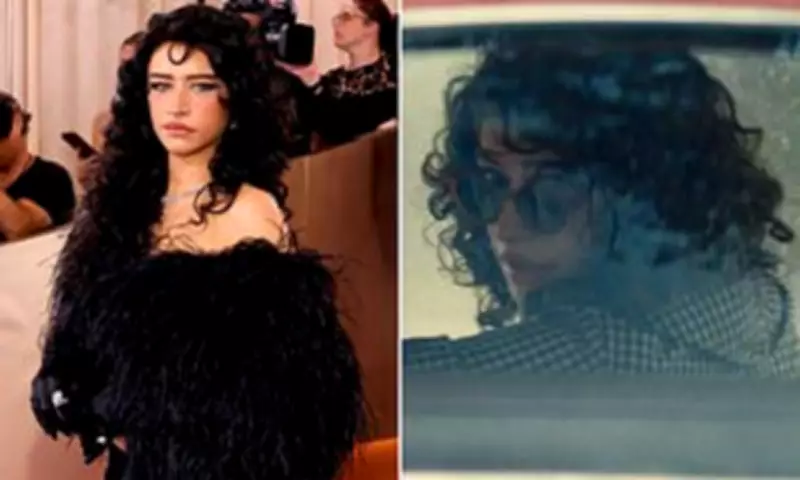
Hollywood finds itself embroiled in yet another whitewashing controversy, as rising star Odessa A'zion has publicly announced her withdrawal from a film role following significant backlash over her casting. The 25-year-old actress, best known for her BAFTA-nominated performance in Marty Supreme, revealed on Instagram that she would no longer be participating in the adaptation of Holly Brickley's novel Deep Cuts, just two days after her involvement was officially announced.
Casting Controversy Sparks Immediate Reaction
The controversy emerged when it was revealed that A'zion had been cast as Zoe Gutierrez, a character explicitly described in the source material as being of Mexican heritage and Jewish background. This casting decision prompted immediate criticism from fans and observers who argued that the role should have gone to an actress who authentically represents these cultural identities.
In a detailed Instagram Stories post, A'zion offered a candid explanation for her decision to step away from the project. She admitted that she had not read the original novel before accepting the role and revealed that she had initially auditioned for a different character entirely before being offered the part of Zoe Gutierrez.

A Transparent Apology and Explanation
The actress wrote emphatically: 'Guys!! I am with ALL of you and I am NOT doing this movie, f**k that I'm out! THANK YOU guys for bringing this to my attention. I AGREE WITH EVERY SINGLE ONE OF YOU!' She continued with remarkable transparency about the casting process, explaining that she had gone in to audition for the role of Percy but was subsequently offered the character of Zoe instead.
'I'm so pissed y'all, I hadn't read the book and should have paid more attention to all aspects of Zoe before accepting,' A'zion confessed in her social media statement. She emphasised her commitment to ethical casting practices, stating: 'I'd never take a role from someone else that's meant to do it. That SHOULD do it! That's not me. There are a plentitude of people more than capable of playing this role and I am NOT one of them.'
Film Details and Production Background
Deep Cuts is set in the 2000s and follows the story of two music-obsessed twenty-somethings as they navigate ambition, belonging, and the transition to adulthood. The film was set to feature A'zion alongside Drew Starkey and Cailee Spaeny, with Spaeny playing music critic Percy and Starkey portraying a songwriter and love interest.
The project is being directed by Sean Durkin, known for his work on The Iron Claw and The Nest, who is also producing alongside Eli Bush, Ronald Bronstein, and Josh Safdie. Daily Mail has reached out to representatives for production company A24 for comment regarding the casting controversy and A'zion's subsequent departure.
Mixed Reactions on Social Media
The announcement of A'zion's withdrawal prompted diverse reactions across social media platforms. Some critics questioned her initial acceptance of the role, with one X user commenting: 'I am with all of you yet accepted the role in the first place,' while another noted: 'It's funny how she says I'm with all of you but she already accepted the role lol.'
However, many others praised her decision to step away from the project. Supporters described her actions as demonstrating genuine allyship, with one observer writing: 'This is what actual allyship looks like. No PR statement, just a direct exit. Respect to Odessa for putting her career on the line for her values.' Another added: 'Respect her for listening, taking a stand, and stepping away. That's not an easy decision.'
Broader Context of Hollywood Whitewashing
This incident represents just the latest in a series of Hollywood productions facing accusations of whitewashing in their casting decisions. The controversy emerges mere weeks after similar complaints were directed at Emerald Fennell's adaptation of Wuthering Heights, which cast Jacob Elordi as the racially ambiguous character Heathcliff.

Historical precedents for such casting controversies include Scarlett Johansson's portrayal of Major Motoko Kusanagi in Ghost In The Shell, a character traditionally depicted as Japanese. Similarly, Ed Skrein stepped down from the Hellboy reboot in 2017 upon discovering that his character Major Ben Daimio was of Asian heritage, while Emma Stone faced criticism for playing a character of mixed Chinese and Hawaiian descent in the 2015 film Aloha.
Contemporary Backlash Against Recent Adaptations
The current Wuthering Heights adaptation has drawn particular ire from social media users for its casting of Margot Robbie and Jacob Elordi, both white actors, in roles that deviate significantly from Emily Brontë's original character descriptions. In the classic novel, Catherine is portrayed as a teenager, while Heathcliff is described as 'dark-skinned' and racially ambiguous.
One social media critic expressed frustration with this adaptation, writing: 'Not to be that one friend who is too woke but bleaching the class and racial otherness out of Wuthering Heights to sell a horny whitewashed romance genuinely pisses me off.' Another added: 'I will be complaining about Wuthering Heights for the foreseeable future as the very existence of a white Heathcliff offends me.'
A third commentator highlighted multiple deviations from the source material, stating: 'Heathcliff is not white (one of the MAIN themes of the novel), Catherine is supposed to be a teenager at OLDEST, and Wuthering Heights is not some booktok erotica bulls**t.' These criticisms reflect growing public awareness and sensitivity regarding authentic representation in film adaptations.
Industry Implications and Future Standards
A'zion's decision to withdraw from Deep Cuts has sparked conversations about establishing new standards within the entertainment industry. One social media user suggested: 'This has to set a standard in Hollywood, don't take roles that is not suitable for you. This is one of the reasons I'm not watching marvel wonder man series.'
The actress, who currently stars in the HBO series I Love LA and has appeared alongside Timothée Chalamet in Marty Supreme, as well as in The Inhabitant and Until Dawn, has demonstrated a willingness to prioritise ethical considerations over career advancement in this instance.
This developing situation continues to highlight the ongoing tension between creative casting decisions and authentic representation in Hollywood, suggesting that the industry may be approaching a potential turning point in how such matters are addressed both behind the scenes and in the public sphere.