At 96, the legendary Chilean filmmaker and artist Alejandro Jodorowsky contemplates his final curtain with characteristic flamboyance. "Soon I will die. And I will go with a great orgasm," he declares, reflecting on a life spent as a director, poet, tarot reader, and psychotherapist. His latest project, a monumental two-volume monograph titled Art Sin Fin published by Taschen, serves as both a vibrant archive and a rebirth, cataloguing a century of counter-cultural creativity.
A Century of Psychedelic Rebirths
Jodorowsky, often dubbed the 'king of the midnight movie' for his 1970s cult classics El Topo and The Holy Mountain, rejects the notion of a single, fixed identity. He estimates he has lived 100 different lives, constantly dying and being reborn. "Because we are different people all the time," he explains. The Art Sin Fin retrospective, curated with the Louvre's Donatien Grau, captures this kaleidoscopic journey, spanning his riotous stage shows, unrealised projects like his famed Dune adaptation, and his influential comic book saga, The Incal.
The book's prose is pure Jodorowsky: metaphor-rich and delightfully absurd. He describes his brain as "like a canary growling like a whale" and later as "two bicycle wheels fighting like dogs." This signature blend of the profound, the provocative, and the outright silly has defined his work, which attracted fans from John Lennon to Dennis Hopper, who helped bankroll his films.

From Tocopilla to Paris: The Eternal Present
His story began in Tocopilla, a small Chilean port town, where he worked in his father's shop from the age of seven. "I was the little young genius," he recalls. "Now I am the little old genius who is talking to you." His escape led him to Paris, where he studied mime with Marcel Marceau. His directorial debut, Fando y Lis (1967), famously sparked a riot in Acapulco. "In Mexico they wanted to kill me," he says. "A soldier marched in and put a gun to my chest."
Now based in Paris, Jodorowsky continues his work in 'psychomagic', his therapeutic practice mixing Freud, shamanism, and tarot. He claims a staggering 8 million people are waiting for his counsel, a figure his wife, Pascale Montandon—who collaborates with him under the name PascALEjandro—gently echoes. At 54, Montandon often assists on Zoom calls, translating and correcting her husband's English. "You're not dead yet," she reminds him when he speaks of his impending death.
Facing Death with an Artist's Resolve
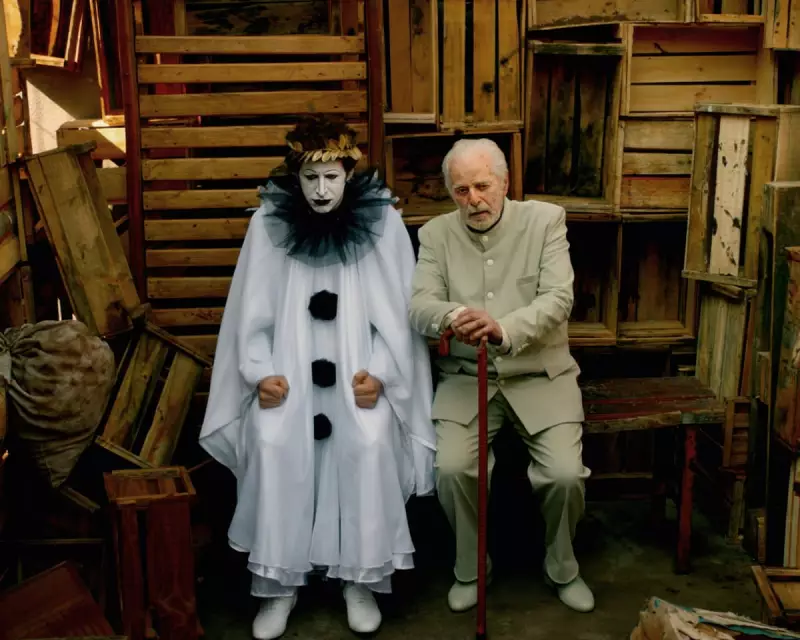
Jodorowsky's meditation on mortality is not new. A photograph in Art Sin Fin shows him at 17, made up as a 90-year-old, "experiencing an orgasm in the arms of death" in a Chilean pantomime. Now, truly in his nineties, he revisits the theme. "Soon I will be in the arms of death," he states. "I am ready to die and I will go with happiness, with a great orgasm."
His later films, The Dance of Reality (2013) and Endless Poetry (2016), were magic-realist memoirs that dealt with his fraught family history. "My father was a monster and my mother was, too," he says, having fled Chile and never seen them again. The work was a form of soul-saving. Tragedy also shaped his path; the death of his son, Teo, from an overdose at 24, led him deeper into tarot-based psychotherapy.
Despite the shadow of the end, Jodorowsky's spirit remains one of relentless action. "Life for me is an adventure," he concludes. "We live in an eternal present. Life is action, action, orgasm, and we experience it all the time." Alejandro Jodorowsky: Art Sin Fin is published by Taschen on 6 February, a fitting testament to an artist for whom creation and existence are one and the same.