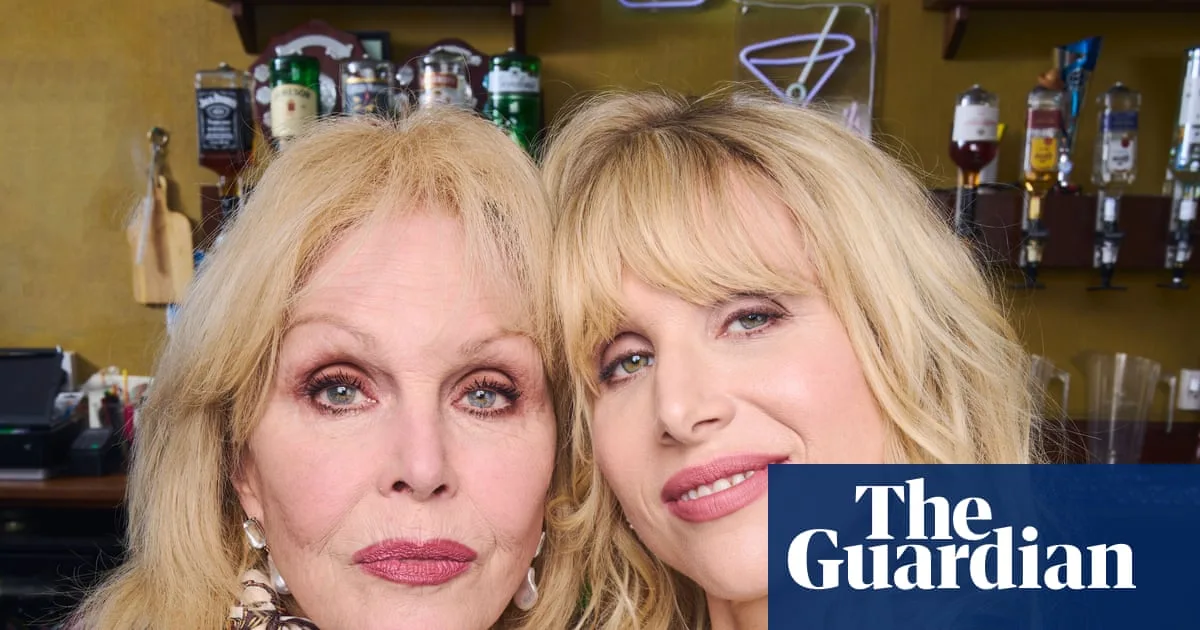
The funniest comedy on British TV is back. Its stars talk about scruffiness, mortifying encounters with the public and why they’ve loved each other for two decades.
In a north London TV studio, there’s a sense of unpredictability in the air. A gaggle of singing teenagers are on set; there’s a dog traipsing around; and – just down the hall in the canteen – Joanna Lumley has paused our interview to very politely ask a catering lady not to pack up her tangerine for her. “Darling, I literally cry with gratitude but I don’t need it in a box this time, it can travel on its own,” she purrs. She’s as poised as you might imagine – even if she looks ready for an arctic expedition, wrapped in a big mustard puffer jacket against the December cold. “Sorry, I’ve gone off on a tangent.”
We’re talking about Amandaland, the funniest and biggest comedy on British TV. Masterminded by the crack team of Sharon Horgan, Barunka O’Shaughnessy, Helen Serafinowicz, Laurence Rickard and Holly Walsh, this spin-off of the Bafta-winning Motherland has shifted the focus from perma-stressed Julia (Anna Maxwell Martin) to pretentious side character Amanda (Lucy Punch) and her mother, Felicity, played by Lumley. The show has been an undeniable hit, with the Christmas special – an Absolutely Fabulous reunion set at Aunt Joan’s (Jennifer Saunders) decrepit country pile – the most-watched comedy over 2025’s festive season, with 7.4 million viewers.

“I was talking about Lucy and her gorgeousness,” continues Lumley. The love-in with her Amandaland co-star has been more than 20 years in the making. With their masses of blond hair and talent for playing icy divas, they first portrayed the wicked stepmother and one of her daughters in 2004’s Cinderella satire, Ella Enchanted. Punch, says Lumley, struck her as “smart and good and committed. She’s like an express train – you could shovel coal into her!” As for Lumley, Punch describes her as the “special sauce” of the show, adding that: “Alex [Shaw] and Miley [Locke], who play my kids, have the most wonderful relationship with her. They have some in-joke about 6-7? I’ve no idea what they’re talking about.”
For Punch, it’s the relationship between her and Lumley’s characters that really makes the show. “I think seeing the dynamic with her mother, and why she is how she is, generates sympathy for an unlikable character,” she says. “But I always said, when talking to the writers, that I didn’t want to pull back on any of her obnoxious behaviour.” Hence the series one plotline in which Amanda’s move from Chiswick to south Harlesden saw her try to rebrand it “SoHa”. Or her attempt to offload most of her possessions, ending with her fighting with a woman at a car boot sale over a giant metal horse. Not to mention the way she attempts to claim that her sales gig at a bathroom showroom was a “collaboration” that fits into her ambition to become a lifestyle influencer.
“For her, the stakes are so high on even the most petty things – she’s a rather tragic figure really,” says Punch, who, away from set, is Amanda’s more bohemian twin, hair out of its blowdried cast and fake nails removed. (“I’ve usually got a head full of dry shampoo, and haven’t used a brush for about three days,” she says.) Naturally, Punch – who lives in the US with her partner, the artist Dinos Chapman, and their two children – has had to get used to being called Amanda a lot, especially when she’s in the UK. At a hotel in Manchester, she accidentally jumped the queue for a key card, “and the girl went: ‘Such an Amanda move.’ I would hate for anyone to think I was like that.”

Across an IMDb page that takes in film and TV – everything from the 2011 Cameron Diaz comedy, Bad Teacher, to British TV staples such as Doc Martin and new US tech bro drama, The Audacity – Punch has never played a character for so long. She’s also played a lot of meanies. Has she ever worried about being typecast? “Well, I haven’t worried about it because it’s kept me working,” she says. “I’ve played so many ugly stepsister types and Amandas … and I enjoy it. From teenagers up, people say they love it – it’s a joy.” One change this time round is that the scenes filmed at antiheroine Amanda’s flat are no longer shot on location. Series two moves her home to a TV studio, which is slightly bigger, so the crew can all pile in, with no traffic sounds outside. “I’d love the people who owned the house to come and see it,” says Lumley. “They’d be jealous I think … or it might be”