Ashes and Diamonds Review: Poland Confronts Bleak Postwar Realities in Andrzej Wajda's 1958 Masterpiece
In Andrzej Wajda's seminal 1958 film Ashes and Diamonds, Polish resistance fighters confront an existential crisis as the Second World War concludes. Far from celebrating victory, the war's end marks a profound moment of national disillusionment and ideological confusion for a country caught between devastating ashes and an uncertain future.
The Poetic Foundation of Disillusionment
The film's title derives from lines by Polish Romantic poet Cyprian Norwid: "Will there remain among the ashes a star-like diamond, the dawn of eternal victory?" These words resonate with bitter irony throughout the narrative. When two lovers discover this poem inscribed in a ravaged church, they struggle to interpret its meaning while simultaneously questioning where their own loyalties and futures lie amidst Poland's chaotic transition.
The central dilemma becomes painfully clear: are the potential diamonds of peacetime prosperity under communist rule—effectively administered by those who initially invaded Poland alongside the Nazis—preferable to the ashes of wartime suffering that at least provided certainty and purpose?

A Provincial Town on VE Day
Set in a provincial Polish town on 8 May 1945, the film captures the complex, unresolved emotions simmering beneath Europe's victory celebrations. Nowhere is this turmoil more pronounced than in Poland, the historic epicentre of the European conflict. Three Home Army resistance fighters—Maciek (Zbigniew Cybulski), Andrzej (Adam Pawlikowski), and Drewnowski (Bogumił Kobiela)—find their patriotic mission against both Nazis and communists continuing despite the war's official conclusion.
Their latest assignment, the assassination of Communist party official Szczuka (Wacław Zastrzeżyński), ends in grotesque failure when, after lounging and sunbathing before the attack, they accidentally kill two innocent young civilians. This tragic error sets in motion Maciek's profound personal crisis.
Maciek's Existential Unravelling
Horrified by witnessing the grief of a young woman engaged to one of his unintended victims, and exhausted by years of conflict, Maciek nonetheless receives orders to attempt the assassination again. Szczuka is scheduled to attend a victory banquet and stay overnight at the ironically named state-run Hotel Monopol, where Maciek secures an adjacent room.
Here, the narrative takes a crucial turn. Maciek flirts with barmaid Krystyna (Ewa Krzyżewska) and persuades her to join him in his room, which transforms from a base for political killing to a site of potential love. He experiences a devastating epiphany: he has fallen for Krystyna, or at least recognises he has become a lover rather than a fighter. The war has ended, and his refusal to complete the mission might not signify cowardice or betrayal. "Why did I want to kill this man anyway? Or anyone? What has it all been for?" he questions desperately.
Symbolism and Visual Metaphors
Wajda employs powerful symbolism throughout the film. When Krystyna questions why Maciek wears dark sunglasses, he replies: "A souvenir of unrequited love for the homeland." The glasses render him perpetually disguised, unable to reveal his true loyalties. Although he eventually removes them, no corresponding liberation or revelation follows.
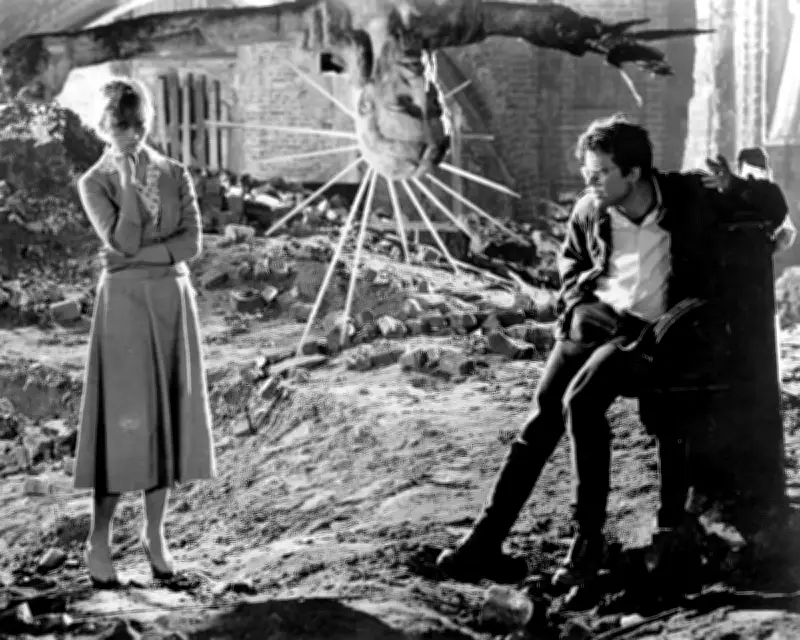
In one of the film's most iconic scenes, Maciek and Krystyna wander through a ruined church where a crucified Christ figure swings upside down—a potent visual metaphor for a world turned violently on its head. Here they encounter Norwid's poem and make a disturbing discovery about another presence in the church.
The Bacchanalian Banquet and Political Opportunism
Meanwhile, the victory banquet deteriorates into a drunken bacchanal. Drewnowski becomes hopelessly intoxicated while manoeuvring for a position in the new communist-controlled press—a pursuit rendered ignoble by scenes showing squares of newsprint being used as toilet paper. Everywhere, sadness and a kind of political delirium prevail.

Created just thirteen years after the events it depicts, and based on Jerzy Andrzejewski's novel published merely three years earlier, Ashes and Diamonds stands as a powerful testament to Poland's profound crisis of identity and ideology during its painful postwar transition.
The film continues to resonate as a masterpiece of European cinema, capturing the moral ambiguities and personal tragedies of a nation rebuilding amidst ideological conflict. Ashes and Diamonds remains essential viewing for understanding Poland's complex twentieth-century history and the human cost of political transformation.