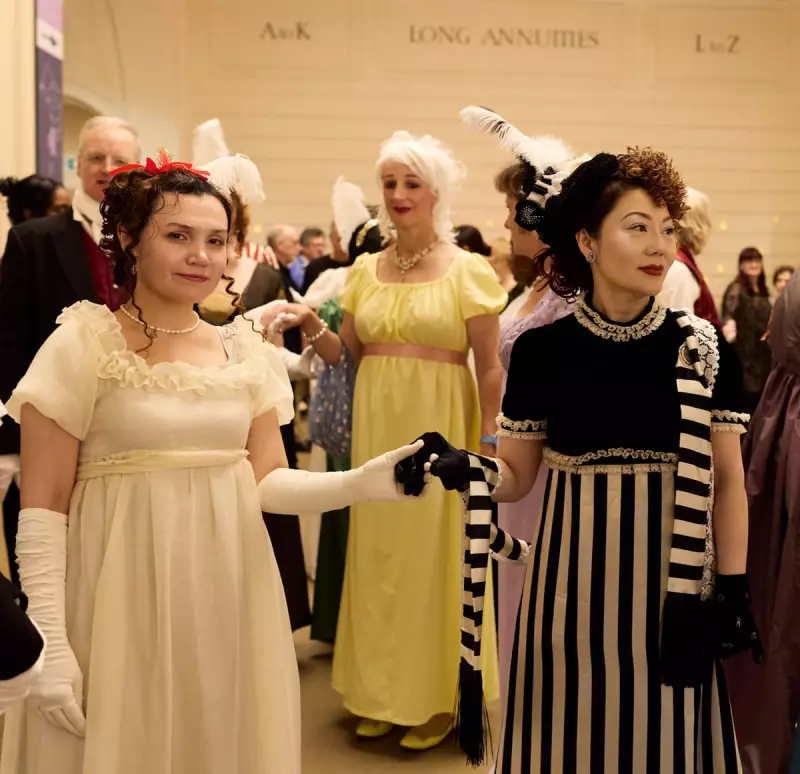
Inside the grand, high-arched lobby of London's Bank of England Museum, the air hums with the sound of violins and lively chatter. Rows of dancers, women in flowing satin gowns and men in formal tailcoats, twirl and step in time to music from a bygone era. This scene is not from a film set but a vibrant Jane Austen-themed ball, one of many held nationwide, celebrating the author's 250th anniversary and captivating fans of the Regency period and Netflix's Bridgerton.
The Social Fabric of Historical Dance
For participants, these gatherings are far more than a historical re-enactment; they are a vital social lifeline. Irina Porter, who became friends with 73-year-old David Symington through the scene, highlights the value of personal connection. "People who take part get a lot of personal interaction – something we are gradually losing," she says. The practice of changing partners fosters introductions and a shared experience.
Gemima Lodge, 40, agrees, calling it "a really effective socialising space" where regular faces become friends. The commitment often extends to authentic costume-making. Enthusiasts like Mary Davidson, 26, and Lian Cooper, 37, craft Regency-era dresses from repurposed materials like old bedsheets, curtains, and secondhand sarees. "Everyone is so disconnected, stuck behind their phones now," Davidson observes. "We're harking back to the old times... it's really fun and social."

Decoding the Dances: From 18th-Century Manuals to Modern Algorithms
Organising these events requires scholarly dedication. Callers and historians pore over 18th-century dance manuals, which provided instructions for social dances, or contredanses. Key sources include John Playford's 1651 'The Dancing Master', with written steps beneath sheet music, and the work of Thomas Wilson, filled with intricate swirling diagrams known as dance notations.
A pivotal system was the Beauchamp-Feuillet notation, first published by Raoul-Auger Feuillet in 1700. It recorded courtly dance steps in spiralling geometric patterns. For contredanses, Feuillet later created a Simplified Feuillet system, focusing on floor patterns rather than individual steps, translated into English by John Essex in 1710.
"It's the first visual guide we get," explains dance historian Jennifer Thorp, an emeritus archivist at New College, Oxford. "You get the tune at the top of the page and then these floor plans telling people where to go."
Today, members like Paul Cooper of the Hampshire Regency Dancers transform these archaic instructions into digital animations. He sees a direct parallel with coding. "The instructions are close to being a computer programme," Cooper notes. "There's iterative activity and a sort of algorithm to it... Some of these dancing masters would probably do quite well as computer programmers." His work involves interpreting ambiguous phrases and adapting dances for modern participants who seek equal engagement.
A Living Tradition: Community, Adaptation and Favourites
The societies provide a space to revive obscure dances and create new traditions. Jorien van der Bor, Cooper's partner and a skilled 'caller' who teaches steps to the room, cites The Duke of Kent's Waltz (c.1802) as a now-popular "swishy" dance that was likely little-known in its day.
Some favourites come from screen adaptations. Mr Beveridge's Maggot, featured in the 1995 Pride and Prejudice series, is danced enthusiastically despite being from a century earlier than the Regency period. "From a strict historian's point of view, we probably shouldn't be doing it," van der Bor admits, "but many people in our community just love it."

At the Bank of England ball, caller Helen Davidge names The Duchess of Devonshire's Reel as a favourite. It was choreographed by Charles Ignatius Sancho, who was enslaved as a child and later became a noted composer and abolitionist. Davidge founded the Georgettes of Oxford in 2023, seeking a blend of community, history, and escapism. "The world is so busy, and sometimes quite a scary place," she says. "To have a space to just come and focus on your body, dancing and sharing that with other people – it's a little break."
Ultimately, these gatherings across the UK are more than a niche hobby. They represent a conscious effort to reclaim face-to-face community, physically engage with history, and find joy in the intricate, shared patterns of dance passed down through centuries.