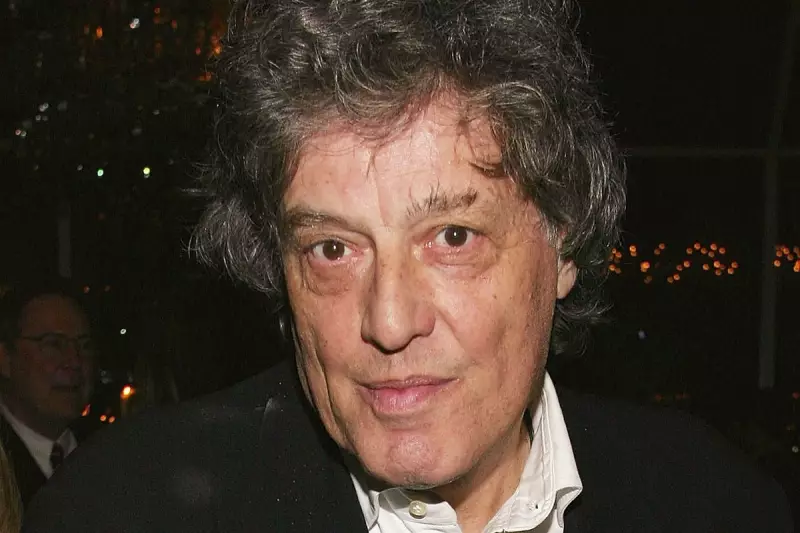
The world of theatre has lost one of its most brilliant and inventive minds with the death of Sir Tom Stoppard at the age of 88. The award-winning playwright, whose career defined British theatre for nearly six decades, leaves behind a body of work celebrated for its dazzling intellect, surreal humour, and profound humanity.
The Stoppardian Universe: Wit, Philosophy and Popular Culture
To remember Tom Stoppard is to recall a unique theatrical voice that could weave together linguistics, quantum physics, moral philosophy, and rock 'n' roll into a single, compelling narrative. His plays were never static; they were intellectual and visual acrobatics. One might think of the hilarious and poignant moment in his 1982 play The Real Thing, where a character agonises over selecting the perfectly unpretentious pop song for Desert Island Discs, ultimately settling on "Um Um Um Um Um Um" by Wayne Fontana and the Mindbenders.
This blend of highbrow concepts with accessible, self-deprecating humour became his signature. In 1972's Jumpers, he mixed circus skills with philosophical debate, featuring a mesmerising Diana Rigg swinging on a papier-mâché moon. The play toyed with Zeno's paradox, musing that an arrow must cover half the distance to its target, then half the remainder, ad infinitum—"and Saint Sebastian died of fright." His 1977 television play Professional Foul, which aired on the BBC, masterfully combined international football, moral philosophy, and totalitarian politics.

From Emigre to Icon: A Life in Language and Discovery
Stoppard's journey to becoming a titan of British culture was itself a remarkable story. Born in Czechoslovakia, he arrived in England as a child. His mother, scarred by the Second World War, had not told him of his Jewish roots or that relatives had perished in the Holocaust. He began his career in journalism in Bristol, where colleagues recalled a young reporter more interested in writing plays than political minutiae. An apocryphal tale has his editor asking who the Home Secretary was, to which Stoppard replied: "I said I was interested in politics, not obsessed with it."
This down-to-earth wit characterised his life. He once turned down Steven Spielberg's initial offer to write Empire of the Sun because he was busy with a radio play, leaving the filmmaker aghast. When probed about his personal life, he was a master of deflection, once saying of a question about his relationship with actor Felicity Kendal: "With these things one can decide whether to contribute or not to contribute. I have decided not to contribute. And that is my contribution."
A Final Masterpiece and an Enduring Legacy
Stoppard's late-career discovery of his heritage profoundly influenced his final play, Leopoldstadt (2020). This searing exploration of a Viennese Jewish family's trajectory towards the Holocaust served as his powerful swansong, a poignant reckoning with his own recently uncovered past.
His repertoire was astonishingly varied. It ranges from his sensational 1967 debut, Rosencrantz and Guildenstern Are Dead, which reimagined the off-stage lives of two minor Hamlet characters, to 1993's Arcadia, a time-hopping masterpiece that intertwined 19th-century romanticism with chaos theory. The Royal Institution of Great Britain praised it as one of the best science-related works ever written.
While his later works grew darker and more complex, the defining hallmarks—the verbal dexterity, the intellectual curiosity, the startling leaps of imagination—never faded. Sir Tom Stoppard was a romantic, a genius, and a permanent fixture of theatrical history. We have lost the complicated, charming man, but his dazzling plays, which dominated British theatre for 60 years, will endure as his ultimate, magnificent contribution.