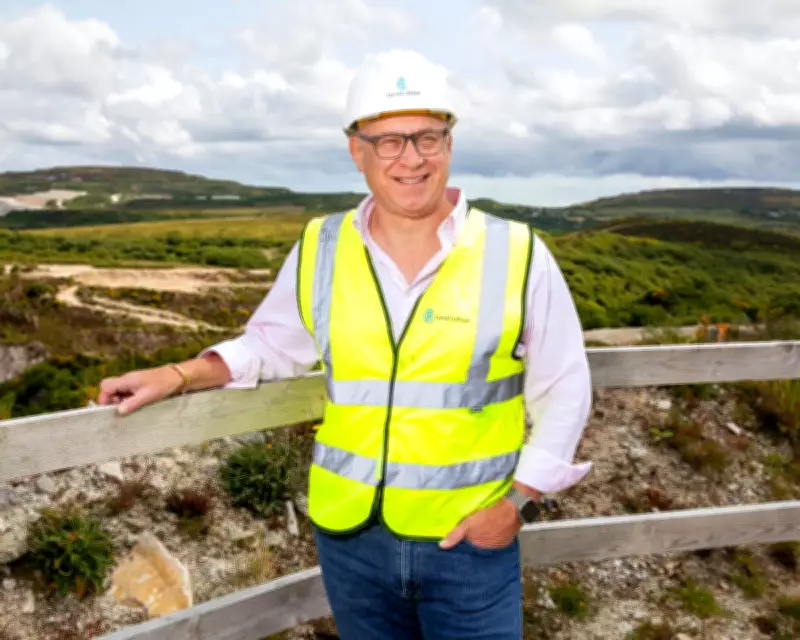
Standing at the edge of the vast Trelavour china clay pit near St Austell, Jeremy Wrathall gazes into what he believes is Cornwall's future. The founder and chief executive of Cornish Lithium sees not just a scarred landscape, but the potential for economic revival through what many call 'white gold' – lithium. This critical element, essential for rechargeable batteries in everything from smartphones to electric vehicles, could bring year-round jobs and prosperity to a region that has struggled since the decline of traditional mining.
The Geological Treasure Beneath Cornwall
The story begins approximately 275-280 million years ago with a continental collision that melted the Earth's crust, forming granite intrusions across Cornwall. Professor Frances Wall of the University of Exeter's Camborne School of Mines explains that within certain granite compositions, minerals called micas contain lithium. "The rock is made of minerals and, if you've got the right composition in the original material and the right conditions, then within those minerals there are some called mica. Some of those micas contain lithium," she says.
This isn't new knowledge – Victorian miners reported finding lithium in groundwater centuries ago. What has changed dramatically is lithium's importance in our modern world. With its high electrochemical potential, lithium can hold charges longer than most elements, making it ideal for the rechargeable batteries powering our technology-driven society.

From Mining Decline to Lithium Renaissance
When Jeremy Wrathall graduated from Camborne School of Mines in 1988, Cornwall's mining industry was in its final stages, with just four active mines remaining from more than 300 in the 1860s. After working in South African gold mines and London's financial sector, Wrathall returned to his Cornish roots with a vision. "I put lithium plus Cornwall into Google and up came four historical records of lithium being found in water," he recalls. Recognizing the geological significance, he began acquiring mineral rights and founded Cornish Lithium in 2016.
Today, Cornwall represents what experts believe is Europe's largest lithium deposit, with companies like British Lithium and Cornish Lithium leading exploration efforts. Wrathall estimates the UK could extract 50,000 tonnes of lithium annually for over 20 years – potentially meeting about 50% of the country's needs by 2030.
Two Extraction Methods: Hard Rock and Geothermal
Cornish Lithium is pursuing two distinct extraction approaches. At Trelavour, the company operates a hard rock extraction site where lithium-bearing granite will be quarried, crushed, and processed. Wrathall picks up a piece of rock, pointing out the sparkly mica: "All of this rock, everything you can see, has lithium."
Approximately 20 miles away near St Day and Gwennap, the company is developing geothermal extraction. Here, deep boreholes reaching 2 kilometers tap into naturally fractured rock where hot brine water contains dissolved lithium. This method represents potentially the least impactful extraction approach, with plans to return the water after lithium removal and potentially use the geothermal heat for local agriculture.
Addressing Environmental and Community Concerns
Unlike controversial lithium projects in Portugal and Serbia, Cornish Lithium argues their approach has distinct advantages. The Trelavour site is an existing quarry rather than pristine land. "You can see the damage is done," says Wrathall. "What are you going to do with this? It's dangerous, fenced-off to stop people getting in. And at the end of it, we will rehabilitate it."
Professor Wall notes that Cornwall's granite is "pretty benign" compared to sulphide ores that can cause acid mine drainage. The company plans electric crushers and is investigating electric trucks while exploring valuable byproducts including silica for cement and gypsum for plasterboard.
Economic Promise for a Struggling Region
The potential economic impact resonates deeply in communities like St Dennis, where three pubs have dwindled to one, and St Austell, described by local Peter Morse as less "bustling and lively" than in previous decades. Morse, who returned to Cornwall after 30 years in US mining, represents what locals call "Cousin Jacks" – Cornish miners who traditionally worked abroad.

Noah Law, Labour MP for St Austell and Newquay, acknowledges both opportunity and challenge: "Mining is more capital intensive than it used to be, and not as labour intensive. Part of the challenge is sharing the prosperity." He emphasizes that Cornwall has historically been "an industrial powerhouse" and can balance natural beauty with economic development.
Cornish Lithium currently employs just over 100 people with plans to triple that number. Wrathall emphasizes the multiplier effect: "Every mining job provides at least four times as many knock-on jobs." These wouldn't be seasonal tourism positions but year-round industrial roles that could fundamentally change local economies.
The Road to Commercial Production
Both extraction methods remain in demonstration phases. The hard rock facility processes crushed granite through physical and chemical separation, while the geothermal project awaits construction of a demonstration plant following successful exploratory drilling. Wrathall anticipates commercial production beginning around 2028-29.
Even with successful development, the UK would still need to import approximately half its lithium requirements. However, as Wrathall observes, attitudes have shifted dramatically: "We've seen critical minerals go from 'Who cares?' to 'Oh my goodness, what are we going to do?'"
As Cornwall stands at the threshold of potentially becoming Europe's lithium hub, the region balances its 4,000-year mining heritage against modern environmental standards and economic needs. The transformation of disused quarries into sources of 'white gold' represents not just technological progress, but possibly the revival of Cornwall's industrial identity for the renewable energy age.