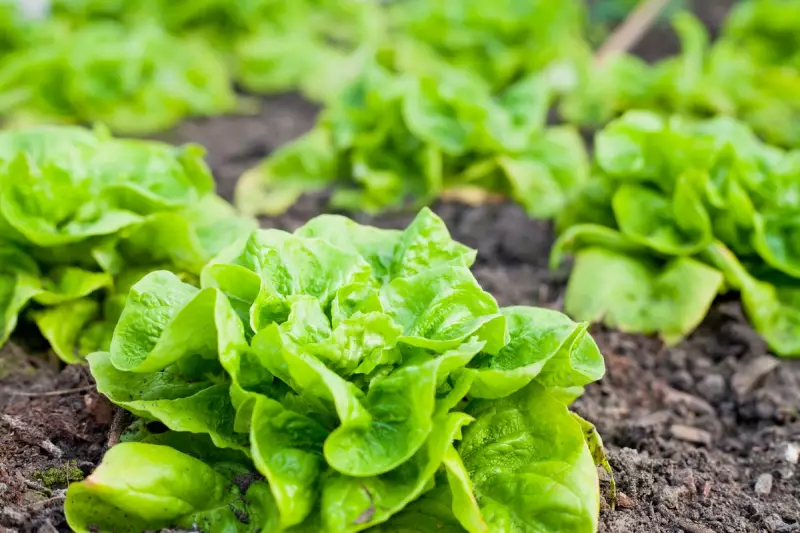
For generations, a soggy, brown lettuce leaf has been the bane of British salads and a frustrating mystery in kitchens across the UK. Now, a groundbreaking study led by scientists from several Spanish universities has finally pinpointed the exact reason why lettuce deteriorates with such alarming speed.
The Leaf's Flawed Raincoat
We are taught that leaves are protected by a waxy, waterproof layer called the cuticle, acting as a natural raincoat. However, this new research, published on Wednesday 17 December 2025, reveals this barrier is far from uniform. Using atomic force microscopy (AFM) to examine lettuce at a scale a thousand times smaller than a human hair, the team discovered the leaf's surface is a patchwork of chemical properties.
"It is as if the leaf's raincoat had some areas of fabric that repel water, and other areas that attract it," explain the researchers. This critical finding explains why lettuce, despite its protective layer, loses water rapidly and wilts soon after harvest.

Stomata: The Gateway to Decay
The study, conducted by the Polytechnic University of Madrid, the University of Murcia and the University of Valencia, focused on romaine lettuce, a common but highly perishable variety. The scientists, including Victoria Fernández, Ana Cros Stötter, and Jaime Colchero, analysed the upper and lower surfaces of the leaves in unprecedented detail.
They found that while most of the leaf's "pavement" cells have a water-repellent surface, the guard cells that form the stomata—the tiny pores used for gas exchange—are chemically diverse. These stomata possess hydrophilic, or 'water-loving', areas interspersed with hydrophobic ones.
"Our study shows for the first time that the surface of stomata, apart from being rough, also exhibits chemical heterogeneity," the team states. This heterogeneity is the leaf's Achilles' heel.
Implications for Food Security and Waste
This discovery has significant implications. The hydrophilic areas on the stomata are likely gateways for two major problems:
- Rapid water loss: Leading to the wilting we see in the fridge or on supermarket shelves.
- Increased susceptibility to pathogens: Making the lettuce more vulnerable to contamination by bacteria and viruses.
Lettuce is the first horticultural species on which such a detailed nanoscale surface study has been performed. The researchers believe applying this knowledge is crucial. Understanding these weak points opens the door to developing new post-harvest treatments, coatings, or even breeding more resilient varieties.
The ultimate goal is to prolong shelf life, reduce food waste, and contribute to a more robust and sustainable food supply chain—a pressing concern for consumers and producers across the UK and beyond.