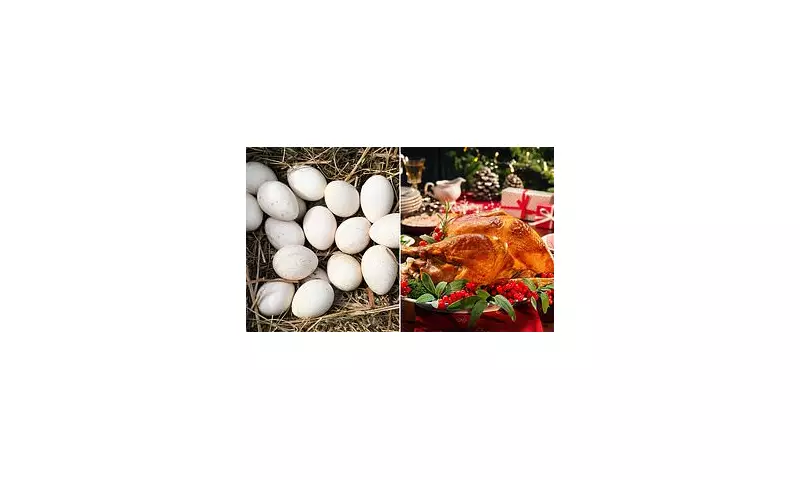
As families across the UK gather for their traditional Christmas feast, a curious culinary question often arises: why does the majestic turkey adorn our plates, while its eggs are conspicuously absent from our holiday menus? The answer is a fascinating tale of biology, economics, and centuries-old suspicion.
The Economics of Egg Production: Why Turkeys Can't Compete
The primary barrier to finding turkey eggs on supermarket shelves is simple economics. Experts point to fundamental differences in the biology of turkeys compared to chickens. Kimmon Williams of the National Turkey Federation explains that turkeys have a significantly longer life cycle. "Turkeys need to get to about seven months before they are able to produce laying eggs," he told ModernFarmer. Chickens, by contrast, start laying at around five months.
The productivity gap is stark. While a chicken reliably produces one egg approximately every 24 hours, a turkey hen will only lay one or two eggs per week. This lower output is compounded by higher overheads. Raising turkeys is more expensive, as they require more feed and larger housing than chickens, driving production costs upwards.

This all translates to a hefty price tag for the consumer. Farmers would need to charge a minimum of £2.22 for a single turkey egg. Consequently, a dozen would cost an eye-watering £26.64, placing them firmly in the luxury category, far from the staple status of chicken eggs.
A History of Suspicion and the Rise of the Chicken
The story of the turkey egg is also one of history and perception. Turkeys are indigenous to North America and were a staple for Native American tribes. They were introduced to early European settlers in the 1600s. While the large, wild birds were an exotic novelty that Europeans quickly favoured, their eggs were not met with the same enthusiasm.
Early Spanish explorers brought turkeys back from the New World, but rumours soon spread, particularly among the French, that the eggs were linked to outbreaks of leprosy. In medieval Europe, new foods from distant, unknown lands were often viewed with deep suspicion, and diseases were frequently seen as divine punishment. This historical wariness stifled any potential market for turkey eggs from the outset.
Meanwhile, technological advancements in farming allowed producers to specialise. Chickens were selectively bred and farmed intensively for either egg production or meat, making chicken eggs vastly more cost-efficient and readily available. The turkey, valued almost exclusively for its meat, never entered this commercial egg-laying race.
A Niche for Enthusiasts and a Creamier Alternative
Despite their scarcity, turkey eggs have their advocates. Some cooking professionals, as reported by Slate, argue they are superior for certain culinary applications, notably sauces, because their yolks are creamier and richer than those of chicken eggs. However, this gourmet endorsement has not been enough to shift commercial demand.
Today, turkey eggs remain a rarity, sought mainly by dedicated food enthusiasts or small-scale farmers looking to meet a tiny, niche demand in the lead-up to Christmas. They stand as a costly, historical curiosity—a festive what-if that never made it to the breakfast table.
So, as you carve the roast turkey this Christmas, you can appreciate it not just for its flavour, but for its unique place in agricultural and culinary history. The bird on your plate won the battle for the centrepiece, but its eggs lost the war for the cupboard.