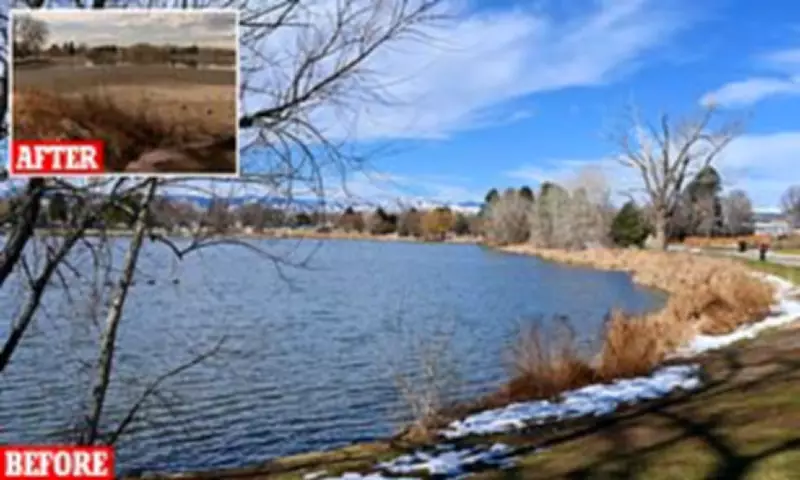
In a startling environmental development, Lake Huston, a beloved body of water in a southwestern Denver park, has lost nearly all its water, leaving residents shocked by the unprecedented dryness of their local lake. The once vibrant fishing spot has transformed into a muddy plain, with locals reporting they have never witnessed such severe depletion in their community.
A Treasured Local Landmark Turns to Mud
Tiercel Duerson, a long-time resident who has lived down the street from Lake Huston for many years with his father, expressed his dismay at the transformation. "It’s always been full of water," Duerson told KDVR-TV. "People fishing here, and eagles come here." Recently, Duerson and his young son were seen roaming the newly exposed muddy plain, searching for treasure where water once flowed.
Canal Failure Triggers Rapid Drying
According to Denver Parks and Recreation, the lake began drying up approximately one month ago when the canal that feeds it suffered a leak and had to be shut down. This artificial water source has been crucial to Lake Huston's existence since the 1930s, when it was first used for agricultural irrigation. The city of Denver acknowledges the lake's historical significance and its classification as a wetland due to its shallow depth and surrounding vegetation.

Now, the water level has receded so dramatically that the area no longer qualifies as a swamp by typical standards. Garrett Scray, an eight-year resident living by the lake, described the disturbing scene to 9News: "It’s more like a pond. It’s kind of an eyesore now with water down so much and half the lake being mud and just being dead fish floating around."
Ecological Concerns and Resident Heartbreak
Resident Chris Burroughs shared his sorrow about the ecological impact, telling FOX31, "I was thinking about all the fish and the pond life that are going to disappear. I mean, it has been extremely dry, and we certainly need rain." The disappearance of water has created visible distress among community members who valued the lake for recreation and wildlife observation.
Broader Drought Conditions Exacerbate Crisis
Officials have pointed to historically dry conditions as a contributing factor to Lake Huston's demise. Large portions of the western United States have endured remarkably low snowfall this winter, with Colorado particularly dependent on mountain snowpack to replenish rivers and reservoirs. The reduced snowfall has intensified already dry conditions across the region.
Federal data currently classifies Denver as being in a severe drought, meaning crop or pasture losses are likely, water shortages are common, and restrictions may be imposed. Much of Colorado was experiencing drought conditions even before this season's inadequate snow accumulation.
Multiple Water Bodies Struggling
Council Member Flor Alvidrez revealed to KDVR-TV that Lake Huston is not alone in its struggle. She highlighted that nearby Washington Park has a pond with extremely low water levels, indicating a broader pattern of water scarcity in the area.
In Aurora, located east of Denver, the situation appears equally concerning. The twelve reservoirs that supply the city are approximately 58 percent full, roughly 10 percent lower than normal for this time of year. Aurora Water spokesperson Shonnie Cline warned, "The reality of the situation is that it will continue to draw down. We might get a quarter to a third of the normal water we see to replenish reservoirs this year."
Water Conservation Efforts Intensify
Both Denver and Aurora have developed sophisticated systems to reuse water, a critical necessity during prolonged drought conditions. Aurora officials report they recycle and treat between 90 and 99 percent of their water supply to meet the city's needs, demonstrating the urgent measures being implemented to address water scarcity.
Despite the bleak current state, officials have indicated that Lake Huston could potentially have water restored by May 1, offering a glimmer of hope for recovery. The lake's historical significance was highlighted by a miniature regatta that took place on November 5, 1975, showcasing its former vitality as a community gathering place.