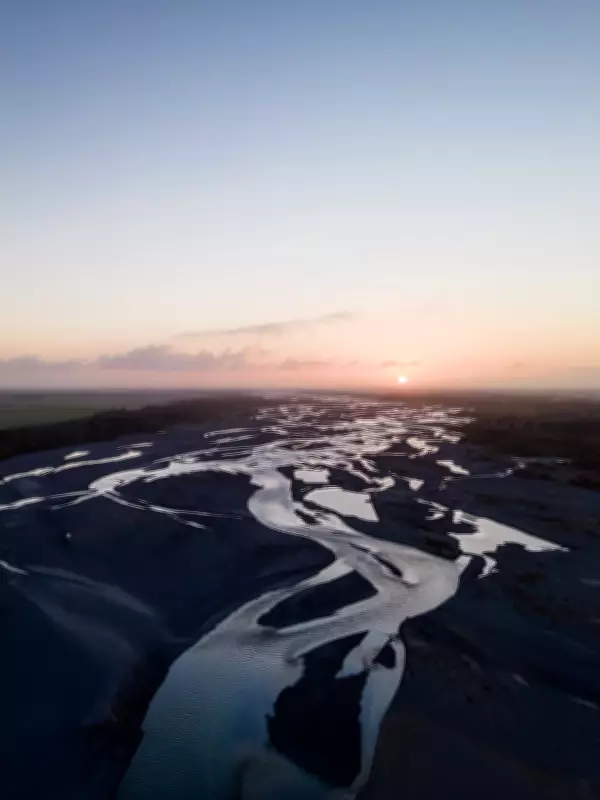
The Waimakariri River, one of approximately 150 braided rivers in New Zealand, has been heavily modified over the past century. Initially ignored by British settlers, the river's shifting channels and flooding led to extensive engineering interventions. Today, it is constrained by stopbanks, tree planting, and gravel extraction, requiring constant maintenance to prevent flooding. This has sparked a debate: should the river be tamed or allowed to flow naturally?
Historical Context and Intervention
When British settlers founded Christchurch 170 years ago, they largely disregarded the nearby Waimakariri River. However, rain and glacial shifts caused the braided river—a globally rare form with multiple woven channels—to change shape, occasionally flooding land and depositing gravel. By the 1920s, authorities described it as a "flood menace," leading to deliberate containment. Fred Brooks, a river engineer with Environment Canterbury, explains, "People say you shouldn’t be interfering with the river; the outcome if we don’t is worse. It has been intervened in so much at this point, you have to keep intervening."
Unique River Systems Under Pressure
Braided rivers are found in only a few places worldwide, including Alaska, Canada, and the Himalayas. In New Zealand, 60% are concentrated in Canterbury. These systems face complex challenges: they have been narrowed for farming and development, damaging ecosystems, reducing water quality, and increasing flood risks. Jo Hoyle, a river geomorphologist at Earth Sciences New Zealand, notes, "Braided rivers are iconic—we use their iconography all over the place. And yet, are we really looking after them?"

Narrowing and Encroachment
Over time, Canterbury's braided rivers have been deliberately narrowed. Gravel beds are gouged out for flood protection and road construction, while water is diverted for intensive dairy farming. In the Waimakariri, diggers extract gravel daily to prevent breaches. A study of nine Canterbury rivers found they had narrowed by 50% on average, with some segments over 90%. Landowners legally occupy riverbeds when water retreats, a practice scientists and advocates want changed. Hoyle warns, "The land on either side is really valuable day-to-day, but it is really vulnerable to big floods."
Ecological Decline
Fish populations are plummeting. In the Rakaia River, salmon numbers dropped from over 20,000 in 1996 to just 608 in the 2024-25 season. Chris Agnew, president of the Rakaia Fishing Competition, says, "There are less and less fish." Scientists attribute this to warming oceans, sediment buildup, pollution, and altered water flow. River birds are also declining due to introduced weeds and exotic willow trees that disrupt natural flow. Stokell's smelt, a native fish, is now critically endangered. Bruce Kelly, a local angler, laments, "At least before when you didn’t catch a fish, you would see a couple. Now you don’t even see them."
Water Quality and Tribal Concerns
Water quality is another issue. In 2025, Environment Canterbury found nearly a third of Canterbury's lakes and rivers unsafe for swimming due to E. coli and pathogens. The Ngāi Tahu tribe, for whom braided rivers are fundamental, took a landmark case against the Crown in 2017 to assert governing authority over waterways. Gabrielle Huria, the tribe's freshwater strategy chief, says, "Braided rivers are fundamental to how we exist as a tribe." She stopped traditional food gathering after finding cow faeces in nets. "We have a saying: 'the river goes where it will.' We need to be a lot smarter."
Future Directions
Minister for Resource Management Chris Bishop is awaiting recommendations on laws allowing landowners to move into riverbeds. Conservation Minister Tama Potaka states the government is committed to protecting braided rivers. Hoyle emphasizes the need for community awareness: "Having those discussions around how we want to live alongside our rivers needs to happen. The only way we will get change is making the community more aware of what the risks are and what we stand to lose."