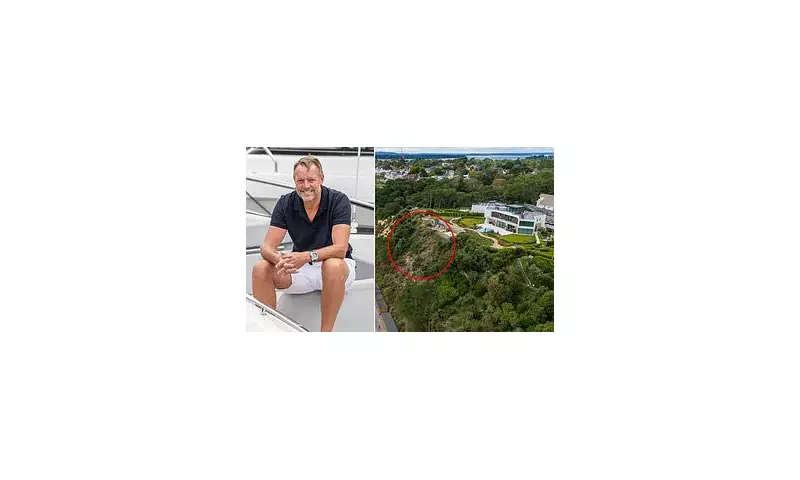
Millionaire Property Developer Hit with £20,000 Fine for Illegal Cliffside Development
A wealthy property developer has been ordered to pay £20,000 in fines after illegally felling 28 trees on a protected clifftop to make way for an unauthorised luxury pool house. Bill Buckler, a businessman, carried out the work at his property in the affluent Canford Cliffs area of Poole, Dorset, despite the site being designated as a Site of Special Scientific Interest (SSSI).
Misleading Conservation Claims Uncovered
In February 2021, Natural England granted Mr Buckler permission to remove the trees for what he claimed were conservation purposes. He told the public body that the felling was intended to protect the cliff from erosion and improve the habitat for sand lizards, a rare and protected species in the UK. However, neighbours soon became suspicious when construction began on a luxury garden pod and infinity pool on the newly-cleared cliff edge, suggesting the true motive was to enhance the property's views.
Mr Buckler maintained that he had been in contact with both the local council and Natural England, asserting that both organisations supported his plans. Despite his claims, outraged locals protested against the development on the sensitive SSSI, which is recognised for its important coastal habitat and geological features.

Unauthorised Works and Legal Action
In early 2022, Natural England received reports of unauthorised excavation works at the site. Following visits in May and September of that year, investigators confirmed that the building work was unauthorised and would have been strongly objected to if proper procedures had been followed. Despite this, Mr Buckler continued with further excavation until February 2023.
In March 2025, he was fined £8,812 for infringements under the Wildlife and Countryside Act (1981) and an additional £11,187 under an Enforcement Costs Recovery Notice. Claiming the penalty was disproportionate and manifestly excessive, Mr Buckler took Natural England to the High Court to challenge the fine. He also argued that he had been open and co-operative throughout the process.
High Court Dismisses Appeal in Damning Verdict
Judges have now unanimously dismissed his appeal, delivering a scathing verdict that labelled it notably free of merit. Judge Anthony Snelson stated: We find nothing of substance in any of the individual points of appeal which we have examined...this is an appeal which is notably free of merit.
Nick Squirrel from Natural England emphasised the irreversible damage caused by the development. He explained that geological features on the protected land have been permanently damaged and cannot be restored. Attempting to undo the illegal works would risk cliff instability and endanger beach users below.
Background of the Development Project
Mr Buckler originally purchased a 1960s bungalow in Canford Cliffs in October 2019 for over £3.1 million. Since 2020, he has been undertaking a £10 million development project to replace it with four luxury homes. The Poole Bay Cliffs SSSI is notable for its layers of rock, sand, and fossilised flora, dating back millennia to when the Isle of Purbeck and Isle of Wight were connected.
For his garden room, which features a 60ft wide viewing platform with a balcony on the roof, Mr Buckler dug into the cliff to install underground concrete pillars. Mr Squirrel commented: It's very heavily engineered for a garden room. Our concerns really relate to the situation on Bournemouth cliffs, where there are a number of slippages occurring. The policy is to keep development set back to prevent erosion and to protect beach huts and people below.
Irreversible Environmental Impact
The unauthorised construction has destroyed part of the geological features that warranted the SSSI designation. Mr Squirrel added: The effect of the unauthorised construction works carried out in the SSSI have destroyed a part of the geological features for which the SSSI is notified. It is apparent that these features are now lost.

He concluded that leaving the structure in place is currently the safest option, as removal could exacerbate instability. The case highlights ongoing tensions between development interests and environmental conservation on Britain's vulnerable coastlines.