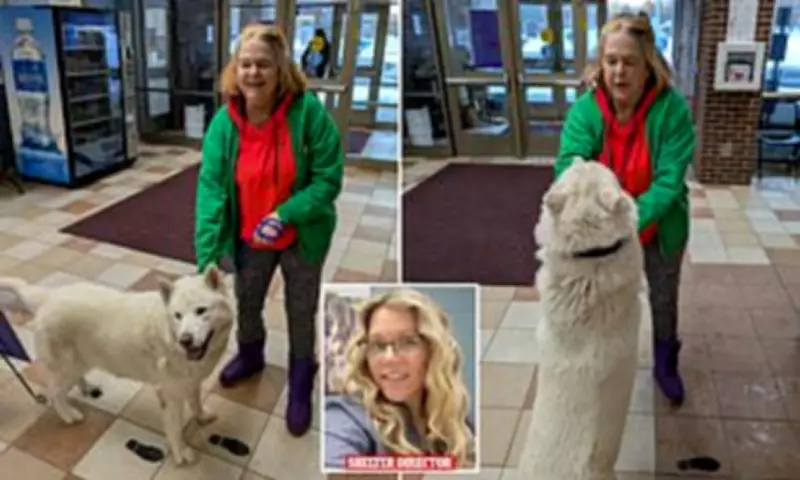
In a heartwarming tale that has captivated social media, a Michigan woman has been joyfully reunited with her beloved dog after a separation lasting more than a year, all thanks to a tiny microchip. Julie, from northern Michigan, had endured months of anguish and relentless searching after her fluffy white companion, Walker, vanished from their home during the summer of 2024.
The Long Wait and the Life-Changing Call
For over twelve months, Julie lived with a painful blend of grief and fading hope, never fully abandoning the possibility of seeing her six-year-old puppy again. Her world was transformed earlier this month when her phone rang with unexpected news from the Kent County Animal Shelter in Grand Rapids.
A stray dog, found approximately fifty miles from Julie's home, had been brought into the shelter. During routine intake procedures, staff scanned the animal and discovered a registered microchip. The details led them directly to Julie, who had been frantically searching since Walker's disappearance.

A Reunion That Spoke Volumes
Racing to the shelter, Julie was initially overcome with disbelief. "A year is a long time," the shelter's social media post recounted. However, any lingering doubt vanished the moment she walked through the doors.
Staff immediately observed the unmistakable connection. Walker locked eyes with Julie "as if no time had passed at all," his tail wagging furiously with recognition. Photographs from the emotional meeting show Julie beaming with joy as Walker, now nearly as tall as her chest, jumped up to greet her.
"In that moment, everything Julie had carried for a year, worry, grief, and hope, collapsed into pure relief," the shelter described. "All because of a microchip no bigger than a grain of rice."
The Critical Role of Microchipping
Shelter Director Angela Hollinshead told Newsweek the team was "really happy that after such a long time apart, these two were able to be reunited," calling it "the best way to start the new year." The shelter shared Julie and Walker's story specifically to underscore the vital importance of microchipping pets.
They warned that traditional collars can slip off and identification tags may fade or become illegible over time. In contrast, a microchip is a permanent, harmless form of identification that remains with an animal for its entire life, providing a reliable way home if separation occurs.
Compelling Statistics and Local Initiatives
Data from Human Animal Support Services reveals a stark reality: pets with a microchip are, on average, three times more likely to be reunited with their families than those without one. A study across seventeen government-funded shelters found only eighteen percent of stray pets were microchipped at intake—roughly one in six.
"Microchipping your pet doesn’t just give you peace of mind, it gives your pet a way home," the shelter emphasised. Hollinshead added a poignant note: "Julie got her dog back after a year apart. Not every story gets that second chance."
In response to a two hundred percent increase in stray dogs since 2019, Kent County has implemented proactive measures. In 2024, they unveiled a new twenty-four-hour microchipping station outside their North Campus in Cedar Springs.
This location was strategically chosen to alleviate transportation challenges for owners in northern Kent County. "Transportation to the shelter or time off work are often reasons owners are unable to come for their pets," Hollinshead explained. The accessible scanner aims to reunite pets with their families before they ever enter the shelter system.
Julie and Walker's extraordinary reunion serves as a powerful testament to the life-changing difference a simple microchip can make, turning a story of prolonged loss into one of joyful rediscovery.