California's Fake Ivy Graffiti Deterrent Vandalised Within 24 Hours
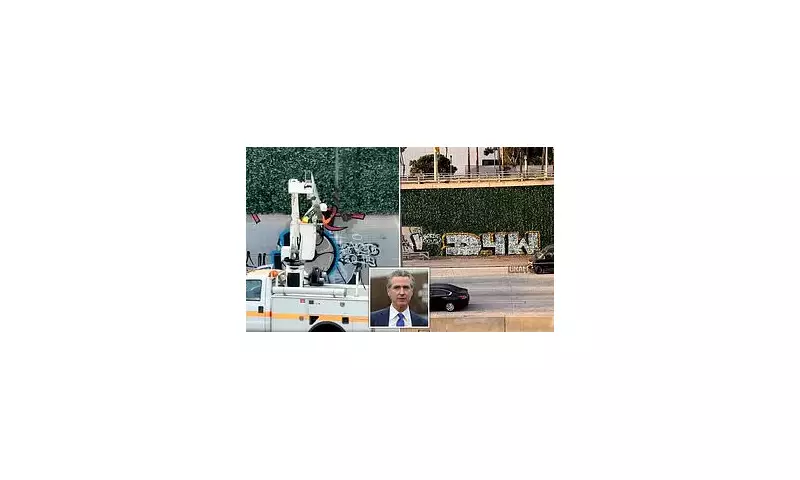
In a striking display of irony, a wall of artificial ivy installed along a California highway specifically to deter graffiti has itself been spray-painted less than twenty-four hours after its installation began. The initiative, part of Governor Gavin Newsom's administration's efforts to combat vandalism, has faced immediate and public ridicule as the very problem it aimed to solve manifested almost instantly.
The Swift Defacement of a Preventive Measure
The project involved covering a grey concrete wall beside the 101 Freeway in downtown Los Angeles with green synthetic foliage. This was intended as a pilot programme under the broader $1 billion Clean California project, which launched in July 2021 with goals of reducing litter, enhancing public spaces, and creating a cleaner, greener state. However, before the ivy installation was even completed, taggers had already descended, painting large white lettering across some of the leaves.
Videos posted online showed crews from the California Department of Transport, known as Caltrans, assembling the ivy wall. Yet, parts of the concrete remained visible when the vandalism occurred, highlighting the project's incomplete state at the time of the defacement.

Immediate Criticism and Official Response
The writing was, quite literally, on the wall before it even happened. Vocal Newsom critic Kevin Dalton, who ran unsuccessfully for the LA County Board of Supervisors in 2022, blasted the idea on social media platform X, asking his followers: 'Any bets on how long it takes for the graffiti proof ivy to be covered in graffiti?' He later shared a video of the spray-painted ivy with the caption: 'Holy Crap. The answer is less than 24 hours. In less than 24 hours, felons in Gavin Newsom's lawless California covered ivy in graffiti.'
In an interview with KTLA, Dalton ridiculed the concept, stating the wall was preserved for 'about eight hours' before taggers made their mark. He called it a 'perfect example of taxpayers dollars going in and failure coming out,' arguing that painting the wall grey would have cost about $50, whereas replacing individual ivy sections would be 'wildly more expensive.'
Caltrans responded to the criticism with a statement, explaining that the artificial ivy installation is a temporary measure. Due to a mural and related agreements at the location and several walls along US 101 in downtown Los Angeles, Caltrans is not legally allowed to paint over or remove graffiti. The ivy acts as a graffiti deterrent and is a more environmentally friendly solution, installed in 1'x1' squares that can be easily removed, cleaned of graffiti, and reused. The agency reported that the graffiti was cleaned 90% after being reported over the weekend.
Broader Context of the Clean California Initiative
The Clean California project, as described on its website, aims to transform streets and highways blighted with litter and hazardous waste. When launching it in July 2021, Newsom emphasised its historic opportunity, stating it would provide thousands of jobs for people exiting homelessness, at-risk youth, and recently-released prisoners. He highlighted its statewide effort, engaging all 58 counties to create public spaces Californians can take pride in.
Since its inception, Caltrans reports that more than three million cubic yards of litter have been collected, with one-third gathered by volunteers. The artificial ivy pilot on U.S. 101 began two weeks ago and is expected to be completed this week, remaining in place until mural artists can rehabilitate their artworks.
This incident underscores the challenges of urban policy implementation, where well-intentioned measures can quickly become symbols of failure in the public eye. The rapid vandalism of the fake ivy wall has sparked debate over the efficacy and cost of such initiatives in addressing persistent issues like graffiti in major cities.