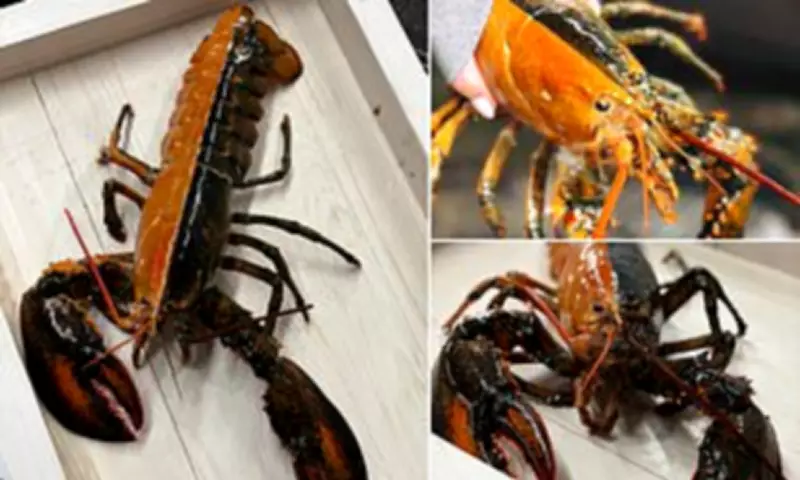
Fishermen fishing off the coast of Cape Cod were in for a surprise this month after reeling in an unusual lobster. Most lobsters are typically brown, olive-green, or dark blue-black. But this one was perfectly split down the middle, with the left side of its body the typical brown colour and the right side bright orange. This rare split colouration occurs in just one in 50 million lobsters.
Donated to Science
The lobster was originally destined for Wellfleet Shellfish Company in Eastham, Massachusetts. However, it has now been donated to Woods Hole Science Aquarium in Falmouth, Massachusetts, where its unique colouration can be studied further. 'The lobster is now with Woods Hole Science Aquarium's animals currently being housed in holding tanks at the Marine Biological Laboratory during the aquarium's construction period,' said Wellfleet Shellfish Company. 'When the aquarium reopens, the lobster will be on display, offering visitors a rare look at one of the ocean's most striking natural anomalies.'
Why Are Some Lobsters Different Colours?
Most American lobsters are a muddy brown colour to help them blend in with the murky depths of the ocean. However, rare genetic defects can result in more colourful crustaceans. Mutations cause the lobsters to produce too much or too little of certain pigments. Blue lobsters, which occur at a rate of one in two million, have a defect causing overproduction of crustacyanin. One-in-30-million orange lobsters only show the carotenoid pigment, which is bright red, meaning they appear to already be boiled. At one in 100 million, albino lobsters are the rarest. They are born completely white and do not even turn red when cooked.

How Split Colouration Happens
Speaking to Popular Science, Julia Studley, a biologist at Woods Hole Aquarium, explained how split colourisation happens. 'Split-colourisation occurs when two fertilized, unlaid eggs contact each other, causing one to absorb the other,' she said. 'This creates a lobster with two sets of genetic information, and the ability to store colour pigments differently on either side of its shell.'
The lobster will now go on display at the aquarium, where visitors can marvel at its unique colouring. Ms Studley added: 'We hope visitors take away just how unique this animal is, and how amazing it is to see genetics at work in a very iconic local species. This animal is not only fascinating to look at but also serves as a great reminder of how intricate genetic mechanisms are and how much we should thank them for the diversity we see in the world around us!'
Social Media Reaction
The discovery has delighted many lobster fans across social media. Commenting on Wellfleet's post on Instagram, one user said: 'Very cool!' Another added: 'Cuuuuute!' And one joked: 'That was incredibly unshellfish of you to donate it!'
Recent Similar Discovery
The news comes shortly after an ultra-rare freckled lobster was caught off the Massachusetts coast. The unusual female lobster had a fancy 'calico' pattern – bright orange with drizzles of black and touches of yellow. Odds of catching a calico lobster are believed to be only one in 30 million, according to local experts, who named the creature Jackie. Such an unusual pattern makes these lobsters sought after by aquariums and Michelin-starred restaurants, but luckily for Jackie she was donated to Northeastern University's Marine Science Center in Nahant. Jackie's vivid shades are from a unique mix of chemical compounds including astaxanthin, which makes lobsters red and shrimp pink. 'Normally, the lobsters that we see are reddish, brownish or a little bit greenish,' said Sierra Munoz, science educator at the center. 'In the calico lobster, the astaxanthin combines with other pigments and proteins in a really unique way. It gives her this really rare kind of mottled or freckled look.'