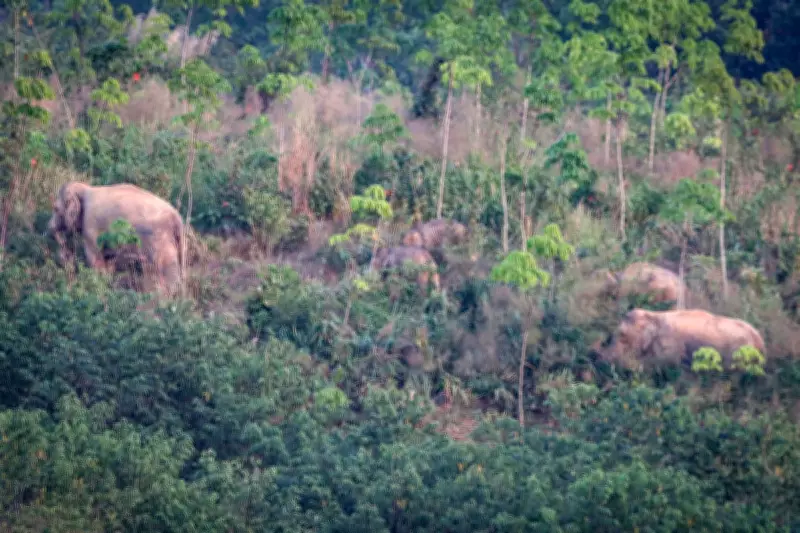
A wild bull elephant has killed a 69-year-old tourist exercising near his tent at Thailand's Khao Yai National Park, marking the third fatality linked to the animal. The incident occurred early on Monday morning, raising urgent questions about wildlife management and tourist safety in the country's protected areas.
Tragic Morning Attack at Campsite
The victim, identified as Jirathachai Jiraphatboonyathorn from Muang district of Lop Buri, was exercising with his wife approximately 5.30am when they encountered the elephant known as Phlai Oiwan feeding outside its forest boundary. According to reports from The Nation newspaper, the bull elephant charged at Jirathachai, grabbing him with its trunk and slamming him to the ground as other campers watched in horror.
Jirathachai's wife managed to escape the attack, but the 69-year-old tourist died at the scene. The tragic event unfolded at the Kho Yor 4 campground, also known as Khlong Pla Kang, within the Wang Nam Khieo district of the national park.

History of Fatal Encounters
Park officials have confirmed this elephant was previously involved in two other fatal attacks on local residents, though the exact timeline of these incidents remains unclear. The Bangkok Post reported that authorities suspect the bull elephant might be connected to additional encounters beyond the three confirmed fatalities.
Wanchai Kaenchantuek, head of the Khao Yai 4 park protection unit, told The Nation he heard the elephant and cries for help before rushing to the scene. After discovering the victim, he immediately alerted relevant officials and emergency services.
Official Response and Compensation
The victim's body has been transferred to a local hospital for postmortem examination. Park authorities and regional protected-area offices are coordinating with multiple agencies to provide assistance to the grieving family and consider compensation under government regulations.
Chaiya Huayhongthong, chief of Khao Yai National Park, told AFP that officials will convene a meeting on Friday to determine the appropriate course of action regarding the elephant. "We will probably decide to relocate him or change his behaviour," he stated, indicating that both relocation and behavioural modification are under consideration.
Increased Safety Measures
In response to the fatal attack, forest officials have ordered enhanced patrolling and monitoring activities throughout the national park. Authorities have issued renewed warnings urging tourists to exercise extreme caution when visiting areas known to have elephant populations.
The incident highlights growing concerns about human-wildlife conflict in Thailand, where elephant populations have increased dramatically in recent years. According to the Department of National Parks, Wildlife and Plant Conservation, more than 200 people have been killed by elephants since 2012.
Growing Elephant Population Challenges
Thailand's wild elephant population has seen a significant surge from just 334 individuals in 2015 to approximately 800 last year. This rapid increase has prompted wildlife officials to administer contraceptives in an effort to manage population growth and reduce conflicts with human communities.
The tragic death at Khao Yai follows other recent fatal elephant encounters in Thailand. Last year, a 22-year-old Spanish tourist named Blanca Ojanguren García was killed by an elephant while bathing at a sanctuary in southern Thailand. In 2024, a 49-year-old Thai woman identified only as Jeeranan from Chachoengsao was killed by a wild elephant while walking along a trail at Phu Kradueng National Park in Loei province.
These incidents collectively underscore the complex challenges facing wildlife conservation authorities as they balance protecting endangered species with ensuring public safety in Thailand's popular national parks and tourist destinations.