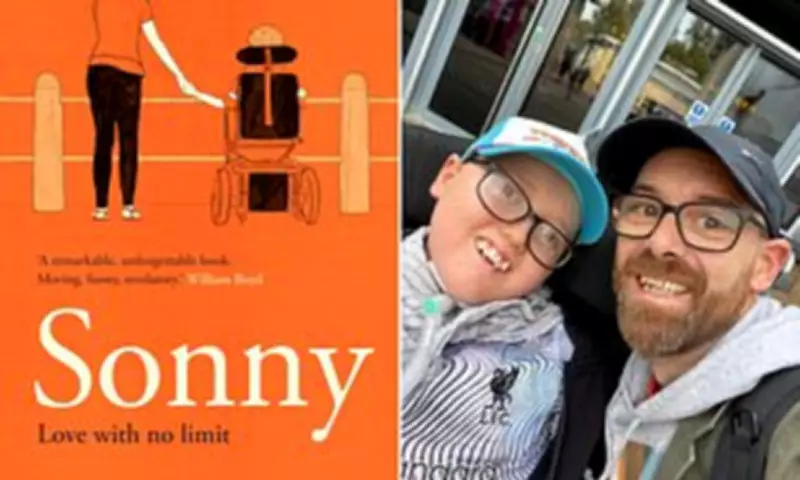
A Writer's Journey with Profound Disability and Unconditional Love
At football matches, we often see them positioned at the side of the pitch—individuals in wheelchairs whom television cameras typically avoid. Some insensitive fans have even been heard complaining that their presence supposedly dampens the atmosphere. This discomfort highlights a broader societal issue: people with disabilities can sometimes unsettle the able-bodied, primarily because the latter often lack understanding of how to engage with their reality.
The Inspiration Behind the Story
The title of the Radio 4 series on disability, Does He Take Sugar?, brilliantly captures this widespread ignorance and underlying fear. Writer Guy Kennaway personally confronted these emotions when he met the teenage boy who became the subject of his profoundly moving book. Initially drawn to Sonny's mother, Andrea—an attractive, vivacious, and unconventional woman—Kennaway's perception transformed dramatically over time.
By the conclusion of this narrative, subtitled Love with no limit, the self-described ladies' man came to view Andrea as astonishingly strong, admirable, and brave. His account of one profoundly disabled boy evolves into an uplifting journey that balances odd comedy with devastating honesty.

Confronting Personal Limitations
When Kennaway learned that Andrea, who is married, had a severely disabled son, he admitted his complete uncertainty about how to interact. "I don't know whether to try and talk, to shake their hand, to bend down, or to ignore them and carry on," he confessed. "I don't even know whether to look at youngsters in wheelchairs when I pass them on the pavement."
This raw candour proved pivotal. Following that conversation, Kennaway decided to undertake the ambitious project of writing a detailed book about a child who cannot respond in conventional ways. He recognized it as both a significant challenge and a compelling subject for any writer.
The Reality of Sonny's Condition
The immense difficulty of this endeavor quickly became apparent. Andrea lives with her husband Maff and their four children in Somerset, which happens to be Kennaway's home as well. Their second child, Sonny, was born with numerous chronic physical and mental challenges that defy precise classification, though his condition is commonly described as Severe Multiple Disabilities (SMD).
At fourteen years old, Sonny experiences total paralysis: he cannot speak, breathe, or swallow food or liquid. His lungs require suctioning every fifteen minutes. Any excursion necessitates accompanying equipment including his wheelchair, ventilator, battery charger, suction pump, batteries, and a box of catheters. His survival depends entirely on round-the-clock care.
Kennaway found himself genuinely terrified of this boy who could neither speak nor act independently.
Finding Connection Through Football
Discovering that both Sonny and his father Maff shared an intense passion for Liverpool Football Club provided Kennaway with his initial pathway into understanding the enigma that was Sonny. The parents confidently asserted that Sonny "loves" Liverpool, but Kennaway questioned whether this was genuinely the case.
They frequently claimed that Sonny "says" certain things or responds enthusiastically to suggestions, despite the absence of any visible evidence. Kennaway gradually learned that "talking Sonny" essentially involved speaking to the boy, imagining his responses, and continuing an appropriate one-sided dialogue.
The Communication Conundrum
Kennaway would chat with Sonny about girls and football, occasionally fancying he detected subtle eye movements or forehead wrinkles as "replies." Initially expecting conventional conversation, he met with frustration. As he persisted, his blend of self-consciousness and bravado became endearing.
Yet as the narrative progressed, doubts began to plague him. Was there an authentic "voice" inside Sonny communicating through some form of telepathy? Or was he merely projecting his own imagined responses onto the child?

Observing how Sonny's parents, siblings, and carers communicated with him, Kennaway realized there were numerous instances where certainty was impossible. What if they were all deceiving themselves? What if, whispered quietly, there was truly nothing there?
The Power of Unconditional Love
Ultimately, "talking Sonny" revealed itself as an act of faith. The "love with no limit" referenced in the subtitle began working its mysterious magic on the conflicted author. Kennaway felt uneasy about the potential self-deception he witnessed in the devoted parents, yet also troubled by what seemed like his own mean-spirited betrayal in doubting Sonny's capacity for understanding.
Caught within this double bind, Kennaway arrived at a crucial insight: what truly mattered wasn't what Sonny could or couldn't sense, but rather what he evoked in all those around him—individuals whose very humanity became enhanced through his presence.
A Story of Courage and Reflection
This narrative intertwines the life of a unique teenager with the world of Liverpool Football Club, bookended by a daring and somewhat foolhardy excursion to Anfield stadium. It chronicles two parents determined to move mountains for their son and a writer whose subject takes him on an emotional rollercoaster filled with laughter and meaningful moments.
The story confronts readers with such profound love and energy that they may question their own capacity to demonstrate similar devotion for their children. It compels deep reflection on profound disability, the right to life, and whether love and blind faith can ever truly be separated.