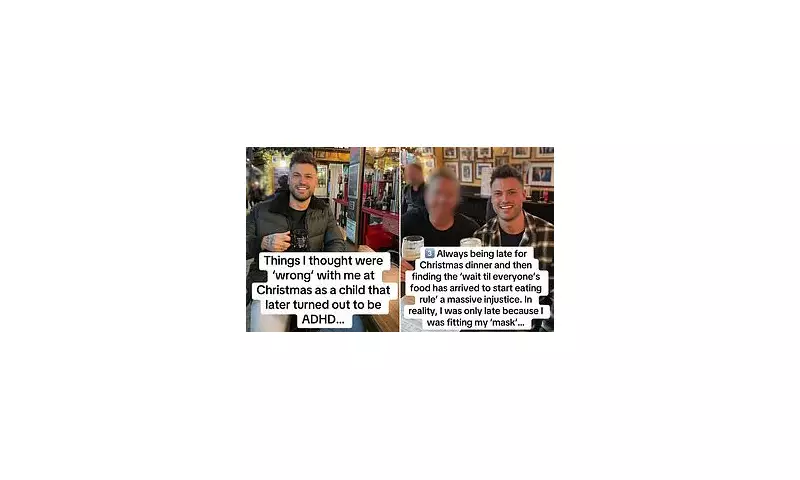
A mental health influencer with a large online following has detailed the six specific ways that living with ADHD can transform the Christmas period into an overwhelming ordeal for entire families.
Dan Hancock, 34, who was diagnosed with Attention Deficit Hyperactivity Disorder in 2022, describes the festive season as 'massively overstimulating' for neurodivergent individuals. He laments a widespread lack of understanding about how the condition's symptoms are amplified during this hectic time of year.
The ADHD Brain Under Festive Pressure
ADHD is a neurodevelopmental condition that causes dysregulation in the brain, affecting emotions, dopamine levels, and executive functions like time management and planning. These are the very skills required to navigate the busy festive period successfully.

'The highest priority things can get left until the last minute,' Hancock explains. 'This happens because as an individual with ADHD you have fewer dopamine receptors. One of the only ways to motivate yourself is to wait until the deadline is imminent, so the dopamine and adrenaline kick in and almost force you to take action.'
Recalling his own childhood, Hancock, who has over 13,000 followers, remembers Christmases filled with resentment and guilt. He admits to thoughtlessly ripping open his siblings' presents and arriving late for the main family dinner on December 25th. At the time, he had no idea his actions were linked to classic ADHD traits like poor impulse control and hypersensitivity, which were worsened by the festive chaos.
Six Key Struggles for Neurodivergent Individuals
Hancock highlights several core challenges that people with ADHD face during Christmas. Firstly, the crucial scaffolding of routine is dismantled. 'People with ADHD often benefit from a routine, and at Christmas this usually goes out the window, causing stress and overwhelm,' he notes. Sticking to a regular schedule, including a consistent bedtime, is paramount for managing symptoms.
Secondly, he points to 'time blindness,' a common trait where individuals either massively underestimate or exaggerate how long a task will take. This makes planning and time management exceptionally difficult when schedules are packed.
The third major issue is sensory and social overload. 'Anyone who is neurodiverse is also likely to be massively overstimulated by multiple conversations, noise, wrapping paper, bright lights and the excitement,' Hancock states. This can lead to exhaustion, even in the absence of conflict, and often results in a desire to escape social gatherings, which can provoke feelings of guilt.
Fourthly, Hancock discusses Rejection Sensitivity Dysphoria (RSD), where subtle shifts in a room's mood can be intensely felt and replayed in the mind for days, increasing emotional exhaustion and the urge to 'mask' true feelings.
The fifth struggle involves task completion, specifically around gifts. The ADHD brain may engage fully with the interesting part—buying presents—but then run out of steam for the mundane wrapping. Combined with time blindness, this often leads to last-minute, messy results. Hancock recalls writing a card so poorly his mother thought it was a joke, which deeply upset them both.
Finally, a pronounced lack of impulse control can lead to difficulties, from opening others' presents as a child to impulsive spending as an adult. Surveys suggest adults with ADHD can spend an extra £1,600 a year on impulsive purchases and missed bills.
Strategies for a Manageable Christmas
Having learned more about his own neurodivergence, Hancock now advocates for a more structured approach. His overarching advice is to allow yourself or neurodivergent family members time and space to process the day's excitement, away from the noise.
He recommends breaking tasks down early with a to-do list, starting preparations as far in advance as possible, and consciously preserving quiet time for oneself to regulate emotions. 'It's all about regulating the same way you would if you had a mental health condition and needed the rest,' he says.

Hancock is now on a mission to raise awareness. 'What people need to understand is that just because you can't see ADHD, it doesn't mean it doesn't exist,' the mental health coach asserts. He concludes with a powerful message: 'Neurodiverse kids don't want expensive gifts for Christmas, they just want to be understood.'