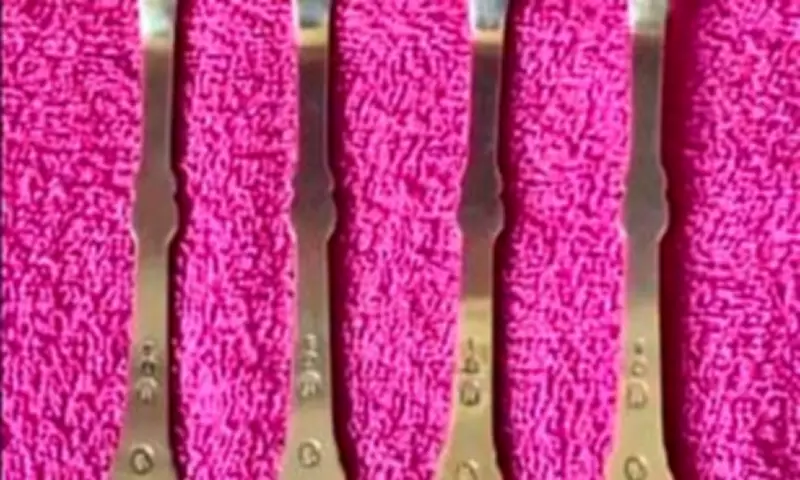
A perplexing optical illusion shared on TikTok has left users deeply divided, as some perceive a bizarre pink slime while others clearly see common kitchen forks hidden in plain sight. The image, posted by author Lex Natoli, has ignited a fierce online debate, amassing over 5.8 million views and countless comments from baffled social media participants.
The Viral Post That Sparked Confusion
Lex Natoli, known for her book 'Strange, Unusual, and Absolutely True', introduced the illusion with a caption stating it 'makes my head hurt'. In her viral post, she posed a critical question to viewers: 'When you first look at this, do you see some weird pink slime dripping down? Or, are you normal and did you see forks?' This simple query has triggered an overwhelming response, highlighting the subjective nature of human perception.
Diverse Reactions from TikTok Users
The comments section exploded with polarized opinions. One user insisted, 'How is it an optical illusion? Totally forks,' while another expressed frustration, asking, 'I'm sorry where are the forks?!??' Conversely, many viewers reported seeing only an amorphous pink blob, with one commenter describing it as 'weird shapes in like a cloth type material' and another likening it to 'a bunch of pink worms on strings.' Some even questioned the debate entirely, with a confused individual stating, 'What are people arguing about? There IS no forks?'

The Sudden Perception Shift
Interestingly, some users experienced a dramatic shift in perception. After initially seeing only pink slime, they reported the forks suddenly 'popping' into view, often irreversibly. As one commenter noted, 'When you said forks, they appeared and now I can't see the slime,' while another exclaimed, 'I gasped when the forks showed up!' This phenomenon underscores the illusion's power to alter visual interpretation in an instant.
Understanding Bistable Images
This fork illusion is a classic example of an 'ambiguous' or 'bistable' image, where a single picture can be perceived in two distinct ways. Similar to well-known illusions like Rubin's Vase or the duck-rabbit drawing, bistable images disrupt the brain's ability to distinguish between foreground and background. In this case, the pink towel and the forks compete for prominence, leading to conflicting interpretations among viewers.
The Psychology Behind the Illusion
Our brains constantly process visual information, deciding what constitutes an object versus background. Bistable images remove key cues, forcing the brain to choose one perception over another. This explains why individuals cannot see both the slime and forks simultaneously and often experience a sudden 'flip' in perception. Lex Natoli emphasizes that such illusions are more than mere entertainment; they delve into the psychology of visual processing, potentially sharpening cognitive abilities and revealing the complexities of human perception.
Historical Context of Optical Illusions
Optical illusions have long fascinated scientists and the public alike. For instance, the café wall illusion, first described by Professor Richard Gregory in 1979, demonstrates how alternating tiles can create deceptive sloping lines. This phenomenon, observed on a café wall in Bristol, has aided neuropsychologists in studying visual processing and has applications in graphic design, art, and architecture. Such illusions remind us that perception is not always a straightforward reflection of reality.
In summary, TikTok's viral fork illusion has captivated millions, showcasing how a simple image can provoke intense debate and highlight the intricate workings of the human mind. As users continue to share their experiences, it serves as a compelling reminder of the subjective nature of sight and the endless curiosities of optical phenomena.