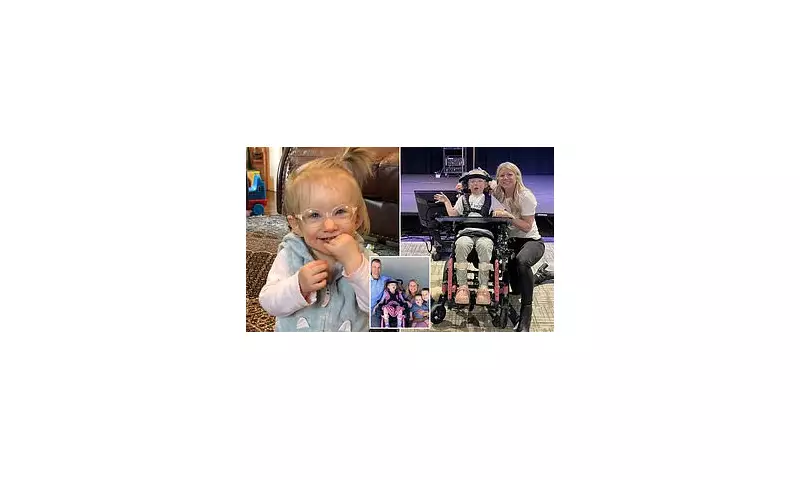
An eight-year-old girl from Colorado has become a prisoner in her own body after being struck down by an exceptionally rare genetic disorder, leaving her almost completely paralysed and able to communicate only with her eyes.
A Childhood Stolen by a Genetic Mutation
Until her second birthday, Everly Green appeared to be developing normally. She could crawl, play, sit up, and even say a few words. Her world, and that of her parents Chrissy and Ryan, was shattered when she was diagnosed with early infantile epileptic encephalopathy type 37, known as FRRS1L or 'Frizzle'.
The disease is caused by a genetic mutation that disrupts key receptors in the brain, crippling communication between cells. This breakdown leads to severe epilepsy, abnormal movements, profound developmental delay, and a catastrophic loss of function that is often life-threatening.

For Everly, the decline was devastatingly rapid. Just six weeks after her first seizure at age two, she lost all mobility. Three months later, she could no longer speak or eat and required a feeding tube. Now, at eight, she needs a wheelchair, tube feeds, and 24-hour care. She cannot hold up her head or move voluntarily and suffers frequent seizures.
A Mother's Mission: Funding Hope Where Pharma Won't
Faced with a condition affecting only around 100 families worldwide, pharmaceutical companies have shown little interest in developing a cure, deeming it financially unviable. 'We were told to just go home, love her, take care of her,' Chrissy Green recalled being told by doctors.
Refusing to accept this, Everly's family and others across the globe took matters into their own hands. In 2021, Chrissy co-founded the Finding Hope for FRRS1L Foundation, a parent-led non-profit with an audacious goal: to raise the millions needed to develop a gene therapy treatment themselves.
'Even before we knew that there was an option for treatment, we were like, we're going to give her the best quality of life we can,' said Green. She describes her daughter as a normal, silly, playful child trapped inside a motionless body. Everly loves reading, crafts, and dancing, and communicates using a gaze-tracking computer system.
The Long Road to a Potential Cure
The foundation's strategy is gene replacement therapy. The concept involves using a harmless virus to deliver healthy copies of the FRRS1L gene into brain cells, aiming to rebuild the faulty receptors and restore function. Early experiments on mice bred with the mutation have shown promising recovery and increased movement.
The financial hurdle is immense. The total process to find, test, and administer a cure is estimated to cost nearly $10 million (approximately £8 million). So far, the foundation has raised $1.5 million, funding initial research and pre-clinical work, including a $400,000 round of gene therapy testing on mice in 2023.
The current phase, toxicology testing, requires another $1 million. Subsequent stages will need $4 million for manufacturing and $2 million for clinical trials. The foundation's ambitious target is to dose the first Frizzle patients by September 2026.
Researcher Neil Hackett explained the stark commercial reality: 'They need specific expertise, which is not easy to find, and they need massive amounts of money.' He noted that big pharmaceutical firms see no profit in treating such rare diseases, forcing families to become unlikely research and development drivers.
Chrissy Green is determined that the treatment, once developed, remains accessible and isn't shelved by a commercial entity for lack of profit. 'We're committed to making sure Frizzle treatment gets fully developed as a drug that can be accessible to all patients,' she stated.
For the Green family and the Frizzle community, this monumental effort is an act of love. 'Frizzle disease is so devastating,' Green said. 'But treatment holds so much hope and potential recovery, and people have rallied behind us and are excited to see this move forward.'