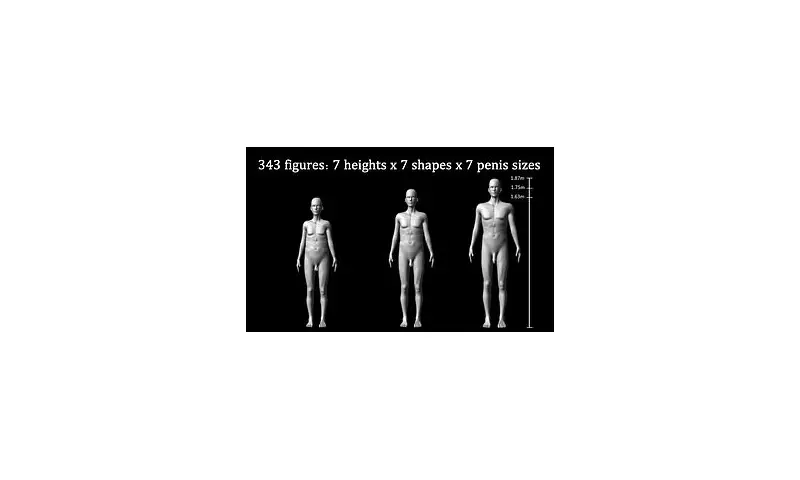
A groundbreaking scientific study has provided empirical evidence supporting a long-standing stereotype, confirming that women genuinely prefer men with larger penises. Researchers from the University of Western Australia conducted an extensive investigation into human sexual preferences and perceptions, shedding new light on evolutionary biology and social dynamics.
Methodology and Participant Demographics
The research team enlisted 800 participants for their comprehensive study, comprising 600 male and 200 female volunteers. These individuals were presented with 343 computer-generated male figures that had been meticulously adjusted across three key physical dimensions: height, body shape, and penis size. The digital models allowed for precise manipulation of these characteristics while maintaining realistic human proportions.
Female Attractiveness Assessments
Female participants were systematically asked to evaluate which computer-generated figures they found most physically attractive. The results revealed a clear and consistent pattern: women rated male figures that were taller, possessed a more pronounced V-shaped torso, and had larger penises as significantly more attractive than other combinations.

Male Perceptions of Rivalry and Threat
Meanwhile, male participants were quizzed on which figures they perceived as most threatening in both sexual competition and physical confrontation scenarios. Interestingly, men identified the same physical characteristics—taller stature, V-shaped physique, and larger penis size—as indicators of greater threat from potential rivals.
Evolutionary Context and Comparative Anatomy
For years, scientists have been puzzled by why human penises are proportionally larger than those of other primates relative to body size. The average erect human penis measures approximately 5.1 inches (13 centimetres), while chimpanzees and bonobos average just 3.1 inches (8 centimetres). Orangutans measure around 3.3 inches (8.5 centimetres), and gorillas possess remarkably small penises at only 1.25 inches (3 centimetres).
The researchers explained in their study, published in the prestigious journal PLOS Biology: "Sexual selection, through female mate choice and male-male competition, is a likely evolutionary driver, but confirming this has been historically difficult due to natural covariation among physical traits."
Interpretation of Findings
"The most important finding of our study is that penis size influences how males assess a rival's fighting ability," the research team elaborated. "Males were most likely to feel threatened if they had to imagine being challenged by a rival with a large penis. We infer that this translates into males being less likely to initiate aggressive interactions with rivals possessing larger penises."
They further clarified: "A larger penis increased male attractiveness to females and was also used as a signal of fighting ability by males. This dual function suggests penis size serves as both a sexual ornament and a status indicator within competitive hierarchies."
Theoretical Explanations for Male Intimidation
The precise reason why men feel more intimidated by males with larger penises remains partially unexplained, but researchers proposed two primary theories. First, a larger penis may indicate higher testosterone levels, which influence penile development during puberty. Higher testosterone in adult males correlates with increased muscle mass, greater aggression, and enhanced competitive ability.
Alternatively, flaccid penis length might serve as an indicator of a male's physiological state. The researchers noted: "Flaccid penis length can shorten in response to stress or anxiety as adrenaline redirects blood flow away from the genitals, a response that may function to reduce injury during 'fight or flight' situations. Therefore, participants may interpret a longer flaccid penis as a signal of rival confidence, lower stress levels, or the relative absence of perceived threat."

Broader Implications and Future Research
This study contributes significantly to our understanding of human sexual selection and social dynamics. The findings suggest that penis size operates as a multi-faceted signal within human interactions, influencing both mate choice and competitive assessments. Future research may explore how these perceptions vary across different cultures and whether they translate into measurable behavioural outcomes in real-world social interactions.
The University of Western Australia team has provided compelling evidence that physical characteristics, including penis size, continue to play important roles in human attraction and competition, potentially reflecting deep-seated evolutionary adaptations that have shaped our species' development over millennia.