Getting into exercise slightly later in life can certainly be a scary and daunting feat, especially if you don't have much experience. You may not know where to start or which workout is right for you, or you may feel like it's too late to become a gym person.
But according to personal trainer Edwina Jenner, who specializes in coaching women over 40, you are never too old to get in shape. She is dedicated to helping her clients 'cut through the fog of conflicting information, as well as overcomplicated programs and exercises that seem designed for someone half their age with twice their free time.'
She broke down the workout moves that are easy to learn at any age, even with no gym experience, exclusively with the Daily Mail.

'You might think that feeling less strong and fit is all part and parcel with getting older and just another depressing side-effect of hitting midlife,' she explained. 'But you couldn't be more wrong. In fact, entering your 40s is the time to build your strength, fitness and condition, targeting your body's biggest muscles in order to not only enjoy life to the full, but to invest in your future.'
The expert explained that many people think that 'cardio is the answer to everything,' but she believes that strength training is much more effective as you age.
'It preserves muscle mass that naturally declines from our mid-30s, supports bone density, improves metabolic health because more lean muscle means your body manages blood sugar and burns energy more efficiently, and builds a body that we can rely on as we age,' she said.
She insisted that the key to staying in shape is 'much simpler than the fitness industry would have you believe,' and comes down to six 'fundamental movement patterns.' She explained that focusing on these simple moves will build strength across 'multiple muscle groups' and suggested doing each one twice a week.
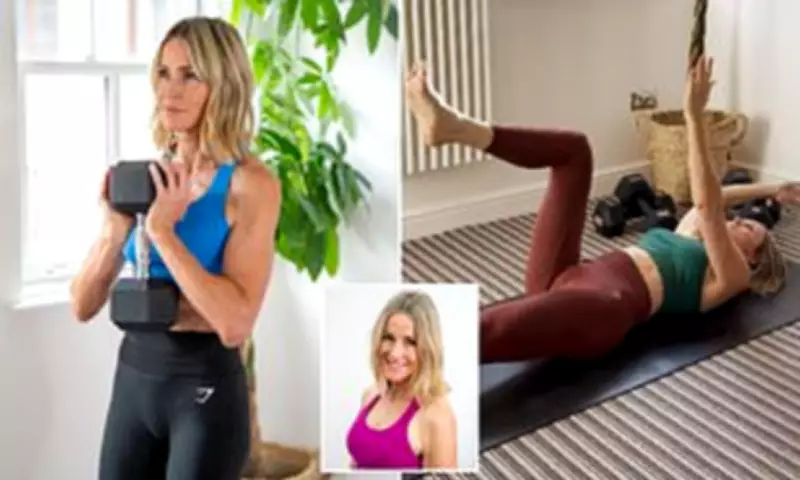
The Goblet Squat
According to Jenner, the squat is 'where every good strength session starts.' 'It's a compound movement, working your legs, glutes and core,' she explained. 'These are the muscles that carry you through life, [helping with] sitting, standing, walking, lifting and climbing stairs. As we age, they're also the muscles we lose fastest if we don't train them, which is why strength here becomes so important now. Strong legs and glutes support your joints, protect your bones and keep you independent.'
There are different squat variations but Jenner's favorite is the goblet squat, where you 'hold a weight at chest height' while squatting. 'That front-loaded position helps you stay upright, engage your core and keep the movement controlled and stable,' she added. 'It's simple, effective and one of the best ways to build strength safely.'
What to do: Stand with your feet slightly wider than hip-width apart, toes turned out slightly. Hold your dumbbell vertically at your chest with both hands. Before you move, brace your core - tighten your midsection as if you're about to take a punch. Push your hips back, bend your knees, keep your chest up and shoulders back and distribute your weight through your whole foot. Lower until your thighs are as close to parallel to the floor as your mobility allows, then drive through your heels to stand. Keep your core braced throughout. If you are not ready for a dumbbell yet, start with bodyweight squats and even use a chair behind you as a target to sit back toward. This will build your confidence and teach you how to do a squat before you start adding weights.
The Romanian Deadlift
Jenner explained that the Romanian deadlift 'targets the back of the body,' particularly the area called the posterior chain, which includes your hamstrings, glutes and lower back. 'Most women significantly undertrain this pattern, which is important because the posterior chain is your powerhouse for posture, injury prevention and everyday strength,' she said.

What to do: Stand with your feet hip-width apart, a dumbbell in each hand, resting in front of your thighs, maintaining a slight fixed bend in your knees throughout. Brace your core and push your hips back (imagine you're pushing your hips back as if you're shutting a car door with your butt) and as you lower the dumbbells down, keep them close to your legs throughout. Another cue here is to imagine you are painting a stripe up and down your legs. Never let the dumbbells leave your legs and keep your shoulders back and your back flat. When you feel a strong pull in your hamstrings, drive your hips forward and return to the standing position. This movement comes from your hips, not your lower back.
The Reverse Lunge
Jenner described the reverse lunge as a 'unilateral movement,' which means it only strengthens one leg at a time. She dished: 'This is important because it exposes and corrects imbalances between sides, something that bilateral movements such as squats, cannot do. A lunge also demands balance and core stability, both of which decline as we age if we don't train them directly.'
How to do it: Stand tall with a dumbbell in each hand, feet hip-width apart, shoulders back and core braced. Step one foot back and lower your back knee toward the floor, keeping your front knee tracking over your toes and your torso upright. Your front shin should stay as vertical as possible. Then push through the front foot to return to standing. Repeat 10 on the same side and then repeat on the other side. If you are new to lunges, leave the weights and use a chair beside you for balance while you build strength and confidence first.
The Bent Over Row
Jenner told the Daily Mail that the bent over row, which strengthens back muscles and core, can help with 'rounded shoulders, neck tension and poor posture.' 'Over 40, when estrogen starts declining, and our desk-heavy, social media-scrolling lifestyles conspire against our posture, this exercise is a non-negotiable,' she said.
How to do it: Stand with feet hip-width apart, a dumbbell in each hand and hinge forward from your hips to about 45 degrees, keeping your back flat and your core engaged. Let the dumbbells hang beneath you, palms facing each other. Now drive the elbows back and up, squeezing your shoulder blades together firmly at the top. Lower the dumbbells back down again with control. Repeat for the full set. Ensure your shoulders stay back and your core is tight.
The Chest Press
Jenner said that chest presses are vital because they help build 'shoulder stability, upper body strength and better posture,' explaining that they strengthen the chest, front shoulders and back of your arms.
How to do it: Lie on your back with a dumbbell in each hand, knees bent and feet flat on the floor. Press the dumbbells up to create an 'A' frame above your face, wrists stacked over the elbows. Maintain a natural arch in your lower back, keeping your glutes and upper back pressed into the floor. Lower the dumbbells until your elbows gently touch the floor, then press back up again with control.
The Deadbug
The deadbug is a move that targets your core muscles, obliques and pelvic floor, according to Jenner. She explained that while all of these movements help build core strength, this one in particular 'adds something the other techniques don't fully target: deeper stabilizing muscles.' 'The deadbug is one of the safest core exercises available, and it's endlessly progressive, meaning you can make it harder simply by adding dumbbells or slowing the tempo down,' she added.
How to do it: Lie on your back, arms pointing to the ceiling, knees bent at 90 degrees above your hips. Gently brace your core and press your lower back firmly into the floor. Then, lower your right arm behind your head while extending your left leg toward the floor simultaneously. Return and repeat on the opposite side.