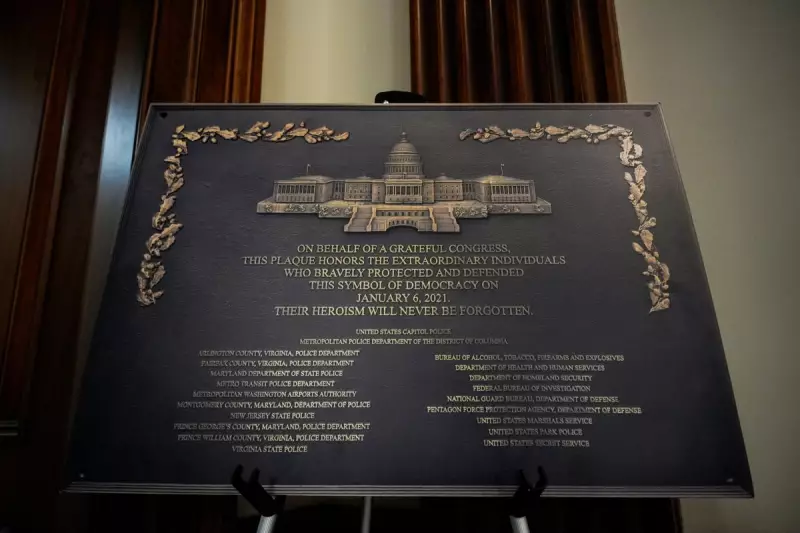
As the United States approaches the fifth anniversary of the January 6, 2021, assault on the Capitol, the congressionally mandated plaque created to honour the law enforcement officers who defended the building is conspicuously absent from public view.
A Mandated Memorial, Nowhere to Be Seen
Despite a law requiring its display, the official bronze plaque has not been formally unveiled at the Capitol. Its current location is not publicly known, though it is believed to be in storage. House Speaker Mike Johnson, a Republican from Louisiana, has yet to preside over its installation. The Architect of the Capitol, the office responsible for obtaining and displaying the plaque, has declined to comment, citing ongoing federal litigation.
In response, roughly 100 members of Congress, predominantly Democrats, have taken matters into their own hands. For months, they have displayed poster-board replicas of the plaque outside their office doors, creating a sprawling, makeshift memorial throughout the Capitol complex. The replicas read: “On behalf of a grateful Congress, this plaque honours the extraordinary individuals who bravely protected and defended this symbol of democracy on Jan. 6, 2021. Their heroism will never be forgotten.”

A Battle Over History and Memory
The intended purpose of the plaque was to serve as a permanent, sober marker near the Capitol's west front, where some of the most violent clashes occurred. Its absence, historians and lawmakers argue, creates a vacuum in the nation's physical memory. Visitors can now tour the Capitol without a formal reminder of the day a mob of Donald Trump's supporters stormed the building in an attempt to overturn the 2020 presidential election result.
This void allows narratives to shift. While the attack was initially condemned by senior Republicans as an “insurrection” and a tragic day, such language has receded. Former President Trump now refers to it as a “day of love,” and Speaker Johnson, who voted to challenge the 2020 election results, holds a powerful role in determining the Capitol's commemorative landscape.
Douglas Brinkley, a noted history professor at Rice University, framed the central question: “Will January 6 be seen as the seminal moment when democracy was in peril? Or will it be remembered as kind of a weird one-off? There’s not as much consensus on that as one would have thought on the fifth anniversary.”
Lawsuits and a Legacy of Violence
The human cost of the day remains stark. At least five people died during or shortly after the riot, including Trump supporter Ashli Babbitt, who was shot by police. More than 140 law enforcement officers were injured, some severely, and several later died by suicide. In one of the largest federal prosecutions in American history, approximately 1,500 people were charged. Upon returning to power in January 2025, Trump pardoned all of them within hours of his inauguration.
The legal battle over the plaque continues. Two police officers who defended the Capitol, Harry Dunn and Daniel Hodges, have sued over the delay in its installation. Their lawsuit argues that Congress, by refusing to follow its own law, “encourages this rewriting of history.” The Justice Department under the Trump administration is seeking to dismiss the case, arguing that congressional approval of the plaque constitutes sufficient recognition and that displaying it would not stop alleged threats against the officers.
Democratic lawmakers leading the replica effort are adamant. “We should stop this silliness of trying to whitewash history—it’s not going to happen,” said Representative Joe Morelle of New York. “I was here that day so I’ll never forget. I think that Americans will not forget what happened.” He noted that the proliferation of replica plaques is a testament to that determination, stating, “Instead of one plaque, we’ve now got 100.”

As the anniversary arrives, the commemorative divide is institutionalised. Democrats plan a hearing with members of the former January 6 committee, while Republicans under Speaker Johnson have launched their own special committee, led by Representative Barry Loudermilk of Georgia, to investigate what Johnson terms the “full truth” of the day. The missing plaque, intended to unify and honour, instead symbolises a nation still fiercely contesting the memory of one of its most turbulent modern events.