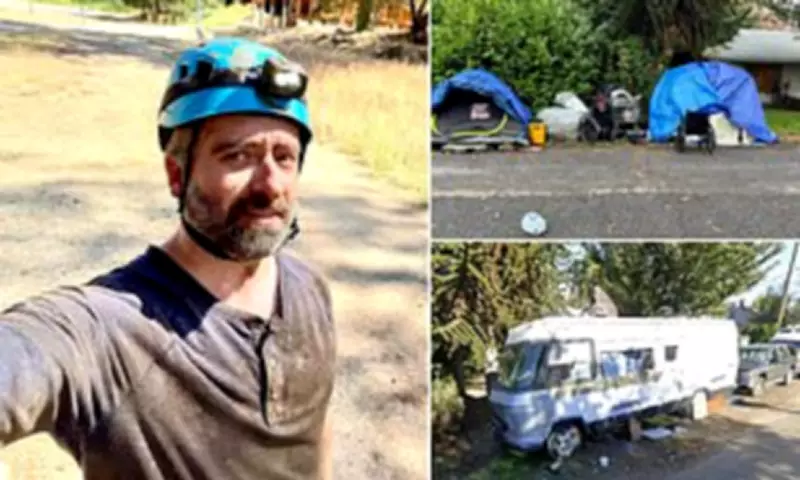
A single father from Oregon has said he begged city officials to deal with a growing homeless encampment outside his home for months - only to be fined for his garden hedge instead.
Rather than addressing Chris Bolton's concerns, City of Portland councilors abruptly turned their attention on him by criticizing his overgrown laurels. Bolton, who lives on the corner of Southeast Clinton Street and 89th Avenue, repeatedly contacted the city about tents, trailers and RVs parking beside his yard.
The dense greenery which frames his garden appeared to serve as a barrier between his home and a stretch of neighborhood plagued by persistent disorder. But in early December, a worker from the Portland Bureau of Transportation arrived at his property, not to address the encampment he had flagged again and again, but to warn him that his hedge had encroached too far into the public right-of-way. The worker said the growth could interfere with the installation of a stop sign at the intersection.

Bolton says what followed was swift and relentless, with enforcement aimed not at the encampment, but at him. Within days, notices began arriving. Code enforcement officers cited him for violating property maintenance rules and warned of financial penalties. A formal notice outlined the possibility of a $693 fine and even a lien against his home if the hedge was not brought into compliance quickly.
The escalation stunned Bolton, a self-employed single parent who said he had already spent months trying to get the city to address conditions outside his home. Residents in the Powellhurst-Gilbert neighborhood said his experience reflects a broader pattern - one in which long-standing complaints about crime and disorder go largely unresolved, while minor code violations are enforced with urgency.
Over the years, neighbors say the area has struggled with a range of issues, including illegal dumping, drug activity, reckless driving and a steady rotation of abandoned or occupied vehicles. The encampments are just one part of a wider breakdown that worsened during the pandemic.
City officials have acknowledged the corridor, just south of Division Street between Southeast 82nd and 92nd avenues, as a recurring trouble spot for lived-in and abandoned vehicles. Records show that at least 22 RVs and other vehicles were tagged for removal near Bolton's home between October 1 and March 31. Seven of those were ultimately towed. The remaining vehicles, officials said, had moved before crews returned - a pattern neighbors say is all too familiar, with encampments simply shifting block by block.
Bolton's attempts to get help were extensive. Public records, including emails and call logs, show he contacted more than a dozen city employees, departments and programs. At one point, six weeks passed before a constituent liaison from the City Council's District 1 office responded to his request for assistance. By his own estimate, Bolton spent more than 40 hours trying to resolve the situation, along with thousands of dollars and significant personal stress.
"A question I often asked myself was, 'How in the world could anybody else deal with this?'" Bolton told The Oregonian. "I never figured out what to do or who to call. It just seemed like I kept getting lost in people's inboxes - or they were simply passing the buck."
City of Portland spokesperson Cody Bowman acknowledged shortcomings in how Bolton's case was handled, describing it as "an example of where we can improve customer service." "We never want Portlanders to feel like they're navigating the city alone," Bowman said. Still, for residents, the response has done little to ease frustration.
Data from Portland's Bureau of Emergency Communications shows 432 reported incidents within a three-block radius of Bolton's home over the past year. Those reports include theft, assault, robbery, prostitution, vandalism, suspicious activity and even shootings. Thirty-two incidents occurred within roughly 165 feet of his property.
Neighbors said those numbers only tell part of the story, pointing to constant calls to 311, emails to city agencies and online reports that often go unanswered. "It's extremely frustrating," resident Kristopher Mahdak told OregonLive. "You've got to have a Buddhist mentality when trying to get the city to respond to just about anything around here."

Another resident, Stefanie Kraus, described taking extraordinary precautions when walking her child through the neighborhood. "I used to carry a baseball bat and bear mace in my baby's stroller," she said.
Bolton's own paper trail shows a steady escalation of concern. In an October 5 email to the city's Public Environment Management Office, he described campers cutting into his hedge and digging into the ground - something he feared was being used for waste disposal. "I have a tenant. I have a grade schooler. I don't want sewage seeping into my yard. Can you help?" he wrote.
Weeks passed without a response, he said, despite repeated calls to 311. On November 3, he sent another message, describing late-night arguments, generator noise and fumes drifting into his home. Still without a reply five days later, he wrote again expressing doubt that anything would be done. "I know this is a fruitless exercise because you won't do anything about it," he wrote.
He finally received a response on November 10, when a city coordinator apologized and said the site would be cleared within a week. Some tents did leave, but debris, trailers and trash remained when transportation officials arrived in early December - shifting the focus to Bolton's hedge.
Unable to fully access parts of it due to the encampment, Bolton says he was nevertheless expected to bring it into compliance immediately. "I can't even get to parts of my hedge because of the trailers," he wrote in a December email to city council offices. "The irony of being threatened with a (lien) on my house if I don't cut down my hedge feels like something out of a Kafka novel."
In the end, Bolton said he and a group of friends and neighbors took matters into their own hands, cutting back the hedge extensively to satisfy the city’s demands. But the experience, he says, has left a lasting impression - not just of a single dispute, but of a system that he and others believe struggles to respond consistently to the people it serves.