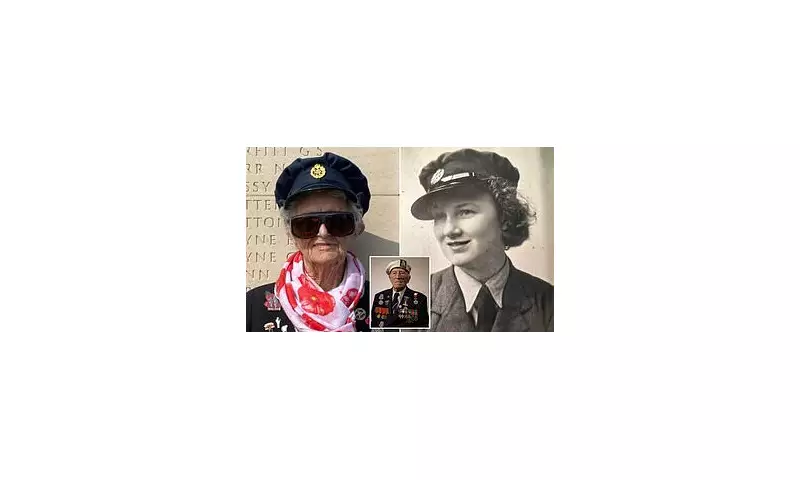
A 102-year-old World War Two veteran has delivered a powerful verdict on global conflict, describing war as "a total waste of flipping time" as she reflects on ongoing battles in Ukraine and Gaza.
A Lifetime of Witnessing Conflict
Robbie Hall, known as Queenie, served in Bomber Command during the Second World War and experienced personal tragedy when her fiancé Frank Vincent died aged just 21. His Royal Lancaster bomber went down in Germany in 1944, just two months before their planned wedding.
Speaking to the Daily Mail during Remembrance commemorations marking 85 years since the end of the First World War, Mrs Hall expressed despair that political leaders haven't learned from past conflicts. "We've got two big conflicts going on - it's getting to be a very dangerous world," she said.

The centenarian, who will turn 103 in a few months, has lived through five monarchies and multiple global conflicts. "I just don't understand why someone always wants what someone else has got," she reflected. "These are young men giving their lives - it's such a waste."
Personal Loss and Recent Discoveries
Mrs Hall's connection to wartime sacrifice runs deep through her family. Her father served at the Somme during the First World War and was "lucky to survive," while her sister's husband was captured by the Japanese and "came back a broken man."
In a deeply moving recent experience, Queenie visited her fiancé Frank's grave for the first time in September, courtesy of the Taxi Charity for Military Veterans. Driver Dean Euesden offered to take her to Rheinberg War Cemetery in north-western Germany during a trip to the Netherlands.
She was profoundly moved to discover her nickname "Queenie" inscribed on Frank's tombstone, which reads: 'To our darling Frank. Treasured memories. Mum, Dad, Sister, and Queenie.' She described the moment as "like receiving a gift I have waited 81 years to receive."
"I have to say, I broke down when I saw my name - I didn't realise it was there," she shared. "All these young men were buried there - they were in their prime. It was a wonderful experience, to be there, but also traumatic for me."
Meeting Modern Leaders and Shared Concerns
Mrs Hall was recently welcomed at 10 Downing Street by Prime Minister Sir Keir Starmer at an event on November 3, describing him as "nice" despite her reservations about current politics. They spent 10-15 minutes chatting, with Sir Keir showing her chairs used by Winston Churchill and King George VI.
Her sentiments echo those of other veterans, including 100-year-old D-Day hero Alec Penstone, who recently stated that Britain has gone "to wrack and ruin" and that wartime sacrifices "weren't worth" what the country has become.
Another veteran, 100-year-old Paul Terry from Pevensey Bay, East Sussex, expressed similar concerns about ongoing conflicts. "I don't like to generalise but it seems rather frightening especially for youngsters these days - but I wouldn't want them to go through the wars we did," he said.
Mr Terry, who still drives his BMW Series 3 convertible despite recent hospital treatment, was particularly critical of Vladimir Putin: "You've got these idiots that think they're going to take over the world - Putin. He's going to die some time, isn't he? The sooner, the better."
A Nation Divided According to Polling
These veterans' concerns reflect broader public sentiment revealed in recent research. A King's College London and Ipsos Mori poll this month found that eight in 10 Britons feel the nation is divided - up five percentage points from two years ago and 10% since 2020.
The study also showed that half of the public feel Britain's culture is changing too fast, up from a third. Notably, nostalgia for Britain's past rose in every age group, with almost a third of 16 to 24-year-olds wanting Britain to return to how it "used to be," up from 16% in 2020.
Mrs Hall, who still lives in Stowmarket, Suffolk, near where she was born and brought up, concluded with a plea for change: "If only leaders would think about what people went through in the two world wars - we need a real change of mindset."

Her powerful reflection serves as a sobering reminder of the human cost of conflict across generations, as the world continues to grapple with violence and division eight decades after the end of the Second World War.