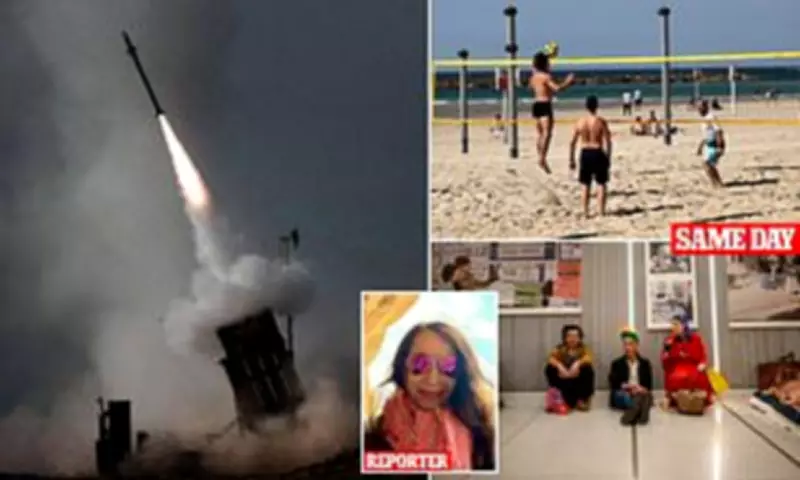
It resembles a scene from a science fiction epic, with defensive missiles streaking across the sky to obliterate incoming threats directly overhead. Having visited Israel previously, it was not until covering its ongoing war with Hamas that I truly grasped the profound significance of the Iron Dome missile defense system for the nation.
A Routine Commute Interrupted by Sirens
Within days of commencing my role as a news correspondent in January 2024, I found myself at a bustling bus stop in southeastern Tel Aviv during the evening rush hour. The scene was a microcosm of Israeli society: students laden with backpacks, elderly women carrying shopping bags, and soldiers with rifles slung over their shoulders, all awaiting the same bus.
As I observed this uniquely Israeli tableau, a piercing, oscillating siren suddenly erupted around us. It took several seconds to register that this was a 'Red Alert'—Israel's urgent missile warning signal. Instantly, the calm dissolved into controlled chaos.

Scrambling for Safety and a View
Everyone began to run. Some individuals sought refuge beneath nearby trees, while others pressed themselves against a concrete wall for protection. Remarkably, a group including young children and uniformed soldiers sprinted up a small hill behind us, evidently seeking an unobstructed view of the sky.
I followed them, instinctively reaching for my notebook and pen, naively hoping to secure a quick interview before the impending event. However, there was absolutely no time for journalism in that moment.
The Interception: A Spectacle of Defense
Approximately forty-five seconds after the sirens commenced, we could audibly detect Hamas rockets, fired from Gaza, zooming northward through the late-afternoon sky. Almost instantaneously, white smoke trails from a volley of interceptor missiles became visible, zigzagging toward the threats.
Loud booms and bright flashes illuminated the sky above as the Iron Dome system successfully destroyed the incoming rockets. The experience was simultaneously terrifying and awe-inspiring—akin to powerful fireworks, yet far more consequential and, paradoxically, comforting.
Returning to Normalcy
The crowd around me collectively exhaled sighs of relief, their expressions clearly conveying a shared sentiment: 'Phew, I'm okay, you're okay.' Shortly thereafter, our bus arrived. Everyone boarded calmly and continued with their evening as if the dramatic interception had been a minor interruption.
Subsequent reports confirmed that Israel's Iron Dome had intercepted those rockets with no casualties. Only one vehicle south of Tel Aviv sustained damage from falling debris.
A Stark Contrast in Perception
While this event was deeply memorable for me as an American unaccustomed to missile attacks, for Israelis, it represented merely a brief episode. It was one of thousands of strikes aimed at their nation over decades of conflict and one of countless retaliatory measures launched toward Palestinian territories and neighboring states since Israel's establishment in 1948.
Most Americans would likely panic at the sight and sound of missiles overhead. In contrast, Israelis have developed a degree of equanimity regarding these risks, largely due to their advanced, mobile air defense systems designed to neutralize threats before impact.
Substantial U.S. Funding and Strategic Development
The United States has been a critical financial backer of the Iron Dome. From 2011 to 2022, Washington provided approximately $2.6 billion in funding. Recent aid packages since 2024 have included multi-billion-dollar allocations specifically for Iron Dome and related defensive systems. Total U.S. support for Israeli missile defense is estimated to be between $5 billion and $7 billion.
The Iron Dome's development was catalyzed by specific historical threats:
- The Gulf War (1991): Israel was struck by 39 Scud missiles fired by Saddam Hussein.
- The 2006 Lebanon War: Hezbollah launched approximately 4,000 rockets into Israel.
How the Iron Dome Operates
Operational since 2011, the system detects incoming short-range rockets, artillery shells, mortars, and drones, calculating their trajectories with precision.

Interception Logic: If a projectile is headed toward open, unpopulated land—a relative scarcity in a country roughly the size of New Jersey—the Israeli Defense Forces (IDF) often choose not to intercept it. However, if the threat is directed toward a populated area or critical infrastructure such as military bases, airports, power plants, or highways, Iron Dome engages, destroying the target mid-air, typically at altitudes of a few kilometers.
Sirens generally provide the public with 30 to 90 seconds of warning, enabling people to swiftly move to reinforced shelters, stairwells, or designated safe rooms—assuming they are not caught in transit, like waiting at a bus stop.
Evolving Threats and Timelines
Israel currently faces missiles from multiple fronts, including Iran and Hezbollah in Lebanon. The proximity of Lebanon means warning times are drastically shorter. When Iran launches attacks, civilians may have around ten to twelve minutes to seek shelter. When attacks originate from Lebanon, the warning time shrinks to about ninety seconds at most.
Proven Effectiveness and Daily Impact
Iron Dome has intercepted thousands of rockets, boasting a reported success rate between 85 and 95 percent. It is widely regarded as one of the most effective missile defense systems globally.
Its impact extends beyond mere interception statistics. The system is credited with:
- Significantly reducing civilian casualties in recent conflicts with Hamas in Gaza and Hezbollah in Lebanon.
- Enabling schools and businesses across Israel to remain operational during periods of conflict.
- Fostering a sense of relative safety among Israelis living in a small nation persistently engaged in warfare with its neighbors.
'It allows life to go on here, even in the face of danger,' remarked Yaakov Katz, an American-born Israeli journalist and defense analyst, in an interview with the Daily Mail from his Jerusalem home. 'It means that when there's not a siren, we can go out, go to the grocery store, to the park. It gives a sense of security and confidence that allows us to exhibit some kind of resilience at a time like this.'
A Layered Defense Strategy
Iron Dome is not Israel's sole missile defense component. The IDF employs a layered defense strategy incorporating systems designed for varying threat ranges:
- David's Sling: Active since 2017, this system protects against medium-range missiles with an estimated 80 to 90 percent success rate.
- Arrow 3 System: This system intercepts long-range missiles, including those from outside Earth's atmosphere, with a similarly high success rate.
This concept has inspired similar ambitions elsewhere. Former U.S. President Donald Trump has advocated for a multi-layered missile defense system for the United States, referred to as the 'Golden Dome.' In 2025, he issued an executive order directing its development, tasking the U.S. Space Force with leading the approximately $25 billion planning and development phase.
Israeli Resilience and Reflection
For long-time residents like Katz, who moved to Israel in the 1990s, these missile defense systems have 'completely changed reality.' He describes it as 'a uniquely Israeli thing to see a threat, understand it and adapt to it by applying a solution to eliminate it.'
However, he also notes that years of successful interceptions fostered 'a false sense of complacency,' most notably preceding Hamas's devastating ground attack on October 7, 2023. 'It was a reminder, for sure, that we can get surprised in a very different way,' he reflected.
Katz draws a stark contrast between Israel and its adversaries: 'We defend our citizens and, tragically, our enemies invest tremendous resources in putting their citizens at risk. I think that's a stark contrast between them and us.'
Empathy Amid Conflict
Other Israelis expressed empathy for civilians in hostile nations lacking similar protections. Dalit, an archaeologist in Jerusalem who requested her surname be withheld, stated, 'I really feel for them, living under a regime that puts them at risk, leaves them starving and unsafe. But I'm absolutely certain that they don't blame Israel for not having shelters, bread, water or systems to protect them. I think they know who is to blame.'
For individuals like Jerusalem-based photographer Alon Spiegel, these defense systems are not abstract concepts but vital enablers of daily life and work. He credits Iron Dome and Israel's broader air defense network for allowing him to remain on his rooftop since recent hostilities began, documenting incoming missiles as they arc across the sky. 'There's no way I'd be up there without them,' he asserted. 'My God, that would be suicide.'
The Iron Dome, therefore, represents far more than a technological marvel. It is a foundational element of Israeli civilian life, a psychological bulwark, and a critical component of national resilience, allowing a semblance of normalcy to persist even as missiles continue to fly.