

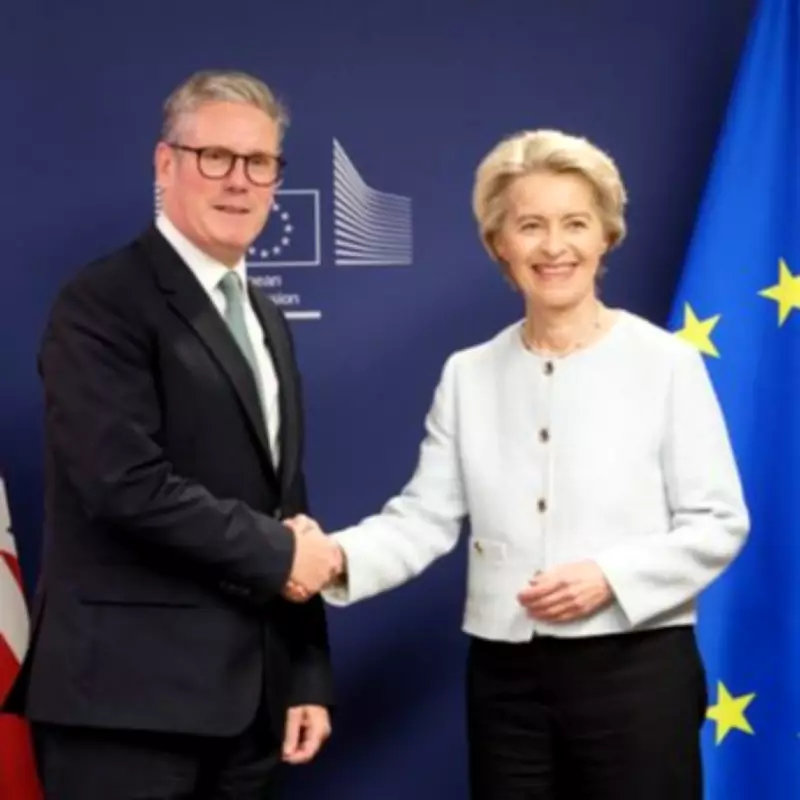
Prime Minister Keir Starmer has indicated that the United Kingdom could seek to restart negotiations on defence cooperation with the European Union, as global security threats intensify and relations with Donald Trump's administration remain strained.
A Renewed Push for European Defence Integration
Speaking during a diplomatic trip to China and Japan, Mr Starmer emphasised the urgent need for enhanced security collaboration across Europe, explicitly including the UK. This move signals a potential shift in Britain's post-Brexit foreign policy, focusing on pragmatic alliances in the face of mounting challenges.
Addressing the Russian Menace and Transatlantic Strains
The Prime Minister's comments come against a backdrop of escalating aggression from Russia and increasingly complicated relations with the United States under President Donald Trump. Mr Starmer argued that these factors necessitate a stronger, more unified European defence posture, transcending traditional political divisions.

"Europe, including the UK, needs to do more on security and defence," Mr Starmer told reporters. "That's an argument I've been making for many months now with European leaders. We've got to step up and do more. It's not only President Trump who thinks Europe needs to do more but other presidents as well. I think the same."
Revisiting the Safe Programme and Broader Cooperation
Central to this potential reset is the Security Action for Europe (Safe) programme, a substantial £130 billion EU fund designed to bolster continental defences. Previous UK efforts to join this initiative collapsed last year amid disputes over entry costs, but Mr Starmer has now explicitly called for a re-examination of such schemes.
He stated: "I've made the argument and that should require us to look at schemes like Safe and others to see whether there is a way in which we can work more closely together. Whether it's Safe or other initiatives, it makes good sense for Europe in the widest sense of the word - which is the EU plus other European countries - to work more closely together. That's what I've been advocating and I hope to make some progress on that."
Moving Beyond Brexit Divisions
This defence overture forms part of a broader strategy by the Starmer government to cultivate closer ties with the European Union, six years after the UK's formal departure. Downing Street aims to move past the acrimony of the Brexit era, seeking a new, cooperative relationship that addresses shared economic and security concerns.
Countering Political Criticism
When challenged by critics, such as Nigel Farage, who have labelled this approach a betrayal of Brexit voters, the Prime Minister offered a robust rebuttal. He highlighted a series of unfulfilled promises from the Leave campaign, including:
- The pledged £350 million weekly boost for the NHS that never materialised.
- Assurances of reduced red tape for trade with Europe, which businesses have found to be the opposite.
- Predictions that regular migration would decrease, when in fact it quadrupled under the subsequent government.
"So I wouldn’t listen too much to what Nigel Farage has to say about this," Mr Starmer concluded. "It is absolutely clear the botched deal we got from the last government has caused damage to our economy which is why we have reset that relationship and do want to get closer on defence and security, on energy, on emissions and trade."
A Multifaceted Strategic Realignment
The proposed defence reset is not an isolated policy but part of a concerted effort to deepen UK-EU collaboration across several critical domains. The government has already secured agreements, such as the SBS pact on food and agriculture, which is anticipated to lower supermarket prices for consumers.
Mr Starmer affirmed that increased defence spending commitments are a baseline, but greater ambition is required in terms of capability development and international cooperation. The evolving global landscape, marked by Russian belligerence and an unpredictable American ally, appears to be compelling a strategic rethink in Westminster, favouring renewed European partnership as a cornerstone of UK security.






