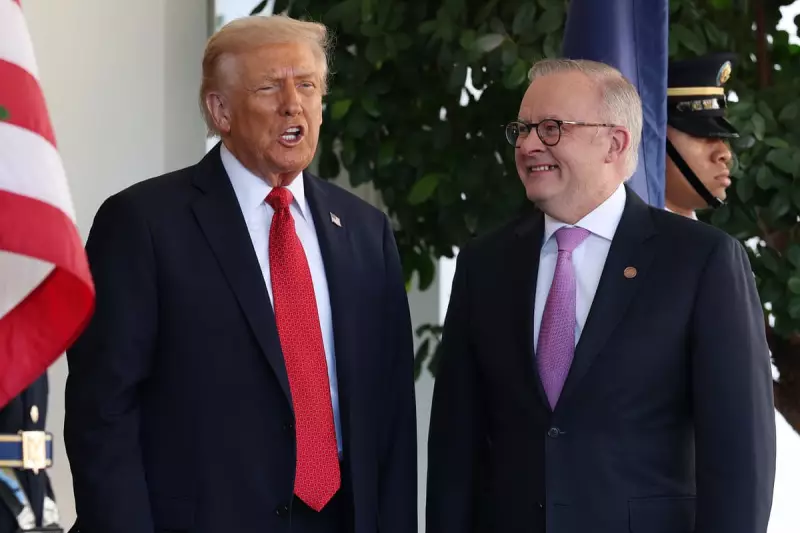
Prime Minister Anthony Albanese faces a delicate diplomatic balancing act as he navigates Australia's relationship with an increasingly unpredictable United States under President Donald Trump. While maintaining a steady course with Washington remains crucial, experts argue that acknowledging the fundamental shifts in global power dynamics represents an essential first step toward crafting a resilient foreign policy strategy.
The Changing Global Landscape
Recent developments have highlighted how dramatically the international rules-based order has transformed. Canadian Prime Minister Mark Carney delivered a stark assessment at the World Economic Forum, declaring that Trump's presidency represents a "rupture, not a transition" in global affairs. Carney's speech, which circulated widely through Canberra's Parliament House, served as a wake-up call about the erosion of established international norms.
The Canadian leader invoked Czech dissident-turned-president Václav Havel's parable of the greengrocer who displayed communist slogans not out of belief but compliance. Carney suggested that countries clinging to outdated diplomatic frameworks risk becoming complicit in maintaining illusions about global stability. His call for "middle powers" to "take their signs down" resonated particularly in Australia, where Albanese frequently describes the nation using that same terminology.

Australia's Regional Response
In response to these shifting dynamics, the Albanese government has intensified diplomatic efforts across the Pacific and Southeast Asia. Foreign Minister Penny Wong and other senior officials have worked diligently to strengthen regional partnerships and cooperation mechanisms. This represents a strategic pivot toward building alternative power structures even as Australian leaders continue to reference the security framework of the traditional rules-based order.
Albanese has simultaneously cultivated relationships with other leaders navigating Trump's unpredictable foreign policy, including Britain's Keir Starmer and France's Emmanuel Macron. At a progressive political summit in London last year, these leaders presented themselves as an alternative power base capable of defending democratic institutions against populist challenges.
The Greenland Controversy and Diplomatic Caution
Trump's recent threats regarding Greenland—including suggestions he might seize the Danish territory by force—tested Australia's diplomatic approach. When questioned about these provocative statements, Albanese and cabinet colleagues offered carefully measured responses, emphasizing that Greenland's future should be determined by its people and the Danish government.
This restrained approach contrasts with more direct responses from other allied leaders. Starmer openly criticized Trump's tariff threats against Britain and the European Union, while European Commission President Ursula von der Leyen promised unified pushback against American aggression. Australia's more cautious positioning reflects a calculated strategy to avoid provoking Trump's notoriously volatile reactions while still subtly signaling disagreement.
The AUKUS Dilemma
Perhaps the most significant challenge involves the AUKUS security pact and Australia's planned acquisition of nuclear-powered submarines. The government recently transferred another $1.5 billion to the United States to maintain progress on submarine delivery, bringing total expenditures to over $4.5 billion despite the vessels not arriving until the 2030s.
Former Australian ambassador to Washington John McCarthy has called for an "unsentimental assessment" of AUKUS, suggesting Australia must move beyond the "sanctification" of the US alliance. With Trump having endorsed the agreement following a secret Pentagon review—which the Australian government refuses to make public—questions persist about whether the substantial investment aligns with Australia's long-term strategic interests in an increasingly uncertain world.

Strategic Autonomy and Future Directions
The fundamental question facing Australian policymakers involves determining how much strategic autonomy the nation should develop as America's foreign policy becomes less predictable. While maintaining strong ties with Washington remains important, experts argue that Australia must cultivate greater independence in defense and foreign policy planning.
Albanese's approach of maintaining diplomatic stability while quietly strengthening regional partnerships represents one pathway forward. However, as global power dynamics continue to shift, Australia may need to more openly acknowledge that the international landscape has fundamentally changed and adjust its strategic posture accordingly.
Navigating relations with Trump's America requires both pragmatic engagement and clear-eyed assessment of Australia's national interests. As middle powers worldwide reassess their positions in this new era, Australia faces crucial decisions about how to balance alliance commitments with the need for greater strategic independence in an increasingly unpredictable world.