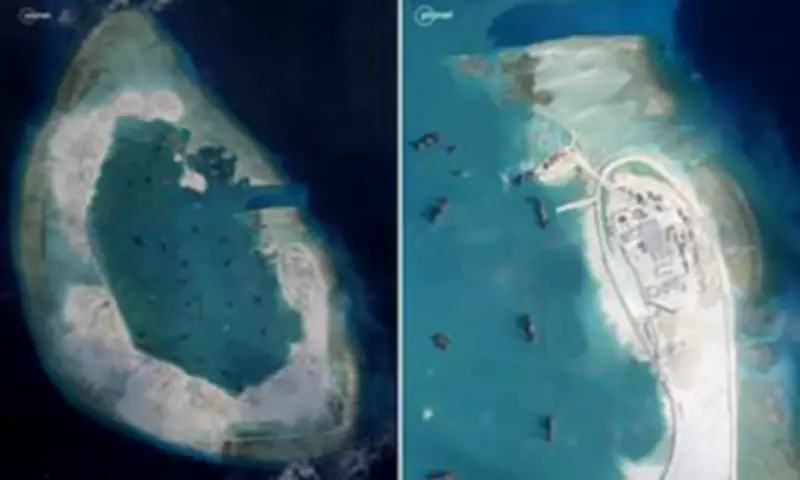
China Intensifies 'Great Wall of Sand' Construction in South China Sea
China appears to have significantly escalated its controversial land reclamation activities in the disputed South China Sea, with new satellite images revealing a substantial fleet of dredgers actively transforming remote reefs into fortified military installations. This development directly contradicts Beijing's 2015 public pledge to cease such expansionist projects in the strategically vital and hotly contested maritime region.
Massive Industrial Campaign Unfolds at Antelope Reef
Recent high-resolution imagery documents more than twenty advanced dredging vessels operating around Antelope Reef, a feature within the Paracel Islands chain. These vessels are systematically excavating sand and sediment from the seabed to create new artificial land, forming the foundational base for future construction. The operation, which began modestly with just two dredgers in December, has now expanded into what analysts describe as a 'massive industrial campaign' involving a fleet of 22 sophisticated 'dark dredgers'.
Antelope Reef is a strategically significant location, also claimed by Vietnam and Taiwan, acting as a crucial stepping stone between China's Hainan Island and the already-militarised Woody Island in the Paracels. The new construction efforts suggest Beijing is further consolidating its military footprint across the sea.
History of Militarisation and Broken Promises
Since 2014, China has pursued an aggressive strategy of transforming obscure reefs and atolls in the South China Sea into potent military forward operating bases. This programme, often termed the 'Great Wall of Sand', has seen the construction of extended runways capable of handling fighter jets and surveillance aircraft on multiple features, including Fiery Cross Reef, Mischief Reef, Subi Reef in the Spratly Islands, and Woody Island.
These outposts are not merely symbolic. They are equipped with hardened aircraft hangars, advanced radar installations, and have previously hosted anti-ship and surface-to-air missile systems. This infrastructure enables China to project military power across vast stretches of the sea, a direct challenge to neighbouring nations and international maritime norms.
In 2015, following international pressure, Chinese officials stated they would halt the militarisation of these outposts. The current satellite evidence indicates that promise has been abandoned, with reclamation and construction activities resuming at an accelerated pace.
Regional Tensions and Legal Disputes
Beijing asserts sovereignty over nearly the entire 1.2 million square miles of the South China Sea through its controversial 'nine-dash line' claim, a boundary repeatedly rejected under international law. A landmark 2016 ruling by a tribunal in The Hague under the United Nations Convention on the Law of the Sea (UNCLOS) invalidated China's sweeping claims, a decision Beijing has ignored.
The sea is bordered by multiple Southeast Asian nations—including the Philippines, Vietnam, Malaysia, and Brunei—each with competing territorial claims based on proximity and their own Exclusive Economic Zones (EEZs). The Philippines, in particular, has seen escalating tensions with China over features like the Spratly Islands and Scarborough Shoal, which lie within its EEZ.
In response to China's actions, Western powers, including the United Kingdom and the United States, regularly conduct Freedom of Navigation Operations (FONOPs), sailing naval vessels through the area to explicitly challenge Beijing's excessive maritime claims. These operations are routinely condemned by China as provocative.
A Regional Arms Race on Artificial Islands
China is not alone in fortifying its holdings. Other claimants are engaged in their own, albeit smaller-scale, construction projects. Taiwan maintains a base on Taiping Island, the Philippines on Thitu Island, and Malaysia on Swallow Reef. Vietnam has been particularly active, rapidly building new land and military facilities, including a 1,300-meter runway on Spratly Island, and has expanded all 21 of its occupied features in the Spratlys.
The recent advertisement for 'community workers' to be stationed on eight Chinese-controlled reefs and islands, including Woody Island, underscores the intent to permanently staff and develop these remote outposts. The job listings call for university-educated individuals aged 18-35 who are 'dedicated to island and community service', signalling a long-term civilian and strategic commitment to these disputed territories.
This ongoing activity solidifies the South China Sea as one of the world's most volatile flashpoints, where territorial disputes, military posturing, and large-scale engineering are reshaping the geopolitical and physical landscape.