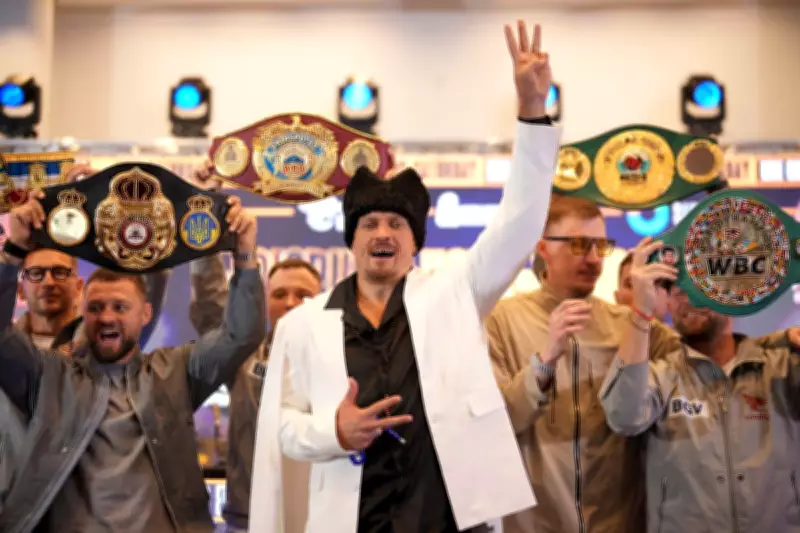
Ukrainian heavyweight world boxing champion Oleksandr Usyk has launched a scathing attack on the gradual return of Russian athletes to global sport, branding the development as "complete absurdity." The undefeated champion, who remains a defiant symbol of Ukraine's resilience during the ongoing conflict with Russia, expressed his unwavering opposition in an interview with the Associated Press.
Usyk's Unchanged Stance on Russian Participation
"My opinion has not changed – this should not be happening," Usyk stated emphatically. He argued that individuals who support acts of violence, including the bombing of civilian infrastructure such as hospitals and schools, should be barred from participating in prestigious events like the Olympic Games. Usyk's comments come as the sporting world appears to be softening its hardline stance adopted after Russia's invasion of Ukraine in 2022.
Shifts in International Sporting Policy
Recent developments indicate a notable shift. Russian athletes are now competing under their own flag at the Paralympics, marking the first time in over a decade that the Russian national anthem has been played at gold medal ceremonies. Furthermore, influential figures like FIFA President Gianni Infantino and International Olympic Committee President Kirsty Coventry have advocated for the reintegration of Russian athletes.

Infantino suggested that FIFA should "definitely" consider lifting its ban on Russian soccer teams, claiming the prohibition "has not achieved anything." Similarly, Coventry emphasized that athletes should not be hindered by "the politics or divisions of their governments," a statement widely seen as paving the way for Russia's potential participation in the 2028 Los Angeles Summer Games.
Usyk's Moral Argument Against Russia's Readmission
Usyk countered these perspectives with a powerful moral argument. He highlighted the inherent contradiction in allowing individuals who are involved in military actions to simultaneously compete as athletes. "If somebody is even following the orders of his commander-in-chief to go and fight, then they cannot also go to sports competitions and represent their country there," he explained. "Because in the evening they are killing, and in the morning they compete as athletes. That simply doesn't add up."
He reiterated that the Olympic Games were originally conceived as "games of peace," making the inclusion of participants from a nation engaged in conflict particularly incongruous. Usyk's stance underscores the deep personal and national significance he attaches to the issue, often wrapping himself in the Ukrainian flag after victories as a gesture of solidarity with his compatriots.
Usyk's Upcoming Fight and Future Ambitions
Amid these controversies, Usyk is preparing for his return to the ring against kickboxer Rico Verhoeven in Egypt on 23 May. Looking further ahead, he remains focused on securing a trilogy fight with British boxer Tyson Fury, whom he has defeated twice. "In my head, Tyson Fury, it's the last dance," Usyk remarked, acknowledging Fury's recent announcement of a comeback from retirement.
Both previous encounters with Fury took place in Saudi Arabia, a country that has increasingly positioned itself as a hub for elite sporting events, including Formula 1, tennis tournaments, and the upcoming 2034 soccer World Cup. However, the escalating conflict involving Iran has introduced uncertainty into the regional sporting landscape.
Regional Instability and Sporting Safety Concerns
Recent retaliatory strikes by Iran and the cancellation of an ATP Challenger Tour tennis event in the United Arab Emirates—after players fled due to a nearby drone attack—highlight the growing safety concerns. Usyk addressed these issues pragmatically, stating, "Given the situation currently unfolding in the world, my task is simply to be ready for what I am preparing for." He added that organizers would ultimately decide on safe venues for future events, ensuring the security of all participants and spectators.

As the debate over Russia's sporting future continues, Usyk's vocal opposition serves as a poignant reminder of the broader geopolitical tensions influencing the world of athletics. His unwavering principles, combined with his exceptional boxing prowess, solidify his status as both a sporting icon and a moral compass in turbulent times.