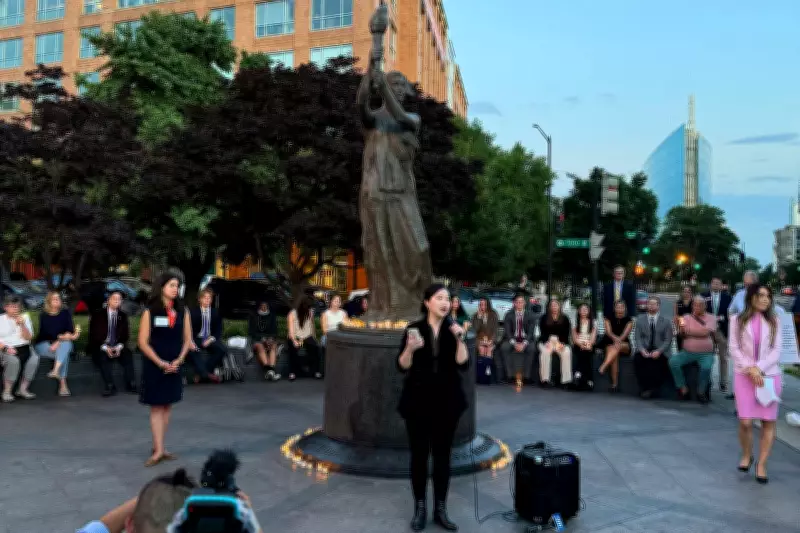
Hong Kong Court Convicts Father of US-Based Activist Under Security Law
A Hong Kong court has convicted the father of a U.S.-based activist for attempting to deal with his daughter's financial assets, in a landmark case brought under the city's homegrown national security legislation.
First Conviction Under Article 23 Legislation
Kwok Yin-sang was found guilty on Wednesday by Acting Principal Magistrate Cheng Lim-chi for attempting to handle assets belonging to his daughter, Anna Kwok, who is wanted by Hong Kong authorities. This represents the first court case of its kind prosecuted under the security law, locally known as Article 23 legislation, which was enacted in 2024.
The elder Kwok was arrested in May 2025 after authorities accused him of attempting to obtain funds from an insurance policy under his daughter's name. He pleaded not guilty to the charges, but the magistrate determined that Kwok must have known his daughter was classified as an absconder and was deliberately attempting to handle her assets.

Background of the Case
According to court hearings, Kwok had purchased the insurance policy for his daughter when she was young, with Anna gaining control of it when she reached 18 years old. In 2025, the father sought to cancel the policy and access the funds, which led to his arrest under the national security provisions.
Anna Kwok serves as the executive director of the Washington-based Hong Kong Democracy Council. In 2023, authorities offered a bounty of 1 million Hong Kong dollars (approximately $127,900) for information leading to her arrest and subsequently banned anyone from handling funds on her behalf.
This action is widely viewed as part of a broader crackdown on challenges to Beijing's authority that intensified following the massive anti-government protests in 2019.
International Reactions and Sanctions
After the verdict, the Hong Kong Democratic Council stated on social media platform X that "it represents yet another escalation of transnational repression." The case has drawn international attention, particularly from the U.S. and U.K. governments, which have criticized Hong Kong's bounties targeting overseas-based activists.
In 2025, Washington sanctioned six Chinese and Hong Kong officials, alleging their involvement in "transnational repression" and actions threatening Hong Kong's autonomy. The U.S. government asserted that Beijing and Hong Kong officials have used national security laws extraterritorially to intimidate, silence, and harass activists who fled overseas.
Weeks later, China announced it would sanction U.S. officials, lawmakers, and NGO leaders whom it accused of performing poorly on Hong Kong issues.
Broader Context of Hong Kong Security Laws
Following Beijing's imposition of a national security law on Hong Kong in 2020, numerous leading activists have been arrested or silenced, while others have fled abroad and continued their advocacy. Hong Kong, a former British colony that returned to Chinese rule in 1997, has seen significant political tensions in recent years.
Both the Chinese and Hong Kong governments maintain that the security laws are essential for maintaining the city's stability and order. The maximum sentence for Kwok's conviction is seven years imprisonment, with sentencing expected to follow in subsequent proceedings.