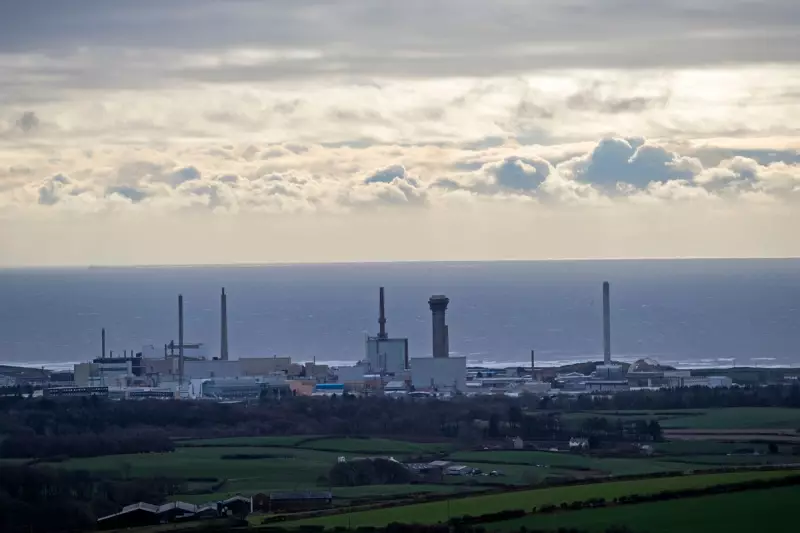
Newly released state papers have revealed that the Irish government seriously considered taking legal action against the UK over the Sellafield nuclear facility in the mid-1990s. The move followed a series of safety incidents that caused significant alarm in Ireland.
Diplomatic Pressure and Legal Reviews
Documents from the National Archives of Ireland, released as part of the annual 30-year rule, show that then-Taoiseach John Bruton raised the issue directly with British Prime Minister John Major. This occurred after several safety breaches at UK nuclear installations, including Sellafield, within a short period.
The potential for litigation was formally explored and reviewed by Ireland's Departments of Justice and Energy, alongside the offices of the Attorney General and the Taoiseach. A key briefing note from 29 November 1995 stated that the Attorney-General had advised any case would need solid scientific proof of harm from Sellafield's operations to Ireland.
"The Attorney-General has retained a Senior Counsel who is appearing for the State in the Shortt/BNFL proceedings to review the material and advise him on the matters at issue," the document noted.
A Series of Alarming Incidents
The Irish government's concerns were not limited to Sellafield. Officials also sought legal opinion regarding an incident at the Wylfa Magnox reactor in North Wales on 31 July 1993. Earlier that same year, Dublin had formally complained to London about the Wylfa event and another incident at the Dungeness A power station in Kent.
In these communications, the Irish government stressed that the repeated problems were "a cause of ongoing deep concern" both to the state and the Irish public. The issue of nuclear safety was raised again by Bruton during an informal meeting of EU leaders in Majorca in 1995.
UK Reassurances and Irish Skepticism
In response, Prime Minister John Major wrote to his Irish counterpart, acknowledging he could understand how "people in the Irish Republic may have been alarmed" by what he termed "sensational reports." He moved to offer reassurance, underlining that safety was the "highest" priority for his government.
"Although some isolated safety incidents have occurred, overall the companies in the nuclear industry have an excellent safety record," Major asserted, adding that they would not permit any weakening of safety standards.
Bruton's reply on 6 December 1995 maintained a firm stance. He requested that experts from Ireland's Radiological Protection Institute be allowed to attend safety inspections at relevant UK installations. While conceding that two specific Magnox plant incidents might have been of "relatively little radiological significance," he emphasised the broader worry.
"The number of incidents within a relatively short period in the UK gives rise to continued concerns about the safety of the UK’s nuclear industry and the potential for a serious accident with trans-boundary effects for Ireland," Bruton warned.
The declassified file, labelled 2025/115/541, provides a stark insight into a period of significant diplomatic tension over nuclear safety between the two neighbouring nations.