Israeli Teen Defies Convention by Staying in Pajamas During Missile Alerts
In the early hours of Sunday morning in Tel Aviv, merely hours after the outbreak of war with Iran, 13-year-old Ronit had already reached her limit. The constant interruptions—being jolted from sleep, scrambling to dress, and dashing to the nearby bomb shelter during yet another missile warning—had become too much. The Israeli-American eighth-grader, whose parents requested her last name remain private, made a bold decision that left her mother less than thrilled.
'I'm staying in my PJs until the war ends,' Ronit declared, clad in her Hello Kitty fleece pajamas. 'Mom's worried what the neighbors will think. But I'm not. I'm like, who cares how you look in a missile attack?'
Life Under Constant Threat in Central Tel Aviv
Like millions across Israel, Ronit and her family have been confined to their homes since Saturday, living in fear of the piercing, oscillating wail of the 'Red Alert' missile warning siren. In Central Tel Aviv, Israel's second-largest city, alarms have sounded with alarming frequency: 19 times on Saturday, 14 on Sunday, three on Monday, and seven on Tuesday. These alerts were triggered by incoming threats launched from Iran and Lebanon.

While Israel's Iron Dome and other missile defense systems have intercepted most projectiles, a few have penetrated, resulting in 10 fatalities. Whenever sirens blare, residents spring into action. Some enter their 'mamads'—reinforced safe rooms built into homes and apartments, typically windowless. Those without mamads rush to various communal shelters with neighbors.
Ronit's family resides in a 1940s Bauhaus-era flat, requiring them to sprint down the block to a newer building with a first-floor safe space known as a 'mamak.' 'We're always the last ones in there,' she noted wryly.
Communal Spirit in Tight Quarters
Other Israelis seek refuge in underground bomb shelters, often located in apartment building basements, serving entire streets or neighborhoods. A remarkable spirit of solidarity prevails: people routinely welcome neighbors, delivery workers, pedestrians, and even strangers into their safe rooms, irrespective of whether they are Jewish, Muslim, or Christian. Businesses are expected to allow customers and passersby inside, and locking a shared shelter is illegal.
Like Ronit in her pajamas, bedheaded Israelis in nightgowns and boxer shorts, clutching blankets and pillows, cram into these confined spaces. They wait out missile strikes together until sirens cease and government notifications confirm it's safe to return home—a process lasting between ten minutes and an hour.
Occupants employ various strategies to pass the time. Some attempt to sleep, do homework, or practice yoga. Others play Sudoku or Wordle, or doomscroll through news updates. Devout Jews use the moments for prayer, while the less religious sing Bad Bunny songs or engage in poker or Cards Against Humanity games.
Art, Pets, and Daily Discussions in Shelters
Israeli artist Reuven Dattner sketches in his shelter, including a drawing of an 'unknown guest' who sought refuge during a Tuesday afternoon strike. Most interviewees reported discussing familiar topics: children and grandchildren, favorite soccer teams, politics, and speculations on when Operation Roaring Lion might conclude.
'It's a good way to get to know your neighbors,' remarked Yaakov Katz, an American-born Israeli journalist and defense analyst, speaking from his Jerusalem home on Tuesday.
Israel's safe rooms and shelters are typically sparse, unfurnished, and uncarpeted, lacking windows, adequate ventilation, or heating. Most have no plumbing, though many stock bottled water, camping toilets, and mattresses for extended stays. In Tel Aviv—a city with one of the world's highest dog-to-human ratios—some shelters even feature astroturf for canine relief.
Holiday Celebrations and Innovations Amid Conflict
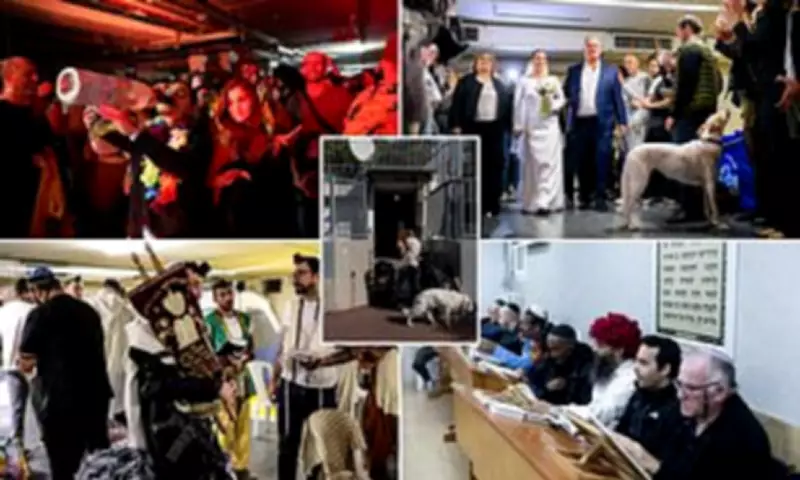
Monday evening and Tuesday marked Purim, a Jewish holiday akin to Halloween, celebrating survival from ancient Persian persecution. The irony resonated deeply as Israel, alongside the US, had attacked Iran on Saturday morning. In religious areas, many conducted the traditional reading of the Book of Esther, or 'Megillah,' within shelters.

Scores of costumed Tel Avivians performed the ritual in the underground parking lot of Dizengoff Center shopping mall, dancing to Gloria Gaynor's 'I Will Survive.' 'We all needed an excuse for a party,' said David Katz, a tech worker dressed as Ayatollah Khamenei, though he withheld photos for safety concerns.
A couple named Lior and Misha, whose wedding was canceled due to airstrike-related bans on public gatherings, rescheduled their celebration in the same mall parking lot on Tuesday. Videos of their dance went viral, hailed as a testament to national resilience.
Innovation thrives even in adversity. Singles use the Hooked app, developed by Israelis Noa Barazani and Roi Revach, which employs barcoding to connect people in bomb shelters. Another app analyzes rocket fire patterns to estimate the safest time to shower, preventing soapy, wet dashes to safety.
Shared Experiences Across Communities
Ronit expressed boredom as the only child in her shelter, passing time by texting school and dance friends. Meanwhile, many Israeli Muslims have been forced to break their Ramadan iftar meals in bomb shelters. Healthcare worker Rima Hattab and her extended family in Haifa have sheltered with Jewish neighbors through 'more wars than I care to count.'
'We are, unfortunately, very used to this,' Hattab stated on Tuesday, entering a protected room for the fifth time that day. She brings a violin, playing for Jews and Muslims, young and old, pro-war and anti-war residents, some of whom bring their own instruments. 'We try, all of us, to make beauty out of this unbeautiful time. If we cannot always make peace, we can at least make music together.'