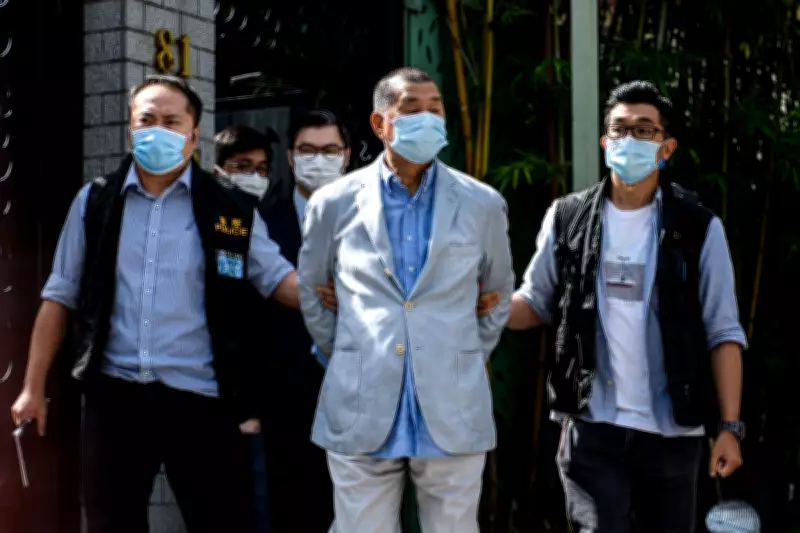
Hong Kong Court Sentences Media Mogul Jimmy Lai to 20 Years in Prison
Hong Kong media tycoon Jimmy Lai has been sentenced to 20 years in prison after a closely watched national security trial that has drawn significant international criticism, including from the United States and Britain. The 78-year-old Briton was found guilty in December of two charges of conspiracy to collude with foreign forces under a China-imposed national security law, as well as a charge of conspiracy to publish seditious material.
International Outcry and Political Reactions
The conviction has sparked widespread condemnation globally. Prime Minister Keir Starmer revealed he had a "respectful discussion" regarding Lai with Chinese president Xi Jinping during a recent trip to Beijing, though he declined to provide specific details. A statement from the Inter-Parliamentary Alliance on China (IPAC), signed by 86 politicians including US Senator Jeff Merkley and Lord Alton of Liverpool, declared that "the imposition of a 20-year sentence on a 78-year-old publisher for peaceful political expression is not justice. It is punishment for dissent, enabled by impunity."
The IPAC statement further argued that Lai's case symbolises the dismantling of Hong Kong's freedoms, criticising the international community's failure to enforce the Sino-British Joint Declaration. They called for coordinated diplomatic pressure and accountability from democratic governments.

Health Concerns and Family Statements
Lai's family has expressed renewed concerns over his deteriorating health condition, alleging mistreatment in solitary confinement at a Hong Kong jail where he has been held for years. His son, Sebastien Lai, stated "Today is a dark day for anyone who believes in truth, freedom and justice. It signifies the total destruction of the Hong Kong legal system and the end of justice." His daughter Claire Lai called the sentence "heartbreakingly cruel" and predicted "He will die a martyr behind bars."
Legal Proceedings and Sentencing Details
The judge described the sentencing as addressing "Lai's serious and grave criminal conduct" and determined that "the total sentence for Lai in the present case should be 20 years' imprisonment." Although Lai was convicted on three separate counts carrying a combined potential sentence exceeding 35 years, the court ruled that some terms would be served concurrently, resulting in the 20-year total.
Hong Kong police chief Steve Li welcomed the sentence as "appropriate" and dismissed claims about Lai's frail health as "exaggerated." He added that police would consult with the Department of Justice regarding potential appeals for longer sentences.
Supporters and Public Reaction
Outside the court, supporters gathered for days, with one named Sum, 64, describing Lai as "the conscience of Hong Kong" who "speaks up for the people of Hong Kong, and also for many wrongful cases in mainland China and for the development of democracy." During sentencing, Lai smiled and waved towards the public gallery, while his wife Teresa sat with an impassive expression as weeping could be heard from spectators.
Broader Implications and Analysis
Author Mark Clifford, who wrote "The Troublemaker" about Lai, described the trial as "just for show" and the sentence as exceptionally severe, noting "Twenty years for a 78-year-old man is effectively a life sentence – or a death sentence." He suggested that sending Lai into exile would benefit all parties, as his continued imprisonment complicates US-China relations.
Given Hong Kong's provision for one-third remission of jail terms for good behaviour, Lai would be approximately 90 if released in 2037, or 96 upon completing the full sentence in 2044. The case has intensified debates about Hong Kong's national security law, which activists argue criminalises basic human rights including freedom of expression and the press.