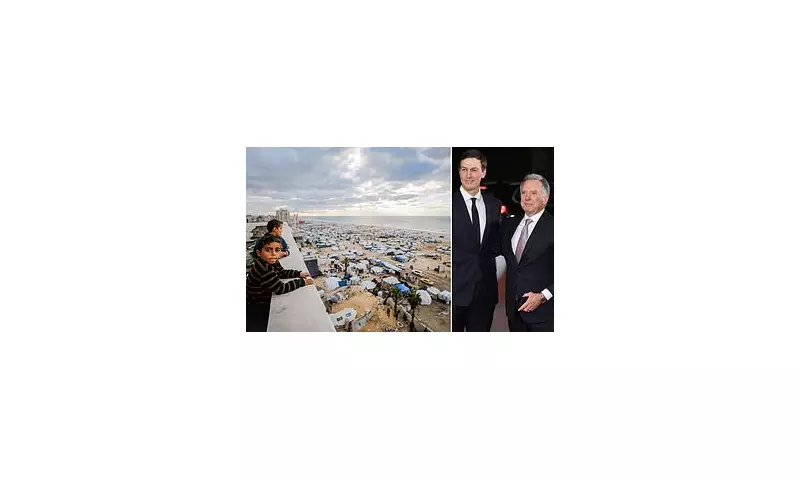
A radical $112.1 billion proposal to completely reinvent the Gaza Strip as a luxury destination, dubbed 'Project Sunrise', has been developed by Donald Trump's son-in-law Jared Kushner and Middle East envoy Steve Witkoff. The ambitious ten-year plan, drafted over the last six weeks, seeks to transform the war-torn territory into what the former president has previously called 'the Riviera of the Middle East'.
The Ambitious Blueprint for a New Gaza
According to details reported by the Wall Street Journal, Project Sunrise envisions a futuristic overhaul of Gaza's infrastructure and economy. The draft proposal includes plans for beachside hotel properties, a high-speed rail network, and AI-optimised electricity grids. Kushner, leveraging his real estate background, and Witkoff collaborated with former senior White House aide Josh Greenbaum, consulting Israeli officials and private contractors.
The staggering cost of the project is estimated at $112.1 billion over a decade, with the United States expected to support roughly half through grants and debt guarantees. The remaining debt placed on Gaza would theoretically be repaid using profits generated from the redevelopment itself. Officials suggest that, if approved, work could commence within two months.
Daunting Practical and Political Hurdles
Before any construction can begin, the plan acknowledges monumental initial challenges. The area must first be cleared of an estimated 10,000 bodies buried under 68 million tons of rubble, followed by ground detoxification and the removal of unexploded ordnance. Furthermore, the militant group Hamas, which remains entrenched in Gaza, is required to 'demilitarize and decommission all weapons and tunnels'—a condition met with deep scepticism by many officials.
The four-phase plan outlines starting with basic humanitarian aid, including temporary shelter, field hospitals, and mobile clinics. This would progress to building paved roads, new power lines, and planting crops before embarking on the more advanced, luxury aspects of the project.
Unanswered Questions and Regional Diplomacy
Significant questions loom over the proposal. The plan does not specify the source for the other half of the colossal funding required, nor does it detail the long-term fate of the two million Palestinians displaced by the construction, beyond the provision of temporary shelter. While the US has shared the plan with nations including Turkey and Egypt, crucial details on governance and funding remain unclear.
Under the proposed structure, a transitional committee of Palestinians and international experts would run Gaza, overseen by a new Board of Peace chaired by Donald Trump. Hamas would be barred from government, with all military infrastructure dismantled under independent supervision. However, Hamas has vowed to retain its weapons, directly contradicting Israel's demand for full demilitarization and casting doubt on the plan's feasibility.
A White House spokesperson stated, 'The Trump administration will continue to work diligently with our partners to sustain a lasting peace and lay the groundwork for a peaceful and prosperous Gaza.' President Trump previously framed the ceasefire deal as a 'momentous breakthrough' promising 'everlasting peace', asserting that Gaza's reconstruction would be funded by investments from neighbouring Middle Eastern states.