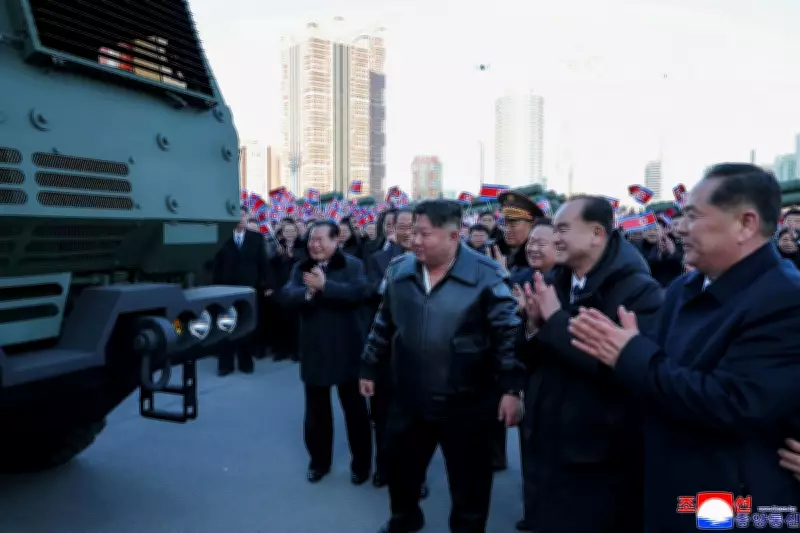
North Korean leader Kim Jong Un has presided over a significant military ceremony to deploy 50 new launch vehicles for nuclear-capable short-range missiles, a move that directly threatens rival South Korea. This display of expanding military capabilities comes just ahead of a major ruling party congress, where Kim is expected to further institutionalize his hostile stance on the Korean Peninsula.
Military Show of Force
State media photographs revealed rows of launcher trucks positioned near the April 25th House of Culture, the traditional venue for party congresses in 2016 and 2021. According to the Korean Central News Agency, these vehicles are designed to support the country's 600-millimeter multiple rocket launcher systems. Military experts note that North Korea's large artillery rockets blur the lines between conventional artillery and short-range ballistic missiles, as they can generate their own thrust and are guided during delivery.
Advanced Weaponry and Strategic Implications
In a speech during the ceremony, Kim Jong Un described the new rocket launchers as "wonderful" and equipped with artificial intelligence and advanced guiding technologies. He emphasized that they are tailored to carry out a "strategic mission," a term that strongly implies nuclear purposes. Kim further announced that the upcoming congress will issue new plans to expand the capabilities of his nuclear-armed military, which already possesses various systems targeting U.S. allies in Asia and long-range missiles potentially capable of reaching the U.S. mainland.

These weapons are part of Kim's growing arsenal of nuclear-capable short-range systems, specifically designed to overwhelm missile defenses in South Korea. The deployment underscores North Korea's continued focus on military expansion amid stalled diplomatic efforts.
Diplomatic Tensions and Border Security
In a separate development, Kim's sister, Kim Yo Jong, who serves as a key foreign policy official, acknowledged an apology from South Korean Unification Minister Chung Dong-young regarding alleged civilian drone incursions. However, she reiterated that North Korea is bolstering border security against what she termed the "enemy" South. "The border with an enemy state should naturally be firm," she stated, adding that the country's military would strengthen surveillance across the border.
Background of Strained Relations
North Korea has suspended nearly all talks and cooperation with South Korea since 2019, following the derailment of Kim's nuclear diplomacy with former U.S. President Donald Trump over U.S.-led sanctions. Relations have deteriorated further in recent years as Kim abandoned the long-standing goal of peaceful reunification and declared a hostile "two-state" system on the Korean Peninsula. This stance is expected to be further institutionalized in the Workers' Party's constitution during the upcoming congress.
Last month, North Korea threatened retaliation after accusing South Korea of launching surveillance drone flights in September and again in January. The South Korean government has denied operating any drones during the specified times, but law enforcement authorities are investigating three civilians suspected of flying drones into North Korea from border areas.
Regional Responses and Future Outlook
In response to the escalating tensions, South Korean Unification Minister Chung Dong-young stated on Wednesday that Seoul is considering reinstating a suspended 2018 inter-Korean military pact aimed at reducing border tensions. This pact included a no-fly zone and other measures to prevent further drone incursions into the North. The move highlights ongoing efforts to manage the volatile situation on the peninsula.
As North Korea prepares for its party congress, the deployment of new rocket launchers and the hardening of border policies signal a continued emphasis on military readiness and confrontation. The international community watches closely, with concerns mounting over the potential for further escalation in one of the world's most tense regions.