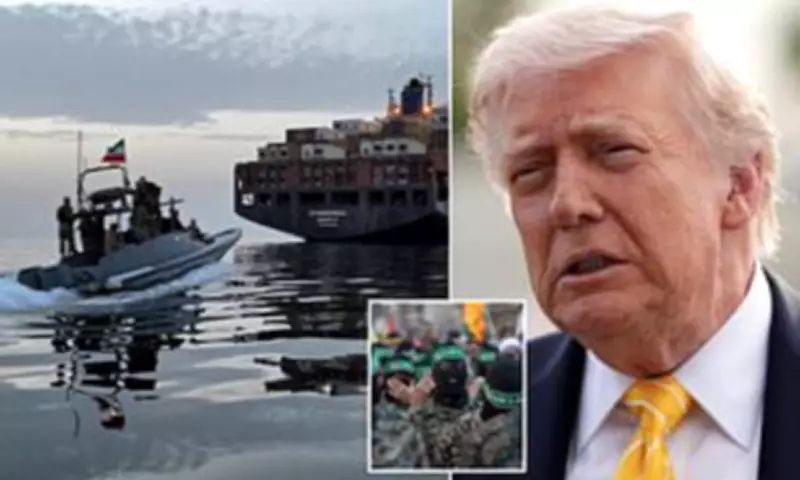
Donald Trump's strategy to resolve the deadlock with Iran over the Strait of Hormuz, a crucial shipping corridor handling one-fifth of the world's oil, has left energy executives perplexed. Tehran's attacks continue, and maritime traffic remains severely restricted.
Frustration in Washington
Trump has privately expressed frustration to his closest advisers regarding the 'no deal, no war' impasse with Iran over control of the strait. A US official told Axios, 'The president wants action. He doesn't want to sit still. He wants pressure. He wants a deal.'
On Thursday night, the president reviewed plans to send US naval warships through the strait to forcibly reopen it. However, he pulled back at the last minute, opting for a more cautious approach. Then, on Sunday night, Trump announced that the US would escort oil tankers trapped in the Persian Gulf, though he provided no further specifics.

US Central Command later confirmed the Navy would assist commercial ships transiting the Strait of Hormuz under an operation dubbed 'Project Freedom,' offering guidance on avoiding mines and protection from Iranian attacks.
Iranian Actions and Market Impact
Meanwhile, Tehran has continued launching drones at oil tankers and warned shipping magnates not to traverse the waterway without the regime's full approval. The de facto closure of the strait has driven gasoline prices to their highest levels since 2022, averaging $4.40 per gallon—a 30-cent increase in a week.
Trump's messaging has left shipowners and oil executives confused due to the lack of concrete details, while fears of further escalation from Iran remain a key concern, according to Bloomberg.
Project Freedom Details
'Project Freedom' will reportedly involve a vast number of guided-missile destroyers, drones, more than 100 land and sea-based aircraft, and the infantry support of 15,000 troops, CENTCOM announced. Another US official told Axios that military officers have been authorized to strike immediate threats to naval assets, including Iran's speedboats.
Iran has effectively closed off the Strait of Hormuz in recent months using small attack boats, drones, and sea mines laid in the narrow waterway. US forces have established an 'enhanced security area' advising oil vessels to cross through Omani waters. However, vessel traffic remains at a standstill, with most ships transiting via the Iranian traffic separation scheme rather than Trump's 'Project Freedom' corridor closer to Oman.
Recent Incidents
Iranian state media claimed the regime fired a 'warning shot' at a US warship on Monday to prevent it from entering the Strait of Hormuz. State media also reported that the frigate was 'targeted by a missile attack after ignoring a warning from the Iranian navy'—a claim CENTCOM promptly denied.
Writing on X, US Central Command stated, 'No US Navy ships have been struck. US forces are supporting Project Freedom and enforcing the naval blockade on Iranian ports.'
A spokesperson for Iran's Islamic Revolutionary Guard Corps (IRGC) declared that any vessel violating the Islamic Republic's maritime rules will be stopped by force, in a statement carried by the Fars News agency. Iran's navy issued a new map of the area of the Strait of Hormuz under its control on Monday. The area starts in the west with a line between the westernmost tip of Iran's Qeshm island and the United Arab Emirates' Umm al Quwain emirate. In the east, the area stops at a line between Iran's Mount Mobarak and the UAE's Emirate of Fujairah.