Trump's Interpreter Criticism Dominates Latin American Security Summit
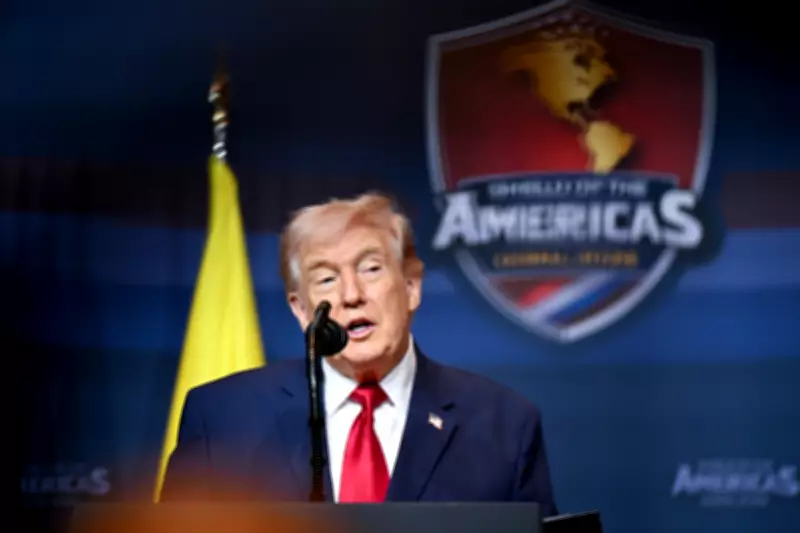
Former President Donald Trump delivered a remarkable public critique of a translator's performance during a high-level gathering of Western Hemisphere leaders in Florida on Saturday. The incident occurred at the Shield of the Americas Summit, hosted at Trump National Doral Miami, where leaders from twelve nations convened to discuss regional security, economic cooperation, and counter-narcotics strategies.
"I'm Not Learning Your Damn Language"
During discussions with Latin American and Caribbean counterparts about enhanced collaboration on migration control and combating drug cartels, Trump unexpectedly diverted attention to translation quality. He contrasted his own linguistic limitations with Secretary of State Marco Rubio's bilingual abilities, declaring emphatically: "'Cause I'm not learning your damn language. I don't have time."
The former president then elaborated on his ability to discern translation quality despite lacking proficiency in other languages. "I had an interpreter recently that wasn't good," Trump informed the assembled dignitaries. "Talking to a very strong person from a different part of the world - and I could tell, even though I don't speak the language - I could tell the interpreter was not good."
Trump specifically criticised a female interpreter's condensed translation of his remarks, noting: "When I give a long, flowing, beautiful sentence... In this case, it was a woman, and she gave it in about 1/4 the time I said. Well, their language may be efficient, but it's not that efficient."
Selective Attendance at Regional Gathering
The summit attracted leaders from Argentina, Bolivia, Costa Rica, the Dominican Republic, Ecuador, El Salvador, Guyana, Honduras, Panama, Paraguay, and Trinidad and Tobago. Chile's president-elect José Antonio Kast also participated before officially assuming office. Notably absent were representatives from three of the region's most influential nations: Mexico, Brazil, and Colombia. Mexican President Claudia Sheinbaum, Brazilian President Luiz Inácio Lula da Silva, and Colombian President Gustavo Petro did not receive invitations to the Miami meeting.
Origins of the Shield of the Americas Summit
This gathering emerged as an alternative after the cancellation of the 10th Summit of the Americas last year, which was scrapped amid heightened US military activity near Venezuela. Trump subsequently organized this smaller assembly of politically aligned conservative leaders, creating what analysts describe as a cornerstone of his second-term foreign policy approach toward the Western Hemisphere.
Commentators have characterized this strategy as a contemporary interpretation of the Monroe Doctrine, sometimes referred to as the "Donroe Doctrine," emphasizing renewed American influence and leadership throughout the Americas.
Military Solutions to Cartel Violence
Beyond the interpreter controversy, substantive discussions focused on coordinated security responses to drug trafficking organizations and transnational criminal gangs. The Trump administration has consistently framed these groups as direct threats to regional stability.
Trump urged participating leaders to adopt more aggressive measures against violent cartels, suggesting conventional law enforcement approaches have proven inadequate. According to Associated Press reports, Trump advocated for military engagement: "The only way to defeat these enemies is by unleashing the power of our militaries. We have to use our military. You have to use your military."
Drawing parallels with the US-led coalition against the Islamic State, Trump proposed similar coordinated military action: "We must now do the same thing to eradicate the cartels at home." This position underscores the summit's broader objective of strengthening hemispheric security cooperation through potentially unprecedented military collaboration.
The Shield of the Americas Summit represents a significant diplomatic initiative during Trump's second presidential term, blending substantive policy discussions with characteristically unconventional diplomatic moments that continue to shape international perceptions of American foreign policy under his leadership.