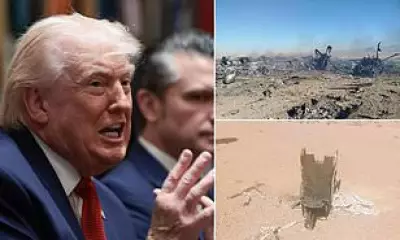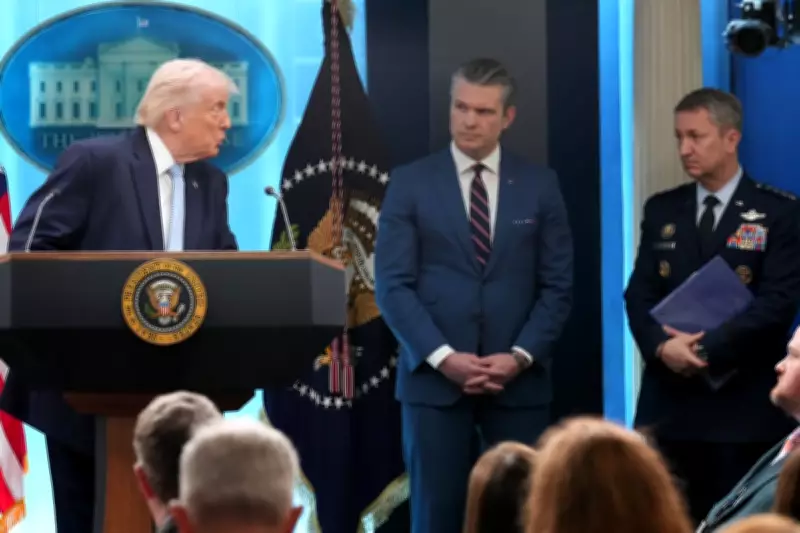
In a dramatic revelation, former President Donald Trump and top US defense officials have detailed a perilous rescue operation that successfully extracted a two-man F-15E fighter jet crew from deep inside Iranian territory. The mission, which unfolded over several days last week, relied on a massive deployment of aircraft, hundreds of personnel, covert CIA technology, and strategic deception to outmaneuver Iranian forces.
A Swift Initial Recovery and a Prolonged Second Effort
According to President Trump, who described the military operation in an unusually detailed valedictory news conference at the White House, US forces managed to rescue the pilot within hours of the jet going down late on Thursday. This initial phase involved a rapid surge of helicopters, midair refuelers, and fighter aircraft deep into Iran after the pilot's location was confirmed.
The second aviator aboard the aircraft, the weapons systems officer, presented a far greater challenge. He was rescued nearly two days later following an intense and complex search effort. The officer, who was injured in the incident, followed his training to distance himself from the crash site, navigating mountainous terrain and hiding within a cave or crevice before making contact with US forces on Saturday.

Technological Edge and Deceptive Tactics
CIA Director John Ratcliffe highlighted the critical role played by the agency's "exquisite technologies," which he claimed no other intelligence service possesses, in locating the missing aviator. Simultaneously, the CIA executed a deception operation designed to mislead Iranian search teams who were also scouring the area. Ratcliffe likened the search and rescue operation to "hunting for a single grain of sand in the middle of a desert."
President Trump elaborated on the use of subterfuge, noting that many of the dozens of aircraft involved in the operation were deployed for deceptive purposes. "We were bringing them all over, and a lot of it was subterfuge," Trump stated. "We wanted to have them think he was in a different location."
Combat Challenges and Coordinated Response
The mission was not without direct combat. General Dan Caine, Chairman of the Joint Chiefs of Staff, reported that an A-10 Warthog attack aircraft, which was primarily responsible for maintaining contact with the downed pilot on the ground, was struck by enemy fire while engaging Iranian forces. The aircraft was rendered "not landable," but the pilot continued to fight before flying to a friendly nation and ejecting. He was promptly rescued and is reported to be in good condition.
Back in Washington, national security officials maintained relentless coordination. Defense Secretary Pete Hegseth described an unbroken chain of command, stating, "From the moment our pilots went down, our mission was unblinking. The call never dropped. The meeting never stopped, the planning never ceased." Officials kept a phone line open for nearly two days straight to oversee the operation.
The final extraction of the weapons officer occurred on Sunday, protected by what was described as an "air armada" comprising drones, strike aircraft, and additional support. The successful conclusion of this high-stakes mission underscores the intricate planning and substantial resources committed to recovering US personnel from hostile environments, even as the specific CIA technologies employed remain classified.