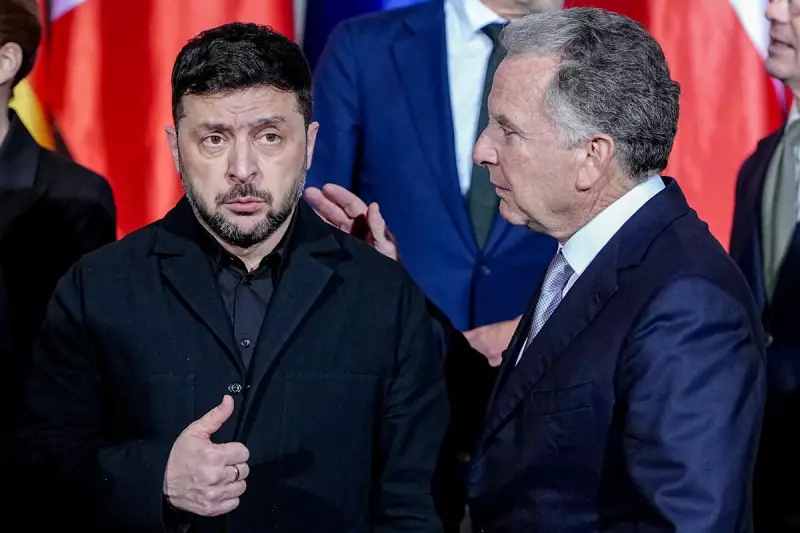
Ukrainian President Volodymyr Zelensky is set for a critical meeting with former US President Donald Trump at Mar-a-Lago this Sunday, aiming to finalise a potential peace agreement to end the nearly four-year conflict with Russia. This high-stakes diplomacy follows months of intricate negotiations involving Kyiv, Washington, Moscow, and European capitals.
The State of the Deal: 90% Complete but Key Barriers Remain
Emerging from preparatory talks in Berlin earlier this month, President Zelensky stated he believes the peace plan is now "90 per cent complete." The framework, whittled down from an original 28 points to a revised 20-point plan, has seen significant progress, particularly on security assurances for Ukraine. However, the final push hinges on resolving the most contentious issue: territory.
Mr Zelensky is constitutionally bound and politically adamant about not ceding land, a demand Russia continues to insist upon. US officials remain optimistic, with one noting after recent discussions that they feel "really good about the progress that we've made, including on territories," and that Zelensky would take new "thought-provoking ideas" back to his team.
Major Concessions and Unprecedented Guarantees
In a major strategic shift aimed at demonstrating good faith, Ukraine has offered to relinquish its ambition to join NATO. This concession, made during five hours of intense talks with US negotiators on 14 December, aligns with long-standing opposition from the Trump administration and is seen as a significant move to unblock negotiations.
In return, Ukraine seeks robust security guarantees. Washington has now offered Kyiv safeguards modelled on NATO's Article 5 collective defence clause, described by US officials as the "platinum standard." European allies have pledged to support this with a 'multinational force'. Crucially, both Ukrainian and European leaders insist these guarantees must be solidified before any discussion on land swaps.
The Kremlin's Stance and Other Complex Provisions
Despite reported momentum, the Kremlin remains the ultimate arbiter. Russia has so far rejected any prospect of returning occupied land or accepting international peacekeepers in Ukraine. Russian Deputy Foreign Minister Sergey Ryabkov stated Moscow was unwilling to concede on the Donbas, Crimea, or the historically claimed region of 'Novorossiya'.
Nevertheless, Ryabkov struck a cautiously positive note after pre-Christmas talks, suggesting 25 December 2025 could be remembered as a milestone when parties "truly came close to a solution." The final agreement, he said, depends on "the political will of the other side."
Other intricate elements of the potential deal include:
- EU Membership: US officials indicate Russia would accept Ukraine joining the European Union as part of a peace agreement, with one senior source suggesting accession as early as January 2027—a timeline EU diplomats in Brussels call "unrealistic."
- Nuclear Power Sharing: Negotiators are close to an agreement on sharing power generated at the Zaporizhzhia nuclear plant, Europe's largest, which Russia has controlled since the war's outset. The practical mechanics of such a scheme remain unclear.
As President Zelensky travels to Mar-a-Lago, the world watches to see if the remaining 10% of the deal—containing its most difficult challenges—can be bridged. The outcome will define the future of Ukraine and the security architecture of Europe.