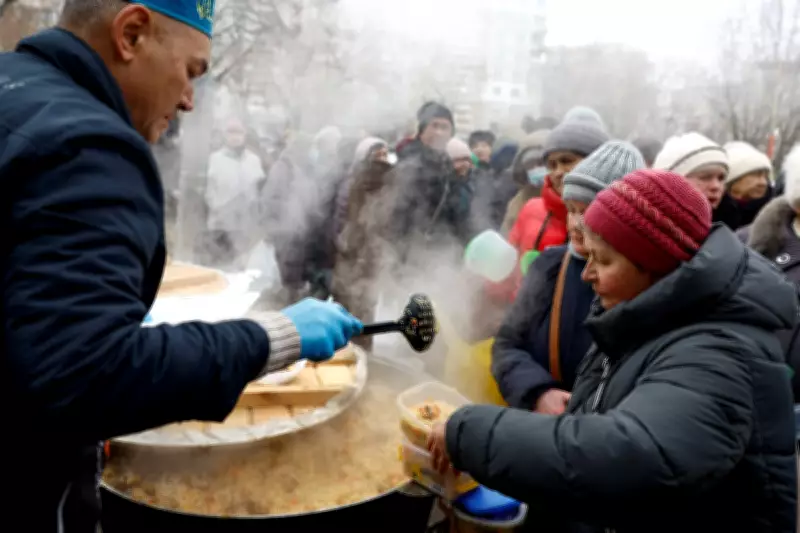
As global leaders deliberate over Ukraine's fate, the grim reality for civilians unfolds in cold, darkened apartments where daily survival has become a relentless battle. In Kyiv, residents like Oleksandr Morezhko and his family face a tawdry routine of showers in darkness, shaves with cold water, and the constant awareness that Russian President Vladimir Putin is targeting them directly.
The New Normal for Ukraine's Youngest Generation
Oleksandr's four-year-old daughter Sophia has never known a world without war, having been born just before Russia's full-scale invasion in February 2022. Her seven-year-old sister Lilian, who has learning difficulties, similarly cannot recall a time when Russian troops were not fighting inside their country. For these children, the sounds of war have become disturbingly familiar.
"Sophia can tell an outgoing missile blast from an incoming Shahed drone attack," explains Oleksandr, who serves as chairman of Ukraine's parliamentary foreign affairs committee. "When sirens scream and the air buzzes with what we call 'bees'—incoming drones—she grabs her sister's hand and leads her to safety in Soviet-era bunkers."

Psychological Toll of Darkness and Cold
The family's ground-floor apartment, which they purchased just before the invasion, has avoided direct hits, but the building next door was struck by a drone weeks ago, setting flats ablaze and injuring three people. Fragments of the Iranian-designed autonomous plane, loaded with 40kg of explosive, still litter the snow outside.
With roughly half of Ukraine's power generating capacity destroyed by Russian attacks—intensified since Donald Trump halted US military aid last year—the Morezhko family typically receives electricity for only a couple of hours after midnight. Oleksandr, a former human rights lawyer married to an academic, admits to battling depression and apathy.
"When it's cold, when for the whole day you cannot even warm up food, and it's dark—it is difficult psychologically," he says, warming his hands on a mug of green tea. "It looked endless. And everything came at once: this cold weather we haven't had for years, this darkness."
Putin's Strategy to Break Ukrainian Defiance
Oleksandr believes Putin has shifted focus to civilian targets and energy systems after realizing he cannot win on the battlefield. "His goal is to create conditions which are uninhabitable, to break our defiance and make us more submissive to his peace plan," says the MP, a member of Volodymyr Zelensky's ruling Servant of the People Party.
He argues this strategy will fail, drawing parallels to the Blitz and the siege of Sarajevo: "Historically it never worked. You cannot make people more receptive to capitulation by bombing and killing the civilian population."
International Pressures and Red Lines
The US, under Trump, has pushed Ukraine to accept the loss of territory now held by Russia—roughly 20% of the country. Moscow demands further control over Donetsk province and the "fortress belt" that has held back Russian assaults for over a year, where NATO estimates over 400,000 Russians have been killed or injured.
Oleksandr sees these demands as a ploy to cause internal divisions, noting that territorial concessions would require a national referendum under Ukrainian law. "Withdrawing our troops from Donetsk is our absolute red line," he insists. "We will never agree to that. It's absolutely out of the question."
Children's Remarkable Adaptability
Despite the horrors, Oleksandr marvels at his daughters' resilience. "For them it's normal. They cannot imagine their life without it," he says. "They have learned how to play using little lights and how to play in darkness. Better than adults, I think, children are more adaptable. And they never complain."
When power briefly returns in the early hours, Oleksandr stays up with all the lights on to recharge his psychological batteries—a ritual shared by millions of Ukrainians enduring similar hardships. European aid, including from the UK, totals an estimated €380 billion, surpassing the US contribution of just over €115 billion, yet the immediate challenge remains surviving the winter as Putin's attacks continue unabated.