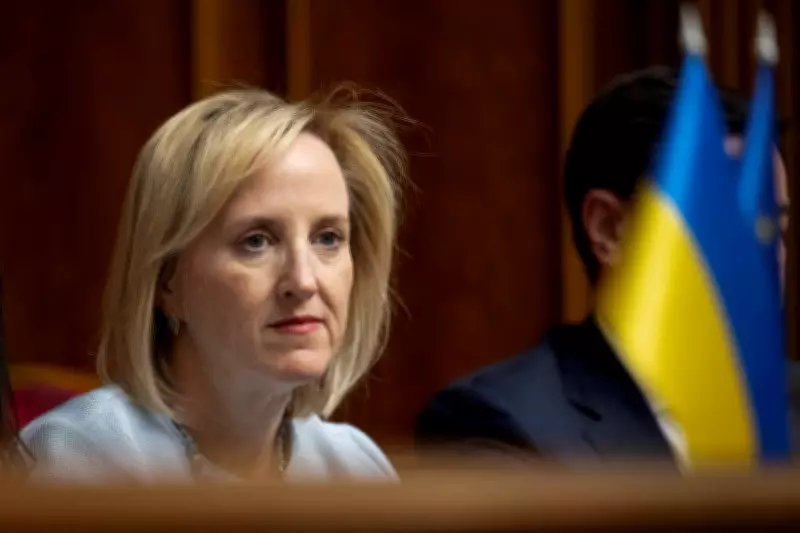
The United States' acting ambassador to Ukraine, Julie Davis, is stepping down from her post and retiring after less than a year in the role, amid reports of clashes with President Donald Trump over policy toward Kyiv.
Departure Amid Policy Rifts
The State Department confirmed on Tuesday that Davis would leave in June before retiring, following reports that she was quitting due to differences of opinion with Trump. People familiar with her decision told the Financial Times that Davis, who served as temporary charge d'affaires at the embassy since May 2025, had grown frustrated by Washington's dwindling support for Ukraine as peace talks with Russia have stalled.
Her departure leaves a key diplomatic post vacant as Russia looks to gain ground in the summer. Ukraine is ramping up production of homegrown domestic capabilities but has warned that shortages of US-supplied air defences 'could not be any worse,' with Trump's attention turned to the crisis in the Middle East.

Career Diplomat's Resignation
A career member of the US Foreign Service with more than three decades of experience, Davis assumed her duties as charge d'affaires in Ukraine in May 2025 after her predecessor Bridget Brink, also a career diplomat, resigned over objections to Trump's Ukraine policy. One unnamed diplomat told the FT that those who advocate for Ukraine within Trump's State Department 'get a target on their back.'
The State Department said it was 'false' to claim Davis, who is also the ambassador to Cyprus, was leaving over differences with Trump. 'Ambassador Davis has been a steadfast proponent of the Trump Administration's efforts to bring about a durable peace between Russia and Ukraine,' spokesperson Tommy Pigott said. 'She will continue to proudly advance President Trump's policies until she officially departs Kyiv in June 2026 and retires from the Department.'
Broader Context: US-Ukraine Relations
Trump has forced a rift between the US and Europe by blaming Ukraine for the lull in ceasefire talks. Kyiv and its allies maintain that Ukraine needs a strong ceasefire, backed by US security guarantees, to ensure Russia cannot invade again. Russia has stuck to its maximalist demands for territory, including Crimea and the fortified, mineral-rich regions in the east.
Delegations sat down for US-brokered talks in February aimed at finding agreeable terms to end the war, before the US launched strikes with Israel on Iran, putting diplomacy on ice. Ukraine's foreign minister said last week that Ukraine had pushed to restart talks, asking Turkey if it could facilitate a summit with Russia.
European Support
The European Union is pushing to provide Ukraine with a €90 billion ($106 billion) loan to cover most of its expenses for the next two years, using frozen Russian funds as a potential backstop to ensure Moscow ultimately pays. The loan was formally approved last Thursday, offering a vital lifeline for Kyiv, which economists said would have otherwise started to run out of money by June. Of the total, Ukraine will get €45 billion in 2026 and another €45 billion in 2027. Each year, €28 billion will be for military needs and €17 billion for general budget needs.