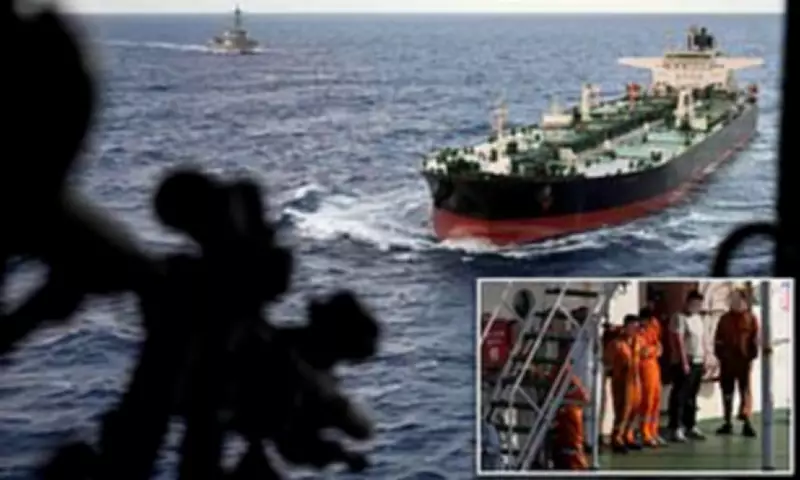
In a dramatic maritime operation, United States forces have successfully captured the Aquila II oil tanker after a month-long pursuit that originated in Venezuela and stretched across the vast expanse of the Indian Ocean. This high-stakes interception represents the eighth vessel seized by American military personnel since the Trump administration initiated its comprehensive crusade against illegal oil shipments from the Caribbean region.
Operation Details and Strategic Implications
The Aquila II was among several vessels that attempted to evade the established quarantine zone in early January, shortly after President Trump's forces captured Nicolás Maduro, Venezuela's former president. The Department of War released compelling video footage showing US troops moving with precision and speed toward the tanker, propelling themselves onto the deck in a textbook demonstration of naval boarding procedures.
'When the Department of War says quarantine, we mean it,' declared an official statement posted on social media platform X. 'Nothing will stop DOW from defending our Homeland — even in oceans halfway around the world.'

Official Statements and Warnings
US Southern Command confirmed the operation had been executed 'without incident' while the vessel was 'operating in defiance of President Trump's established quarantine of sanctioned vessels in the Caribbean.' The military command responsible for Central and South America operations emphasized that Marines and sailors captured the Aquila II without encountering any resistance from the crew.
'It ran, and we followed,' stated military spokesperson Hegseth in a social media post that served as a stark warning to future tankers and operators considering similar evasion attempts. 'By land, air or sea, our Armed Forces will find you and deliver justice. You will run out of fuel long before you will outrun us.'
Background and Previous Sanctions
The Aquila II had reportedly loaded nearly one million barrels of crude oil at Venezuela's Jose terminal on December 6, just days before facing international sanctions. The United States officially sanctioned the vessel on January 10, citing its involvement in transporting Russian oil. Prior to this American action, the United Kingdom had already imposed sanctions on the tanker due to its established connections with Russia.
This latest seizure follows the capture of the Motor Vessel Sagitta, which marked the seventh vessel intercepted by American forces as the Trump administration continues to tighten its grip on South American oil exports. The broader strategic campaign aims to sever Venezuela's primary revenue streams by preventing unauthorized oil shipments from reaching international markets.
Broader Geopolitical Context
President Trump imposed the comprehensive blockade on December 16, with Secretary of State Marco Rubio describing it as one of the largest 'quarantines' in modern history. Rubio emphasized that this maritime strategy is successfully 'paralysing' the Venezuelan regime's ability to generate crucial revenue from oil exports.
Following the capture of former President Maduro by US Special Forces, Secretary Rubio clarified that while the United States does not intend to govern Venezuela directly, the Trump administration will maintain its stringent 'oil quarantine' on all vessels entering or exiting the country's territorial waters.
Expanding Interdiction Operations
The campaign has expanded beyond Venezuelan vessels to include a fleet of Iranian tankers that were also apprehended in recent operations. Despite a long history of brazenly transporting sanctioned Iranian oil, the so-called 'shadow fleet' of Iranian-linked vessels has been observed sailing perilously close to the American coastline as President Trump continues his unrelenting bombardment of alleged drug smuggling boats.
A comprehensive investigative report has exposed a deep, clandestine network of approximately twenty illicit tankers currently operating in Caribbean waters, serving as a crucial lifeline for the regimes of Venezuela's Nicolas Maduro, Iran, and Russia. These vessels represent a significant challenge to international sanctions enforcement and maritime security protocols.

'The only oil leaving Venezuela will be oil that is coordinated properly and lawfully,' emphasized the US Southern Command in their official statement regarding the Aquila II interception. This declaration underscores the administration's commitment to maintaining strict control over maritime traffic in the region, regardless of the distances involved or the evasive tactics employed by targeted vessels.